
Imagine, if you will, a world in which a floor covering retailer, contractor or installer could use an AI-generated tool to provide customers with photo-based “virtual” estimates that are on par with or better than an in-home consultation. How cool would that be?
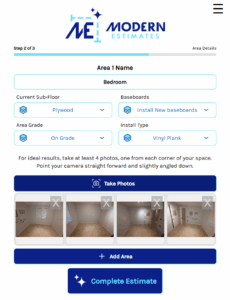
Well, there’s no need to wish it into existence—such a virtual estimator is already available. The innovation is called MEasure, and it was created by a company called Modern Estimates, which specializes in technologies that leverage artificial intelligence. How it works: The technology, which is photo based, is built into a retailer’s website. Customers doing research online can access a dedicated link on a dealer’s site, fill in some basic information and answer four preliminary questions about their project—which area the project is located, what product they want installed, etc. Customers can then upload photos of the room or area that’s targeted for a renovation. Once the images are uploaded, the customer can press the “generate” button and MEasure’s AI model takes it from there.
“MEasure analyzes the photos, determines the size of the room, looks at what the existing flooring is, what the furniture situation is and basically builds a labor and materials virtual estimate for the homeowner based on the pricing of that retailer,” Maksim Nazarchuk, president, Modern Estimates, explained. “Next, the customer—presumably the homeowner—will receive a summary that says, for example, the labor for vinyl plank installation will be this much and the materials for this project will cost this much. It breaks down the labor cost to line items— itemizing demolition, furniture moving, prep work, installation and other labor line items and gives the customer the total estimated price.”
In keeping with the general concept of AI-based technologies, the system was designed to “learn” as it goes along. “The model has been trained on more than 10,000 different projects ranging from small bathrooms to large homes measuring thousands of square feet and everything in between,” Nazarchuk explained. “The AI tool will also detect if the subfloor is exposed and build the estimate accordingly. So let’s say the homeowner doesn’t have existing flooring in place and there’s obvious cracks in the concrete subfloor. The model is smart enough to pick up on those cracks and include any prep work that would be needed. But if it’s hardwood that’s already installed, and the homeowner is looking to have it refinished, the model will review the data received from the photos and see that the existing hardwood has some big stains or obvious rot in places like around kitchens or dishwashers and flag it on the retailer’s side.”
Improving efficiencies
Amid all the bells and whistles driving MEasure, it’s really about serving a basic function—freeing up the retailer’s time to focus on what they do best: sell flooring. It also represents a time-saver for managers or store owners who have to spend hours out of the store going out to for a measure where a customer might just be shopping around.
“What this does for the retailer is it alleviates a complex process that’s currently being done daily,” Nazarchuk explained. “Every retailer gives out virtual quotes, except today the conversation goes something like this: ‘I want to get new laminate flooring in a living room I want to redo. It’s about 200 square feet. I don’t have that much furniture. What will your rough price be?’ And the retailer oftentimes will give some sort of answer, usually kind of a brush-off answer because the thinking in the industry is anybody who wants an over-the-phone quote isn’t a serious buyer.”
However, according to Nazarchuk, nothing could be further from the truth. “The people who are calling in for quotes are being treated as non-serious buyers, so they’re getting lower service-level treatment; therefore, they become less serious buyers because they’re not receiving a serious buyer service level, and it becomes a closed loop. I understand from the retailer’s side that they may be busy. MEasure gives the retailer the ability to have a better answer.”
Another problem MEasure aims to solve, according to the company, is the potential for inaccurate estimates. “For example, when the sales rep gives the customer a number over the phone, they might assume that what they heard is the same thing as what the customer meant, including certain services in that number with maybe a little bit of margin,” Nazarchuk explained. “Homeowners hear a number and they think, ‘OK, it won’t get worse than that.’ But oftentimes the rep didn’t have enough information to provide an accurate scenario and that usually prevents the lead from converting into a sale. MEasure solves that issue by collecting, for the homeowner, enough context for the retailer to make a very informed decision. The retailer controls the pricing through the portal so they can set what pricing is shown to the customer, both on labor and materials. It’s completely in their control.”
When it comes to retailers, MEasure helps them to be “the first in the door” ahead of potential competitors—independent installers, even—who might be more aggressive and quicker in giving the customer a quote and locking out their competition. “With technology being so readily available to every Joe in a truck, installers are able to show up to the customer’s home, do the measure and give them the estimate on the spot,” Nazarchuk explained. “If it’s a single installer and his tools, he doesn’t need to confirm any pricing with a sales rep or manager—he can make the decision right on the spot. Your average retailer is now in a race against time to be the first in front of the customer with tangible prices, and it’s a failing race because a retailer has to look up and check on more things than an installer would.”

OK, that’s the best-case scenario. But what happens if a homeowner takes a quote provided by MEasure and shops around for a lower price? According to Nazarchuk, that’s a risk that all retailers take, but the victory often goes to the flooring dealer who can get in front of the customer as a professional consultant quicker—guiding the customer to the evadible sale. “Nothing’s stopping the homeowner from coming into your store, getting a quote from you and then taking that quote to a competitor and seeing if your competition can beat it,” he said. “The fact of the matter is that happens all the time and every day. With MEasure, everybody saves time and everybody wins. The retailer has a chance to be the first in line to present their pricing and discuss the project with the customer, and the customer receives a tangible estimate and not a brush-off answer.”
Worst-case scenario: What happens if the AI-generated estimate is way off and not in the retailer’s favor? According to Nazarchuk, the likelihood of that happening is slim to none. “One of the concerns that we hear from retailers is, ‘What if it’s not 100% accurate? There’s a chance that my cost will be higher and I will be forced to honor the virtual estimate price.’ Remember, the purpose of MEasure is to be a virtual estimator and give a detailed ballpark estimate. In all cases that we’ve tested, a rough calculation is significantly further off than the AI model. Any difference between an in-home consultation and a virtual estimate would usually be because of additional services that are needed but are not visible through the photos—such as the condition of the covered subfloor.”
Indeed, the follow-up, in-home measurement could very well reveal issues not evident in the pictures. “Having been an installer for years, I’m able to feel things under my feet that provide more context, in addition to the photos,” Nazarchuk explained. “But just looking at the photos, as good as I am at estimating, I wouldn’t be able to give even close to the accuracy that MEasure gives. The accuracy is there and retailers have been responding accordingly.”
