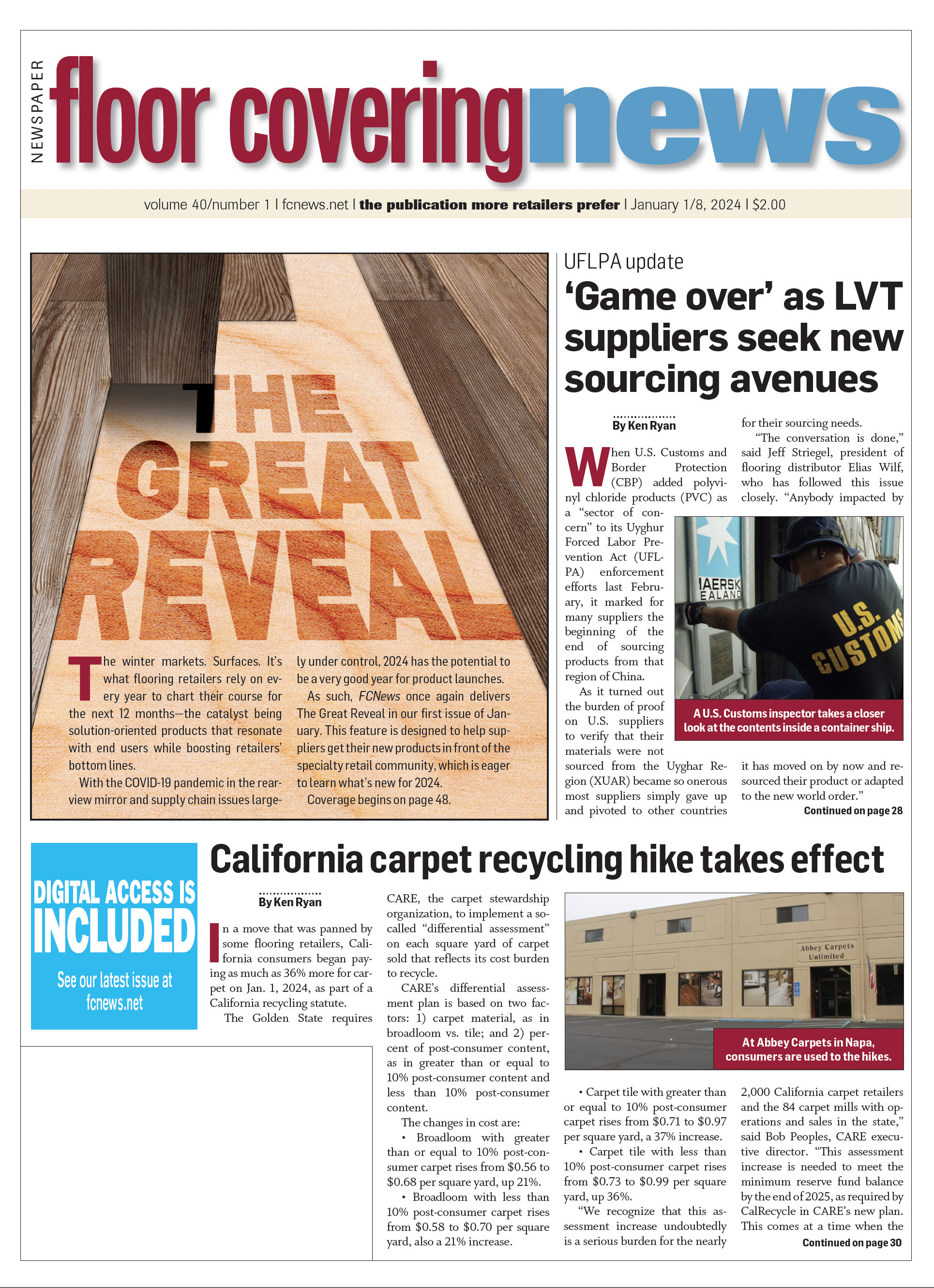
 In a move that was panned by some flooring retailers, California consumers began paying as much as 36% more for carpet on Jan. 1, 2024, as part of a California recycling statute. The Golden State requires CARE, the carpet stewardship organization, to implement a so-called “differential assessment” on each square yard of carpet sold that reflects its cost burden to recycle.
CARE’s differential assessment plan is based on two factors: 1) carpet material, as in broadloom vs. tile; and 2) percent of post-consumer content, as in greater than or equal to 10% post-consumer content and less than 10% post-consumer content.
The changes in cost are:
- Broadloom with greater than or equal to 10% post-consumer carpet rises from $0.56 to $0.68 per square yard, up 21%.
- Broadloom with less than 10% post-consumer carpet rises from $0.58 to $0.70 per square yard, also a 21% increase.
- Carpet tile with greater than or equal to 10% post-consumer carpet rises from $0.71 to $0.97 per square yard, a 37% increase.
- Carpet tile with less than 10% post-consumer carpet rises from $0.73 to $0.99 per square yard, up 36%.
“We recognize that this assessment increase undoubtedly is a serious burden for the nearly 2,000 California carpet retailers and the 84 carpet mills with operations and sales in the state,” said Bob Peoples, CARE executive director. “This assessment increase is needed to meet the minimum reserve fund balance by the end of 2025, as required by CalRecycle in CARE’s new plan. This comes at a time when the California program has achieved remarkable results in terms of carpet collection and recycling; the assessment increase is necessary to continue the progress and to meet the challenging goals for the program that have been set by CalRecycle.”
The program attained a record 33.9% recycling rate in 2022 and typically recycles approximately 79% of carpet collected.
Carpet retailers are tasked with collecting the increases at the point of purchase. The mills are responsible for advising retailers on which products qualify in terms of post-consumer content. CARE will continue to supply POP material as well as training support materials.
The California carpet stewardship legislation (AB 2398, 1159 and 729) is designed to find ways to incentivize the growth of carpet reclamation and recycling and yet still allow the market to work. The law (AB 2398) generates funding to meet its stated goals through the assessment on all carpet sold in California. AB2398 was signed into law in 2010. The monies collected support CARE’s efforts.
Retailers comment
California retailers are no strangers to taxes, leading some to express ambivalence toward the increase. “Since we have many recycling fees in California, our customers are not surprised when one of them increases,” Janice Clifton, owner of Napa-based Abbey Carpets Unlimited, told Floor Covering News. “I also think since most carpet is now sold by the square foot it does not seem to be as much per unit for the consumer. The CARE recycling fee is listed as a separate item on our invoices, so it is easy to explain to the customers.”
Anaheim-based Sterling Carpet & Flooring also adds the increase on a separate line item, like sales tax. “We don’t put any signage in the showroom, just pamphlets that the state gives us,” said Dan Mandel, co-owner.
Others were not as understanding of the increased fee. “The assessment started at a nickel; soon it will be close to $1. Next thing you know California will outlaw carpet by 2035—just like gas-powered cars and leaf blowers,” said Phil Meyer, owner of Carpet One Floor & Home, Concord, Calif. “California never introduced a tax they didn’t like.”
Meyer said he uses RFMS software to update the changes, and posts the state letter near the sales kiosk, adjacent to state-supplied educational brochures.
While California is the only state to have an EPR, or Extended Producer Responsibility program, there are other states with active legislation that have either come up for vote or were postponed at the last minute.
Some floor covering dealers are concerned the policy could spread to their state. “State legislation regarding recycling needs to come to a halt,” said Kevin Rose, owner of Carpetland USA, Rockford, Ill. “We all need to support lower prices as we fight for our share of disposable income.”