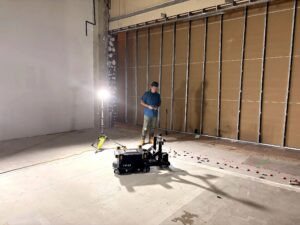
For years, the flooring industry has talked about the shortage of skilled installers. Contractors have more work than qualified people to perform it, especially in demanding categories such as ceramic and stone. Human Friendly Robotics believes part of the answer may come from a machine named Tyler.
Tyler is a robotic flooring installer built to work alongside a crew. The system handles repetitive placement across the main field of a floor. Installers remain responsible for work that requires judgment, experience and craftsmanship.
That distinction matters. Automation can make people uneasy, particularly in trades where skill has always been measured by what a person can do with their hands. Human Friendly Robotics wants contractors to view Tyler as another piece of equipment, not a replacement for the installer.
“We understand the concern, but the reality we see in the market is that contractors are struggling to find enough qualified installers, not looking for ways to eliminate the ones they already have,” said Shamoon Siddiqui, CEO of Human Friendly Robotics.
How it works: The company designed Tyler so contractors do not need a robotics specialist on site. Crews can typically unload the system, position it in the work area and complete setup in less than 30 minutes. An operator enters basic project information on an iPad, including material type and dimensions.
The installer establishes the first row, which sets the layout, alignment and squareness of the floor. Tyler then uses that installed material as its reference. Its vision system then calculates where each tile or plank should go next.
The process keeps critical layout decisions with the installer while Tyler handles the repetitive placement that follows.
Crews remain responsible for substrate preparation, material staging, cuts, edges, grout (when required) and jobsite conditions that demand experience.
“Tyler is a tool that makes existing installers more productive while shifting their time toward the parts of the installation where skill and judgment matter most,” Siddiqui explained.
Installing ceramic, in particular, can be challenging for human installers. The materials are rigid, heavy and less forgiving of placement errors. Here’s where Tyler excels, according to Siddiqui. The robot can control spacing, alignment and orientation while handling products that can crack or chip. Moreover, Tyler can install about 1,000 square feet of stone or tile in a day. With products such as LVT, output can reach roughly 1,500 square feet and Tyler can maintain that pace throughout a full shift. For contractors, that creates more predictable production and makes it easier to estimate how much work a crew can complete.
There is an ergonomic benefit as well. Tyler takes on much of the lifting, carrying and placement work that wears on installers over time. The installer can spend more time on layout, cuts, finishing and quality control.
“A crew using Tyler can install substantially more flooring in a day on the right projects,” Siddiqui noted. “That can lower labor cost per square foot and allow the crew to move to another job sooner.”
Changing the economics
Human Friendly Robotics designed the robotic portion of installation to cost less than $2 per square foot. Actual costs depend on the material, labor market and project conditions.
The bigger issue may be capacity. Contractors often turn down projects because they cannot staff them. If automation allows the same number of installers to complete more work, contractors can pursue additional projects without adding workers at the same rate.
“The skilled labor shortage is one of the biggest drivers of interest in Tyler,” Siddiqui said. “Flooring contractors regularly tell us they have more work available than they have qualified installers to perform it, particularly in technically demanding categories such as ceramic and stone.”
That is where the automation debate becomes more complicated. The same technology that helps address a labor shortage can also raise questions about the future of the people doing the work.
Siddiqui said the company sees robotics as a way to extend a skilled installer’s value. “Our goal is not to remove expertise from the installation process. It is to give that expertise more leverage,” he said.
Contact Human Friendly Robotics to schedule a demonstration.