
 Atlanta—Interface has completed a pilot social life cycle assessment (S-LCA) of natural rubber used in select nora rubber flooring products.
The company said it is the first flooring manufacturer to publish an ISO-compliant S-LCA covering the life cycle of natural rubber production with one of its suppliers.
The pilot examines the people and communities involved in material production. It also aims to provide a broader understanding of the social impacts associated with flooring products.
“Our path to carbon negative by 2040 depends on innovation, transparency and collaboration across our supply chain. The same communities that help produce the materials we rely on also experience the effects of climate change most directly,” said Liz Minné, head of global sustainability strategy at Interface. “Environmental LCAs help us understand carbon impacts. This social LCA pilot adds another layer by helping us better understand the human dimensions of natural rubber. That broader visibility can inform responsible sourcing decisions over time as part of our ‘all in’ commitment.”
Interface conducted the pilot in accordance with the ISO 14075:2024 framework. The assessment examines social conditions associated with natural rubber production and sourcing.
The study establishes a baseline for evaluating social performance. It also identifies strengths, data gaps and opportunities for improvement that could guide future supplier engagement.
The pilot represents an early application of the methodology within a specific portion of Interface’s raw material supply chain.
“There is growing conversation around the connection between environmental impacts and people. The recently approved ISO standard gives us a consistent framework for measuring social footprints across a product’s life cycle,” said Luca Achilli, global director of sustainability innovation and programs at Interface. “We piloted the framework with one of our natural rubber suppliers to better understand conditions and opportunities further into our value chain by collecting on-the-ground insights. As the first flooring manufacturer to publish an assessment of this kind, we now have a sample social performance baseline for this raw material. It’s early days for this approach and by sharing our experience, we hope to inspire other manufacturers to consider conducting assessments like this.”
Examining natural rubber production
Architects, designers and manufacturers increasingly seek greater transparency about where and how companies produce building materials.
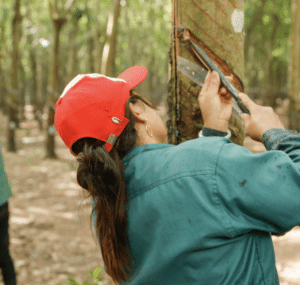
Interface worked with S-LCA experts and a natural rubber supplier in Vietnam to conduct the pilot assessment. The study included site visits and interviews with farmers, workers and other stakeholders.
Natural rubber moves through a complex supply chain before reaching the manufacturing stage. Examining how suppliers cultivate, harvest, collect and process the material can help inform responsible sourcing and future product specifications.
The assessment:
- Establishes a baseline for understanding the social footprint of natural rubber production.
- Uses an international framework to evaluate social impacts alongside environmental considerations.
- Identifies strengths and opportunities for improvement within the raw material supply chain.
- Explores how social impact measurement can inform future sustainability discussions.
- Encourages supplier engagement to support long-term climate resilience and shared learning.
Expanding the definition of product sustainability
The S-LCA pilot adds social considerations to the environmental data traditionally used to evaluate product sustainability.
By examining conditions affecting workers and communities, Interface aims to develop a more complete picture of its products’ impacts throughout the supply chain.
The initiative builds on more than 30 years of sustainability measurement and reporting at Interface.
The company has introduced several sustainability initiatives, including:
- Publishing its first sustainability report in 1997.
- Becoming the first U.S. flooring company to publish a verified environmental product declaration (EPD) in 2009.
- Expanding EPDs to all standard products globally in 2012, becoming the first flooring company to do so.
- Developing cradle-to-gate carbon-negative carpet tiles that store more carbon than their manufacturing processes emit, without offsets.
- Incorporating bio-based and carbon-storing raw materials into carpet tile, luxury vinyl tile and rubber flooring manufacturing to reduce product carbon footprints.
Interface continues to pursue its goal of becoming carbon negative by 2040 without offsets.
The company said the pilot provides an initial social performance baseline that can support ongoing supplier engagement. It may also help guide future sourcing decisions and sustainability initiatives.