 Behind many of the flooring products manufactured and sold today are innovations that help determine how the floor installs, performs and stands out in the market. Unilin Technologies develops these innovations and licenses them to manufacturers around the world.
Unilin Technologies is the intellectual property and technology division of Unilin, a Belgian company founded in the 1960s. What began as a collaboration between flax farmers has grown into an international group and a subsidiary of U.S.- based flooring leader Mohawk Industries.
Alongside Unilin Technologies, the Unilin organization includes production divisions dedicated to flooring, insulation and wood fiberboards. This industrial foundation plays an important role in how Unilin Technologies develops its innovations. By working closely with R&D teams, engineers and production specialists across these divisions, the company gains practical insight into the realities of manufacturing. New technologies can be developed with production efficiency, product performance and large-scale implementation in mind.
Unilin Technologies is best known for its locking systems for flooring, including Uniclic, Unidrop and Unipush. These technologies have played an important role in the growth of laminate and resilient flooring by making installation faster, easier and more reliable. Their success is built on careful engineering, consistent quality and decades of flooring manufacturing expertise at Unilin’s own production site.
Today, Unilin Technologies manages close to 4,500 patents across more than 550 patent families. Furthermore, its portfolio reaches well beyond locking systems. It includes technologies for bevels, surfaces, core materials, waterproof technologies and manufacturing processes.
Through its licensing model, manufacturers gain access to proven technologies without having to develop every solution in-house. This can shorten product development cycles, reduce R&D costs and help bring distinctive flooring products to market more quickly. Unilin Technologies’ engineers also support licensees with technical guidance, training and implementation services by working closely with the engineering teams of manufacturers.
Broad technology portfolio
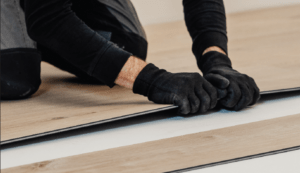
The history of Unilin Technologies begins with a breakthrough that changed modern flooring installation. In January 1997, Unilin introduced a new glueless locking system at Domotex Hannover – Uniclic. Unlike earlier systems that relied on glue, separate inserts or added components, this one-piece profile was milled directly into the laminate board. Its simple concept made flooring easier and faster to install while providing a strong, reliable connection between planks. Uniclic became the start of Unilin Technologies and helped establish click flooring as an industry standard.
In the years that followed, the company expanded its intellectual property portfolio beyond locking systems. New patents covered technologies such as beveled edges and embossing in register, which matches a floor’s printed design with its surface texture to create a more realistic look and feel.
In 2012, Unilin Technologies introduced the License to Click program. The program identifies flooring products manufactured under valid patent licenses, helping industry professionals recognize properly licensed products. It also makes infringing products easier to detect, supporting fair competition and protecting licensees and their customers.
In the years following, the portfolio continued to grow. Unizip followed in 2019 and introduced a breakthrough for installation of a herringbone floor with only one panel, while Unicoat entered the market in 2021 and revolutionized the water resistance of wood-based flooring. Unigrout arrived in 2022, offering resilient floors a more authentic ceramic tile and grout appearance. More recent developments also include technologies for creating perfectly matching flooring accessories.
Unilin Technologies today
Nearly three decades after Uniclic first entered the market, locking systems remain a cornerstone of the Unilin Technologies portfolio. The original one-piece concept has evolved continuously, keeping pace with new flooring categories and installation requirements. Today, Uniclic sits alongside systems such as Unidrop, Unipush and Unizip, giving manufacturers a broad range of options to support easier installation, stronger performance and more efficient production.
Uniclic itself continues to play a central role. In recent years, that role has become even more relevant as the flooring industry has faced increasing concerns over the quality and performance of some SPC locking systems. Problems linked to peaking, gaps and height differences have brought reliability back to the top of the agenda. For many manufacturers, distributors and retailers, this has even more increased the interest in Uniclic, which has a long and proven track record.
At the same time, Unilin Technologies has continued to build on the foundation created by its locking systems. Many of its current technologies are designed to work alongside the click connection or to improve another part of the flooring experience. They address challenges ranging from moisture protection and design consistency to installation efficiency, acoustics and accessory production.
 Unicoat protects the edges
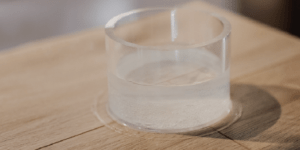
A strong locking system is the first safeguard against moisture entering the floor joints. Adding Unicoat strengthens that protection by adding a water-repellent coating to the panel edges, one of the most vulnerable parts of a wood-based floor. The coating acts as a sealant, helping liquids remain on the surface instead of penetrating the joints and reaching the core. When combined with a suitable click design, Unicoat significantly improves waterproof performance. It greatly exceeds the standard NALFA water-resistance test and also performs well under more demanding wet-cleaning conditions. This helps manufacturers create floors that remain reliable under everyday use.
Unigrout targets ceramic tile segment
Unigrout gives resilient flooring the appearance of ceramic tiles without losing the practical benefits of SPC. Its distinctive U-shaped bevel creates clearly defined grout lines, while a recently introduced cement-look lacquer makes the bevel closely resemble real grout.
Matching flooring accessories
Unilin Technologies has also developed a manufacturing method that transforms original flooring planks into matching accessories. Manufacturers can use the technology to create stair nosings, clickable baseboards and moldings that carry the exact design, texture and wear layer of the floor. This technology is applicable to wood, laminate and resilient flooring, making it unique in the market.
For stair applications, an HDF- or PVC-based insert determines the final shape of the stair nose. Manufacturers can create traditional rounded profiles or more contemporary square designs. The insert also reinforces the accessory, reduces the amount of glue required and supports a longer product life. Because the accessories are made from existing flooring planks, manufacturers don’t need to stock separate accessory ranges for every SKU.
Unizip – one panel herringbone
Unizip builds on Unilin Technologies’ locking-system expertise to simplify herringbone floors. This technology set a new standard when it entered the market a few years ago since it removes the need for separate A and B panels. This makes herringbone installation easier, faster and more efficient from start to finish. Today, it is a widely adopted solution used across the flooring market. The panel locks vertically and horizontally on all four sides and can be installed by angling or tapping, much like Uniclic. This makes installation more straightforward and accessible for professional and DIY installers.
Using one panel type also simplifies manufacturing, packaging, inventory and transportation. Producers no longer need to manage equal quantities of two mirrored planks.
Comfort Core – a quieter, softer floor
Comfort Core addresses the sound and feel of resilient flooring. It places a soft cushioning layer between the SPC core and the upper layers of the product. This construction reduces walking sound and creates a softer feel underfoot.