For more than a decade, resilient flooring makers had a formula that worked: source efficiently in global markets, scale up rigid core and LVT, and give consumers more performance and design at increasingly competitive prices. In 2026, that formula is under pressure.
Tariff volatility, escalating shipping costs, geopolitical uncertainty and a stubborn housing slowdown are among the major issues forcing manufacturers to rethink how—and where—they make resilient flooring. SPC and other rigid-core products are at the center of the shift.
The challenge is no longer simply producing a competitive product. It is about ensuring reliable supply, controlling costs and delivering enough value to keep customers buying in an increasingly cautious market.
The resilient category enters Q4 facing a strategic turning point, with rigid core products at the epicenter of the shift. SPC, the dominant construction in residential resilient, has been disproportionately exposed to tariff swings and freight unpredictability. Imports represent approximately 80% of U.S. resilient consumption, according to FCNews research, leaving suppliers vulnerable to global disruptions that can ripple through the builder, remodel and multifamily channels.
“There are still issues related to war overseas impacting transportation,” said Sarah Duncan, Mohawk’s director of product management. “Container costs are on the rise due to oil prices increasing and incoming tariffs. The ever-evolving landscape means Mohawk continually adjusts our product assortment and planning to meet customer needs.”
That exposure is forcing a recalibration of long held, cost driven sourcing models. “As a result, customers are placing greater value on reliable supply, shorter lead times and lower inventory requirements rather than evaluating products solely on initial cost,” said Jennifer Zimmerman, AHF Products’ chief commercial officer.
AHF is among the manufacturers reshaping its footprint. Its expanding U.S. manufacturing network—including major rigid-core capacity in Cartersville, Ga.—helped the company establish a buffer from port congestion and freight spikes that rattled the market the past two years. “By controlling our supply chain and manufacturing for a significant portion of our products in the U.S., we ensure fast, reliable delivery,” Zimmerman explained.
Indeed, sourcing strategies are being re-evaluated with an intensity not seen since the early LVT boom. Vendors are weighing cost against resilience, speed and control. “While global manufacturing remains the standard, having options and flexibility is important moving forward,” said Noah Fulton, Karndean CEO.
Even diversified global sourcing carries risk. “The industry has already adapted many of its sourcing strategies,” said Floris Koopmans, president, Unilin. “However, one key lesson remains: Circumstances can change almost overnight, making flexibility more important than ever.”
That volatility is influencing product selection as well, industry watchers say, with importers and distributors more cautious about what they bring to market. “This trend has been a positive driver for our proven and trusted locking technologies, such as Uniclic,” Koopmans added.
Manufacturers with multi-country footprints say the turbulence has reinforced the value of flexibility. “Tariffs and trade policy are making supply-chain flexibility more important than ever,” said Kim Hill, VP of product and marketing at Novalis. “Manufacturers can no longer rely on a single country or region when policy changes can quickly affect costs, lead times and product availability.”
For many suppliers, the strain has been relentless. “On and off again tariffs have driven a lot of disruption to managing our supply chain,” said Al Boulogne, Mannington’s SVP, residential product and marketing. “Some stability, regardless of which direction we choose to go as a country, would be welcome from our product management perspective.”
Domestic production
Producing flooring stateside offers potential responses to that volatility, with manufacturers pointing to speed to market, flexibility and greater control over supply. But expanding U.S. capacity comes with significant economic and operational challenges. “The key challenge is ensuring that product quality and innovation aren’t compromised,” Karndean’s Fulton pointed out.
FCNews research found only 17% of resilient consumption was domestically produced, a reflection of how deeply entrenched overseas manufacturing remains. “We offer a blend of domestic and sourced production, depending on where each product’s capabilities are best supported,” Mohawk’s Duncan noted. “It’s working well. Resilient flooring started over in Asia, so they have first mover advantage and great capacity from the start—which still works in favor of the vendors in Asia.”
Unilin’s Koopmans agreed, adding, “Asia has developed highly efficient manufacturing ecosystems around flooring production that are difficult to replicate. U.S. manufacturers continue to face disadvantages related to raw material and labor costs, and the ongoing dependence on imported components and equipment.”
Market uncertainty is another barrier to expansion. “Until we really understand the cost benefit versus imported product, it’s tough to place a large investment to build additional domestic manufacturing capabilities,” Mannington’s Boulogne said.
Even so, domestic production is gaining traction as part of a broader diversification strategy, experts say. Some flooring producers, such as Novalis, view U.S. manufacturing as one piece of a balanced global model. “Making it economically viable requires investment in equipment, automation, workforce development, raw-material availability, quality systems and distribution infrastructure,” Hill explained. “Manufacturers also need sufficient scale and consistent demand to support those investments.”
For some suppliers, domestic capability is already a differentiator. AHF Products’ U.S. network spans 11 manufacturing facilities and domestic film production in Pennsylvania. “Our domestic manufacturing capabilities and streamlined logistics are designed to help avoid shipping delays, container shortages and price increases often tied to international trade challenges,” Zimmerman noted. “The objective is to deliver products sooner while giving customers greater predictability around supply and cost.”
Shaw also boasts a formidable domestic production footprint. Over the past five years, the company has invested more than $1 billion in its U.S. operations to ensure that its facilities, equipment and processes support the creation of products customers want today and in the future. Central to Shaw’s domestic resilient production is state-of-the-art Plant RP in Ringgold, Ga. Since 2024, Shaw has continued to enhance its domestic resilient flooring manufacturing capabilities with a $90 million investment in Plant RP in Ringgold, where the company makes SPC and LVT resilient flooring. This latest investment will more than double the facility’s resilient flooring production while providing customers with enhanced product specifications, such as smaller production runs, new embossing textures and added dimensional stability for loose-lay applications and more product sizes.
Housing woes
Predictability is nothing new to residential new construction, a market grappling with one of the most prolonged housing slowdowns in recent memory. Elevated mortgage rates, affordability challenges and cautious consumer spending have reshaped demand patterns, forcing resilient suppliers to rethink product strategies, forecasting models and channel priorities.
“We are four years into a sluggish market, and there is no promise of when it will shift in the right direction,” Mannington’s Boulogne said. “The demand for flooring has certainly felt that stagnation.”
The drag is widespread. According to the U.S. Census Bureau, single family housing starts hovered near 1 million units by mid year, well below peaks above 1.3 million earlier in the decade. “Consumers do continue to invest in their homes, however, even if they are delaying a home sale or purchase,” Karndean’s Fulton said. “Floor replacement is one of the most common ways to upgrade a home’s interior.”
Still, residential resilient flooring sales remain under pressure. “Housing remains the principal challenge for residential resilient,” AHF’s Zimmerman said. “Affordability pressures and interest rates have constrained both new construction and remodeling, making consumers more price conscious.”
Even so, resilient’s core value proposition continues to resonate. “The opportunity is that resilient remains well suited to the needs of cost conscious residential customers,” Zimmerman said.
Manufacturers report that consumer caution is influencing project timing as inflation slows discretionary spending. “Home renovations and flooring projects are often among the first investments consumers postpone until economic conditions improve and confidence returns,” Unilin’s Koopmans noted.
Product differentiation
Diversification is a long-time calling card for resilient, renowned for its innovation and design across multiple flooring formats. For years, LVT— particularly SPC and WPC constructions—led the charge, redefining flooring choices in the home builder and remodeling markets. However, the success of both products has led to commoditization and now represent the baseline for resilient.
Manufacturers concur the next wave of meaningful product differentiation will not come from the structure alone. “We know that flooring is ultimately a design decision,” Karndean’s Fulton said. “Consumers ultimately choose a floor based on how it looks, feels and enhances a living space.”
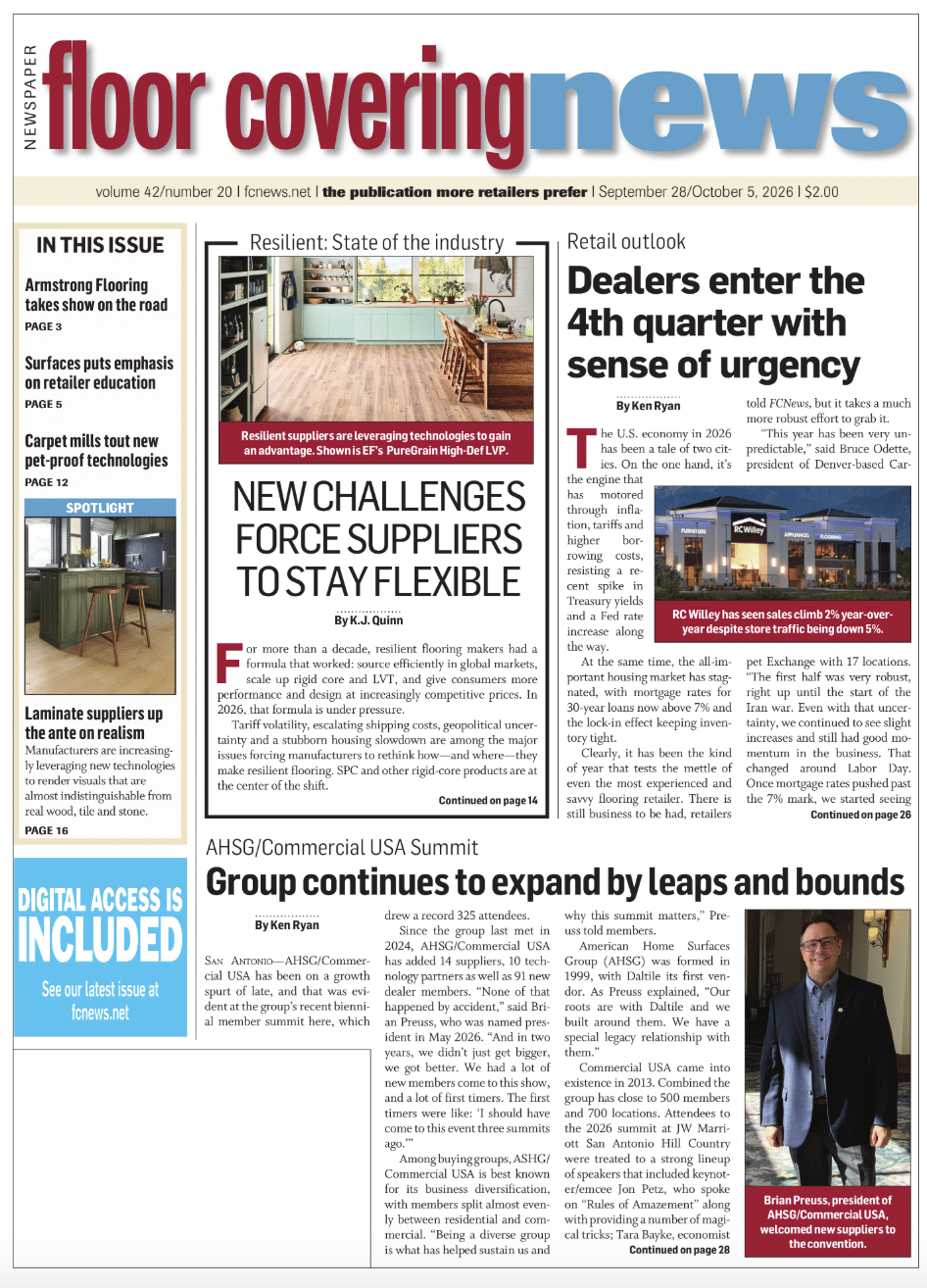
The design first mindset is reshaping product development across the category. For example, “in the case of PureGrain High-Def, we are utilizing high-definition print technology and authentic digital embossing to deliver the premium, natural look of hardwood,” said Eric Ruppert, VP of soft surface product development and marketing, Engineered Floors.
Then there’s Mannington, whose Adura LVT line offers more than 80 visuals across glue down, SPC and WPC formats. “If the customer is looking for durability and surface performance in a floating floor,” Boulogne said, “SPC can still be the optimum construction.”
Accessories, once peripheral, are now central to the differentiation story. “What was once considered a nice-to-have has become an important factor in the purchasing decision,” Koopmans noted, pointing to Unilin’s technology that creates matched stair noses and trim directly from flooring planks.
Construction refinements are also accelerating. “At Novalis, we see this in the continued development of pressed bevels, embossed-in-register texture, oversized planks, improved locking systems and specialty formats and finishes,” Hill said. These enhancements, she added, help create more convincing finished floors and complete design solutions.
Differentiation is expanding beyond the product itself. “From a supplier’s standpoint, it really goes back to the whole product offering,” Mohawk’s Duncan said, “such as being able to provide retailers with displays and marketing support for their showrooms, things they need to make it easier to operate on a day-to-day basis.”
Southwind Floors is pushing that philosophy further. “Southwind is focused on better visuals, reliable performance, application-specific products and a complete dealer experience, from dependable inventory and accessories to displays and service,” said Drew Hash, president/CEO.
AHF’s Zimmerman sees the next wave of differentiation rooted in performance and reliability. “In residential rigid core, SPC remains the dominant construction, but concerns about lower quality products have made customers more attentive to thickness, locking performance, dimensional stability and durability,” she said. AHF is responding with proprietary HDPC technology and Diamond 10 coating to elevate core strength and surface performance.
Growth opportunities
After more than a decade of growth, the resilient category is defining its next wave of expansion. Industry members anticipate it will continue to be shaped by technology, design innovation, application specific performance and evolving consumer expectations. “For residential, the key opportunities are remodel, builder and multifamily,” Zimmerman said. “Across these markets, the opportunity is being driven by the combination of performance, design, customization, cleanability, sustainability and the need for products that can meet specific project requirements.”
Rigid core is expected to anchor much of the category’s growth. “SPC continues to serve the value and mainstream segments while premium WPC constructions create opportunities in more design-focused projects,” Novalis’ Hill said. “Richer textures, unique patterns and realistic tile visuals are helping resilient compete more directly with natural materials.”