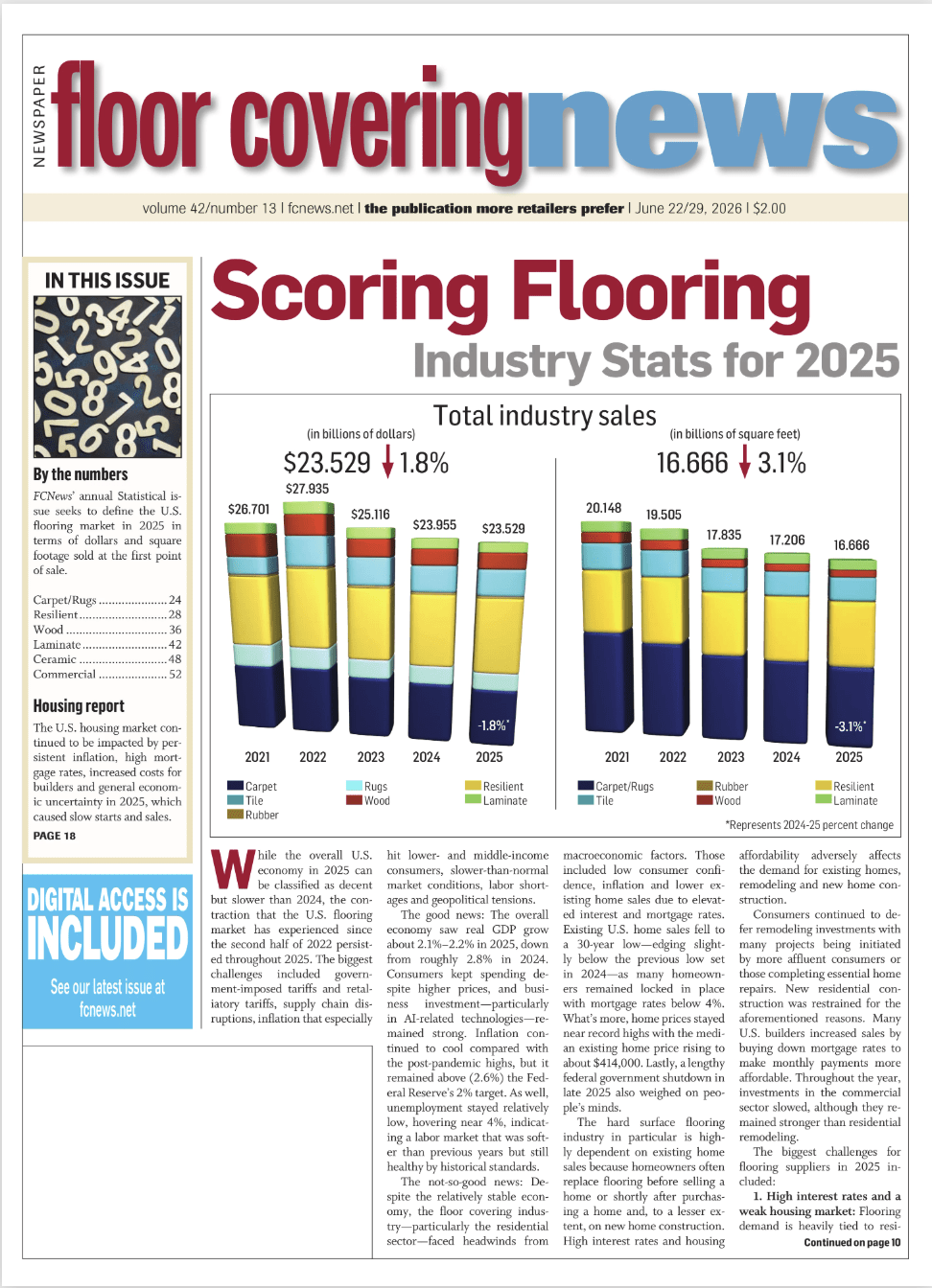
After two years of modest decline, the resilient flooring category saw an uptick in dollar sales in 2025. That was mostly due to price increases caused by tariffs and a higher-end product mix. Volume in 2025 declined modestly. The commercial segment bolstered the category as it proved stronger than the residential market, which continues to struggle with housing and inflationary pressures.
The category as a whole continued to garner the largest percentage of total dollar sales (36.5%) in the industry, and 59.5% of total hard surface sales (not including rubber) for the year. Rigid core continues to be the workhorse and growth driver of resilient flooring. What’s new is that WPC outpaced SPC growth in 2025. However, SPC remains the behemoth of the category, alone garnering more than $3.5 billion in 2025.
Overall, the category’s meteoric rise can be seen in its unprecedented growth throughout the last decade-plus. Ten years ago in 2015, the category saw the highest gain in dollar sales of any category at 13.9%. The next closest gain that year was 9.8%, which went to ceramic. That momentum continued for years, fueled by innovation, evolving consumer preferences and the rapid adoption of rigid core products. The category’s first dollar decline happened in 2023; however, the category’s market dominance continues.
In 2025, Floor Covering News research found the resilient flooring category as a whole generated $8.587 billion, which was up about 2.5% from the year prior’s $8.374—and even up slightly from $8.576 billion in 2023. In terms of volume, the resilient flooring category (not including rubber) accounted for 5.8 billion square feet, down about 1.2% from 5.877 in 2024.
The resilient category has experienced a whirlwind rise. Looking back 10 years, the segment garnered just $2.7 billion in sales. Five years prior to that in 2010, the category registered $1.7 billion, meaning in just half a decade it increased by $1 billion. The next five years would see an explosion of $3.9 billion and then another $2 billion over the last five years. That’s an unprecedented fourfold increase in dollars in the last 15 years.
The resilient category experienced its meteoric growth mostly between the years 2015-2023 where it saw double-digital increases each consecutive year—with growth peaking at 30.3% in 2021, before the first minor decline in 2024.
Resilient also held onto its lead as the No. 1 category in dollars for the third year running, eclipsing carpet by $1.8 billion (not including area rugs). The LVT segment of the resilient category alone (including residential and commercial rigid core and flex), also eclipsed carpet sales for the second year running with $64 million to spare, which is twice that of last year.
If we include area rugs and rubber into the mix, total resilient dollars ($8.83 billion) are just $3 million shy of reaching No. 1 (carpet + area rugs generated $8.86 billion in 2025).
Overall market dominance
 The total resilient flooring category (including residential and commercial sheet, LVT, tile, VCT and linoleum) showcased its dominance in the market in several ways last year. For instance, it was the only category to register gains in dollars.
The category also produced growth in terms of overall market share. Looking at total flooring sales (carpet, area rugs, resilient, ceramic, laminate, wood and rubber), the vinyl portion of resilient garnered 36.5% of total dollars vs. 35% the year prior and 34% in 2023. In terms of volume, vinyl saw an increase to 35% vs. 34% in 2024 and 32.9% in 2023.
Looking back a decade to 2015, total resilient sales accounted for just 13.3% of total flooring sales ($2.724 billion), which was up from 12.4% the year prior, and about 17% of total volume (3.145 billion square feet), which was up from 15.1% the year prior.
To look back just another five years, those numbers become even more staggering. In 2010, resilient garnered just 10.6% of total dollar sales. That means in a decade and a half, resilient flooring’s share of total dollars and volume has more than tripled.
Resilient’s market share dominance in 2025 is even clearer when measured against the hard surface market. When compared to ceramic tile, hardwood and laminate, FCNews research found resilient accounted for 59.5% of total hard surface sales vs. 57.4% in 2024 and 56.7% in 2023. Looking at hard surface volume (not including rubber) in 2025, resilient sales reached 61.5% share. That’s compared to 60.4% in 2024 and 59% in 2023.
Looking back 10 years to 2015, total hard surfaces sales reached $8.533 billion. Resilient’s share of that was just 31.9%. In terms of hard surface volume in 2015, resilient captured 38.8% (7.184 billion square feet) of the total 18.526 billion square feet.
In terms of dollars, that’s an increase of more than 27 percentage points in just 10 years and nearly 23 percentage points in terms of volume.
Of that 59.5% hard surface dollar share, the LVT subcategory garnered $7.424 billion of the total $14.422 billion pie (not including rubber). That’s compared to $7.185 billion in 2024. That means LVT alone accounted for 51.5% of hard surface sales (not including rubber) compared to 50% in 2024.
For the second year running, this resilient subcategory alone (LVT) generated more dollar sales than any other flooring category, including carpet.
For the last decade LVT has been the driver of growth for resilient flooring and that hasn’t changed. Rigid core, in particular, is the workhorse of the LVT subcategory. FCNews research found rigid core (SPC/WPC) garnered $4.972B of the total $8.587B in resilient sales in 2025. That means rigid core alone accounted for nearly 58% of all resilient flooring sales in 2025. That’s slightly up from 2024.
Rigid core also garnered about 70% of all LVT sales last year. That is up about 2 percentage points in terms of market share vs. 2024.
In volume, rigid core garnered 49.6%, or 2.874 billion square feet, of all resilient square feet sold in 2025. That’s vs. 47.6% in 2024 and 46.6% the year prior. Rigid core accounted for nearly 64% of total LVT volume in 2025, which is down just 1 percentage point from the year prior.
By comparison, five years ago rigid core clocked in at just $2.62 billion and 1.63 billion square feet. Looking back 10 years, sheet vinyl held the major of the category’s share at just over 57%.
SPC continues to hold the lion’s share of total rigid core sales and volume. In 2025, SPC garnered 71.3% of rigid core sales across both the residential and commercial markets. That’s on par with 2024’s share.
In terms of overall flooring sales, SPC garnered $3.544 billion in 2025. That’s 15% of total flooring sales, which was on par with 2024. What’s more, SPC alone makes up 25% of hard surface sales (WPC garnered another 10%). Looking at that against total resilient sales, SPC’s share is 41.3% of the market, which is down slightly from 43% of total resilient sales in 2024. Taking the LVT subcategory as a whole into consideration, SPC garnered 47.7% of that market last year.
In terms of volume, SPC garnered 2.207 billion square feet in 2025, which was more than 13% of total flooring volume—nearly flat to 2024. SPC was 34% of total hard surface volume and 38% of total resilient volume last year.
Residential resilient breakdown
 The residential market remained a challenging environment in 2025 as elevated mortgage rates, affordability concerns and sluggish existing home sales continued to suppress demand for both new construction and remodeling projects. Like nearly every flooring category, resilient felt the effects of a housing market that never fully regained its footing.
“The residential resilient category continued to face a slow market in 2025,” said Adam Ward, Mohawk’s vice president of strategic initiatives. “Headwinds included relatively high credit costs, soft existing home sales and overall consumer hesitation toward large purchases such as remodels. Broader macroeconomic uncertainty, driven by geopolitical tensions, tariffs and general market malaise, also weighed heavily on demand.”
Despite those headwinds, resilient maintained its position as the residential market’s dominant hard surface flooring category. That market leadership speaks to the category’s broad consumer appeal, which continues to be driven by waterproof performance, durability, design versatility and value. While residential activity slowed, resilient remained the flooring product of choice for many.
FCNews research shows the residential resilient market hit $6.181B in 2025, leaving $2.406 for commercial. That’s about a 1.3% increase from the year prior ($6.101B), but a whopping 24% increase in sales from just five years ago when residential resilient garnered $4.847B.
In terms of volume, residential resilient garnered 4.57 billion square feet—or 79%—of total resilient square feet sold. That’s about a 2.5% decrease from last year when residential volume reached 4.689 billion square feet.
FCNews research shows something interesting in regard to the residential/commercial breakdown. While total residential resilient sales were up in 2025, it is about one percentage point down in terms of market share, garnering less than 72% vs. 2024’s nearly 73%. That 72% is also down about 2 percentage points from 2023.
That reflects the growth the commercial resilient market experienced in 2025, with segments like hospitality, healthcare and even workplace picking back up after the post-pandemic lag.
The bulk of the resilient flooring market’s activity was driven by residential LVT (including glue down, loose lay, WPC and SPC), which generated $5.578B of the total $6.181B resilient market in 2025. That’s about 90% of the residential resilient market, which is half a percentage point gain from the year prior.
To put that into perspective, just five years ago residential LVT garnered just $4.857B. That’s more than a 27% increase in sales.
In terms of volume, residential LVT accounted for 3.626 billion square feet of the total 4.566-billion-square-foot residential LVT pie, which amounts to 79.4% share. That’s a 2% increase vs. 2024’s 3.438 billion square feet. That’s also a 5% gain in terms of market share from the year prior.
Of that total residential resilient market, rigid core continues to remain the workhorse and driver of growth. Rigid core accounted for 77% of total residential resilient sales—or $4.766B. That market ownership is even more impressive when looking at the overall LVT market, the segment in which rigid core resides. Last year, the subsegment (residential rigid core) made up a whopping 85.4% of residential LVT sales. That’s slightly up from 2024 and even the year prior.
With respect to volume, rigid core commands more than 60% (2.773B) of total residential resilient square feet (4.565B). That is just slightly higher when looking at the residential LVT subcategory at 61.6% of dollar sales.
“Rigid core remains one of the most dynamic segments in the industry,” said Matt Rosato, senior director of hard surface business development, Engineered Floors. “Consumers continue to gravitate toward it because it delivers a compelling value proposition—style, durability and ease of maintenance. At the dealer level, preferences vary widely by region, whether that’s plank width, thickness or specific performance attributes. The category is highly competitive, so both consumers and dealers are increasingly focused on meaningful differentiation.”
In terms of the rigid core subcategories, WPC outpaced growth vs. SPC in 2025. WPC garnered about $1.423B in sales in 2025, a 4.2% increase over the year prior. Meanwhile, SPC saw just a 2.9% increase in sales to $3.34B, which was due mainly to price increases over tariffs and a higher-end product mix.
In terms of market share, WPC garnered nearly 23% of total residential resilient sales in 2025. Looking at residential LVT that number becomes 25.5%.
In terms of volume, WPC clocked in at 662 million square feet in 2025—that’s 14.4% of total residential resilient volume last year. When looking at just residential LVT market, WPC captured 18.2% of the market in 2025.
“I think there were some bad players in market with SPC for a few years,” said Al Boulogne, senior vice president, residential product and marketing, Mannington Mills. “Products were value engineered and failed, burning some bridges with retail on the platform. As a result, we have seen a resurgence in sales for WPC. The highlight is renewed attention to the sub-category because of the aforementioned shift in market preference. Sound and comfort are the biggest draws to WPC vs. alternative product constructions. The components and make up of a good WPC product enhance those attributes vs. SPC.”
However, SPC still holds a vast share of total residential resilient dollars at 54%. Looking at residential LVT sold ($5.58B), SPC alone garnered nearly 60% of sales. Of total residential rigid core (WPC/SPC) sales ($4.76B), SPC accounted for 70% of sales in 2025.
With respect to volume, residential SPC clocked in at 2.11 billion square feet in 2025. That’s 46.2% of total residential resilient square feet. Compared to the residential LVT category as a whole, that goes up to 58.2%. Within rigid core itself, SPC garnered 76% of total square feet sold in 2025.
“Residential SPC had a challenging year in 2025, especially from a volume standpoint,” said Steve Ehrlich, vice president, business and operations, Novalis. “That said, SPC remained one of the steadier categories within flooring. While volume softened in some channels, other parts of the market held up better, particularly at the value and upper-end segments. At the value end, SPC continues to offer an affordable, high-performance product with durability, waterproof performance and strong visuals at an attainable price point. At the higher end, fashion, innovation and premium design helped support demand.”
Flexible LVT products (glue down and loose lay) continue to cede market share to the more popular rigid core subsegment, at least on the residential side. Of the total estimated $6.181 billion residential resilient market, flex came in at just under $800 million in 2025. That’s down from $862 million the year prior and $920 million in 2023. That $800 million represents about 12.9% of the total residential resilient market in 2025. That’s down from about 14% in 2024.
In terms of volume, flex LVT garnered about 850 million square feet in 2025, or 18.6% of total residential resilient volume in 2025. That’s down from 20% in 2024. In terms of residential LVT volume, flex garnered 23.4% in 2025, that’s compared to 26.8% in 2024 and 25% in 2023.
Glue-down products remain the most sought after in the residential flexible LVT category, garnering nearly $700 million of the $800 million in residential flex sales and 775 million square feet of the total 850 million square feet sold.
“The category continues to face a shift toward easier-install formats, though glue-down remains a core part of the market,” said Noah Fulton, CEO, Karndean Designflooring. “The biggest challenges were labor availability, installation complexity versus rigid core and ongoing price pressure at the lower end of the market. The bright spot is that at the premium end, glue down remains highly relevant, where design flexibility, customization and long-term performance matter most.”
Loose lay, while a smaller portion of the LVT market, continues to be viable.
“Loose lay was a relative bright spot in 2025, delivering flat to modest growth and outperforming more labor-intensive install formats,” Fulton added. “Demand continues to build, as retailers and consumers prioritize ease of installation and design versatility. While there’s a lot of new loose lay in the market, we introduced the Karndean LooseLay collection 15 years ago, in 2011. That long-term focus and specialized expertise make a significant difference in the quality of the product—style, reliable installation, durability and performance.”
Sheet vinyl also continued to be a viable part of the residential resilient market in 2025. According to FCNews research, the resilient subsegment saw $451.5 million in sales last year, up less than half a percentage point from the year prior. Overall, it claimed about 7.3% of the total residential resilient market.
In terms of volume, 2025 saw 756.2 million square feet of sheet sold, or about 16.5% of the market. That was down 2.6% in dollars vs. 2024 and about half a percentage point in terms of market share.
Domestic rigid core
 As demand for SPC and WPC flooring exploded during and after the pandemic, suppliers accelerated investments in U.S.-based production to improve supply chain stability, shorten lead times and reduce reliance on overseas manufacturing. The disruptions experienced throughout the global supply chain in 2020 and 2021 highlighted the risks associated with heavily import-dependent product categories, prompting manufacturers to expand existing facilities and build new operations across the country.
Ongoing geopolitical tensions, shifting trade policies, tariffs, transportation disruptions and fluctuating ocean freight costs have continued to create challenges for suppliers importing products and raw materials. Those conditions have only reinforced the value of domestic manufacturing. Today, many suppliers view U.S.-based rigid core production not simply as a supply chain advantage, but as a long-term strategic necessity.
“Interest in domestically produced rigid core has grown noticeably, driven by both dealer and consumer demand as well as broader geopolitical considerations,” EF’s Rosato said. “‘Made in the USA’ carries real weight today.”
Novalis’s Ehrlich agreed, adding, “I would say domestics gained some ground in 2025. Tariffs, supply chain concerns and customers looking to diversify their sourcing strategies all created opportunities for North American manufacturers, including those in Mexico. We have seen continued investment in domestic production, and customers increasingly value shorter lead times, consistent supply and the ability to respond quickly to market changes.”
Commercial breakdown
Many predicted back in 2022 when residential resilient sales went through the roof that the bubble would eventually pop and commercial sales would catch up to its outpacing counterpart. That prediction was realized in 2025. In fact, the commercial market provided a measure of stability for resilient flooring in 2025, helping offset some of the softness experienced on the residential side of the business.
While commercial activity was not immune to broader economic uncertainty, several key segments continued to generate opportunities for resilient products. Healthcare, education and select workplace projects were active, according to suppliers.
Designers and specifiers continue to gravitate toward resilient flooring for its broad range of visuals, performance attributes and increasingly robust features. As budgets remained under scrutiny, resilient’s ability to deliver both design and value helped it maintain a strong position within commercial specifications.
Suppliers also noted that while project timelines often remained extended and decision-making cycles slower than in previous years, the category continued to gain share across many commercial applications.
“The commercial resilient market performed slightly better than residential, finishing modestly up for the year,” Mohawk’s Ward said. “Key growth areas included healthcare and hospitality, along with offices that have started recovering from COVID-19.”
FCNews research shows commercial resilient flooring generated $2.41B, a 6.4% gain in sales vs. 2024. Looking back to 2020, the commercial market generated $1.72B, which is a 40% increase in just five years.
Volume also experienced an uptick of 3.7% over 2024 to 1.23 billion square feet.
In terms of the commercial dollar sales, FCNews research shows commercial resilient flooring accounted for 28% of the overall resilient market’s $8.587 billion.
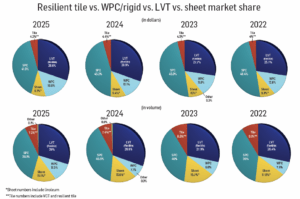 For the commercial resilient flooring market, LVT remains the star—though several segments saw upticks in sales. The subcategory (including glue down, loose lay and rigid core) kept its market share, up slightly, at 76.8% of the total commercial resilient market. That’s vs. 76% in 2024.
In terms of volume, commercial LVT garnered 71% of total commercial resilient square feet sold in 2025, or 874 million square feet. To put that into perspective, five years ago in 2020 LVT garnered just 61.2% of the commercial resilient market’s overall volume.
Within the resilient flooring LVT category, flex remains the favorite. FCNews research shows flexible LVT (including glue down and loose lay) brought in $1.64B, which was nearly 68% of the total commercial resilient market. In regard to volume, flex accounted for 775 million square feet in 2025, which was 63% of the total commercial resilient market. That’s up from 2020 when flex was 61.6% of sales and 53.6% of its volume.
“Flex LVT remained the predominant choice in the commercial market, particularly in 2.5mm or loose lay formats,” Mohawk’s Ward explained. “Its continued popularity made it a primary driver of growth and one of the category’s bright spots.”
Glue down is still the workhorse for the commercial LVT market. According to FCNews research, commercial glue down garnered $1.46B of the $1.64B commercial flex LVT sales and the $1.85B total LVT commercial sales.
In terms of volume, commercial glue down garnered 721 million square feet in 2025, which was up from 688 million square feet in 2024.
The rest of the commercial resilient market segments each garner less than 10% of total sales. Rigid core, for example, is a small player. FCNews research shows rigid core garnered just $206 million last year—registering at about 8.5% of overall commercial dollar sales, which is down from 9% the year prior. Of the overall commercial LVT market, rigid core represents about 11.2% share.
In terms of volume, rigid core garnered 101 million square feet in 2025, which was up just slightly from the year prior.
VCT continued its upward momentum in 2025 and continues to be a mainstay in the commercial market, albeit another minor player. In 2025, VCT garnered $210 million and 283 million square feet. That’s up from five years ago when VCT registered $191.4 million and 342 million square feet.
VCT garnered about 8.7% of overall commercial resilient sales in 2025, and 19.3% in square feet.
“We’re seeing an overall stable market for VCT,” said Michael Mathews, senior vice president of commercial strategy, Tarkett North America. “While that’s not the growth market we’d of course love to see, our VCT offering meets an important need for our customers, particularly in the education segment. We see VCT as a critical component of the overall portfolio we’ve developed.”
Linoleum sales were flat in 2025 over the year prior, garnering $95 million, which was just below 4% of the overall commercial market. Linoleum’s market share continues to decline—it had been hovering around 5% since 2020.
“Demand for linoleum is also stable and meets an important need in our portfolio as a durable sheet surface, especially for customers prioritizing non-PVC materials,” Tarkett North America’s Mathews said. “Education is our leading market segment for lino and it also has a footing in healthcare. So we see it as an important component of the overall Tarkett Solution SPECtrum.”
While the bulk of linoleum sales do come from the commercial side of the business, it has seen some growth in popularity on the residential side as well.
“We’re seeing a lot more Main Street commercial activity for linoleum,” said Tim Donohue, national sales director, residential, Forbo. “We’re seeing a lot of color scheme activity, and linoleum offers a very wide color palette. And when you look at the brights spots, Forbo’s Marmoleum is a middle-to-upper-end product; so people know when they put it in it’s going to last. We also have the ability to offer it in not just in sheet form (direct glue-down sheet) but also in glue-down tile and, more importantly, in a click version. That has been skyrocketing for the last eight to 10 years.”
Commercial sheet remained relatively flat in 2025, generating $233 million in sales and 83.4 million square feet. In terms of market share, commercial sheet garnered about 9.7% of overall commercial resilient sales and just over 6.7% of commercial resilient volume.
Commercial sheet is split into heterogeneous and homogeneous constructions. In 2025, heterogeneous comprised 66% of the total commercial sheet market in terms of dollars ($233 million) and 63.8% in terms of volume (52.75 million square feet). Homogeneous garnered $79 million in 2025. In terms of volume, the segment sold 30.7 million square feet.
Price points
Between 2021 and 2023, prices climbed sharply across nearly every segment as manufacturers contended with pandemic-related disruptions, escalating raw material costs and unprecedented increases in shipping and freight expenses. Those pressures pushed pricing to historic highs throughout much of the category. As supply chains gradually stabilized and transportation costs moderated, some constructions began to see pricing ease again in 2024-2025. While prices remain elevated compared to pre-pandemic levels, the market has started to normalize, reflecting a more balanced cost environment than the industry experienced during the height of the disruption.
The construction that has seen the highest price increase since the pandemic is commercial sheet. Pre-pandemic (2019), the cost of commercial sheet averaged $2.21. Just six years later that cost is now $2.79, up from $2.76 in 2024. That is more than a 26% increase.
Commercial glue down also continued its upward pricing trajectory, reaching $2.02/square foot in 2025.
SPC peaked in 2021 at $1.85/square foot. In 2025, that remained relatively flat from the year prior at $1.61.
VCT came down more than 9% in price vs. 2024, which reached $0.97. Last year, that was $0.88. Suppliers agree VCT is stabilizing after pandemic-era pricing and settling into the more user-friendly price point it’s known for.
The price of WPC continued its downward trajectory in 2025, reaching $2.15/square foot. It remains the second highest after commercial sheet across residential and commercial constructions.
Moving forward suppliers agree pricing may continue to fluctuate but should mostly remain on downward trajectories from their peak in 2021-2022.