In today’s flooring landscape—where hard surface can account for two-thirds of the floor and most options favor wood looks with minimal pattern—incorporating patterned rugs or installing patterned carpet in adjacent spaces can significantly enhance the overall design.
Indeed, for homeowners, patterned carpet provides the opportunity to bring greater personality, texture and visual interest into a space while still creating a warm and comfortable foundation.
“Patterned carpets give homeowners a way to add personality, warmth and visual interest to their spaces while keeping the overall design elevated and livable,” said Abigail Ayson, senior manager of product design for Karastan. “Today’s patterns are moving beyond traditional looks and leaning into more handcrafted, organic and nature-inspired expressions, which can help a room feel more customized and high-end.”
Bailey Walton, vice president of Anderson Tuftex, added that residential carpet trends are shaped by a desire for spaces that reflect both personal identity and a shared commitment to sustainability. “Consumers are seeking designs that foster genuine connection, with a strong emphasis on personalization and customization,” she said.
Mill executives agree that patterned carpet offers both aesthetic and practical benefits, making it an increasingly attractive choice for today’s homeowners.

“From a design perspective, pattern adds personality, visual interest and depth, allowing consumers to create spaces that feel more curated and expressive,” said Eliza Pace, senior designer for Engineered Floors. “It can add a sense of flavor to each living room inside the home and brings warmth and character to a room without overwhelming the space. The drive for each room in the house to be a space that allows consumers to feel is increasingly important.”
Unlike 20 years ago, when carpet was often the dominant flooring choice throughout a home, today carpet is typically selected on a room-by-room basis.
“As a result, consumers have more freedom to make unique design statements in the spaces where carpet is used, most commonly bedrooms, home offices and lower-level living areas,” said T.M. Nuckols, president of the residential division of The Dixie Group.
Advances in tufting technology have dramatically expanded the range of available patterns, textures and visual effects, allowing homeowners to create spaces that feel more customized and fashion-forward.
“Whether the goal is subtle texture, added dimension or a more distinctive statement, patterned carpets provide visual interest that can elevate a room beyond what a traditional solid-color carpet can achieve,” Nuckols added.
The advantages of patterned carpets range from subtle tonal designs to bold geometric statements. Beyond style, patterned carpets are also highly practical, as they can help minimize the appearance of everyday wear, footprints and soiling, making them especially appealing for active households.
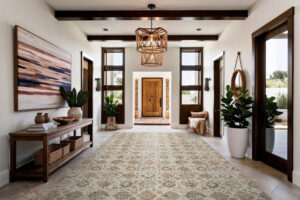
“While hard surface flooring often serves as a neutral canvas, consumers are increasingly realizing that patterned carpet can be an active part of the design of the room,” said Lauren Schnakenberg, senior director of marketing & design, Tarkett Home. “It gives homeowners a way to bring texture and personality into the space, while still enjoying the warmth and comfort that carpet is known for.”
For retailers, patterned carpet gives them a strong design story to share with customers because it brings both beauty and practicality to the home.
“Visually, pattern helps create dimension, movement and a more finished, designer-driven room,” said Cole Lewis, marketing director at Kaleen. “From a performance standpoint, patterned constructions can also be very forgiving in lived-in spaces, helping to minimize the appearance of everyday traffic.”
Key trends
Mill executives note that homeowners view carpet not just as a floor covering but as an overall part of the design story of the room.
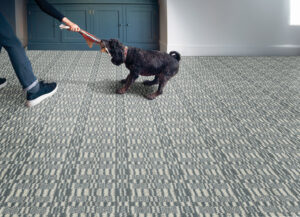
As Tarkett Home’s Schnakenberg noted, woven-inspired visuals are popular because they bring the look of textiles into the room. Classic patterns, like trellis and subtle geometrics, are resonating because they feel familiar while still offering enough visual interest to make a room feel thoughtfully designed.
Finally, designers are seeing botanical influences that draw inspiration from nature gaining momentum. These patterns create a sense of calm and connection in the room.
TDG’s Nuckols noted that small-scale patterns continue to resonate strongly with homeowners, often outselling larger, bolder designs by a margin of nearly two to one.
“While dramatic patterns can create a beautiful statement, many consumers find them more challenging to visualize in their own homes and are therefore less comfortable making that commitment during the purchase process,” he explained. “Fortunately, advances in digital visualization tools are helping bridge the confidence gap. The room visualizers available on our websites allow consumers to see how a particular pattern will look in their own space, making it easier to embrace both classic and more fashion-forward designs with confidence.”
From a colors and materials perspective, carpet design is evolving toward warmer tones and richly textured surfaces, celebrating the beauty of imperfection, according to Anderson Tuftex’s Walton. “Products are increasingly valued for their character and authenticity, featuring deep colors that are connected to nature and bring a sense of warmth and comfort to the home.”
Executives say they are also seeing market movement in traditional patterns and fibers like wool. “Elements like herringbone, chevrons, mid-scale geometrics, stripes and plaids bring customers a nostalgic retro vibe,” explained Vincent Ciricosta, executive vice president, residential division, Couristan. “These patterns paired with soft and modern color palettes give customers the ability to make a statement, add creativity and truly customize their space.”