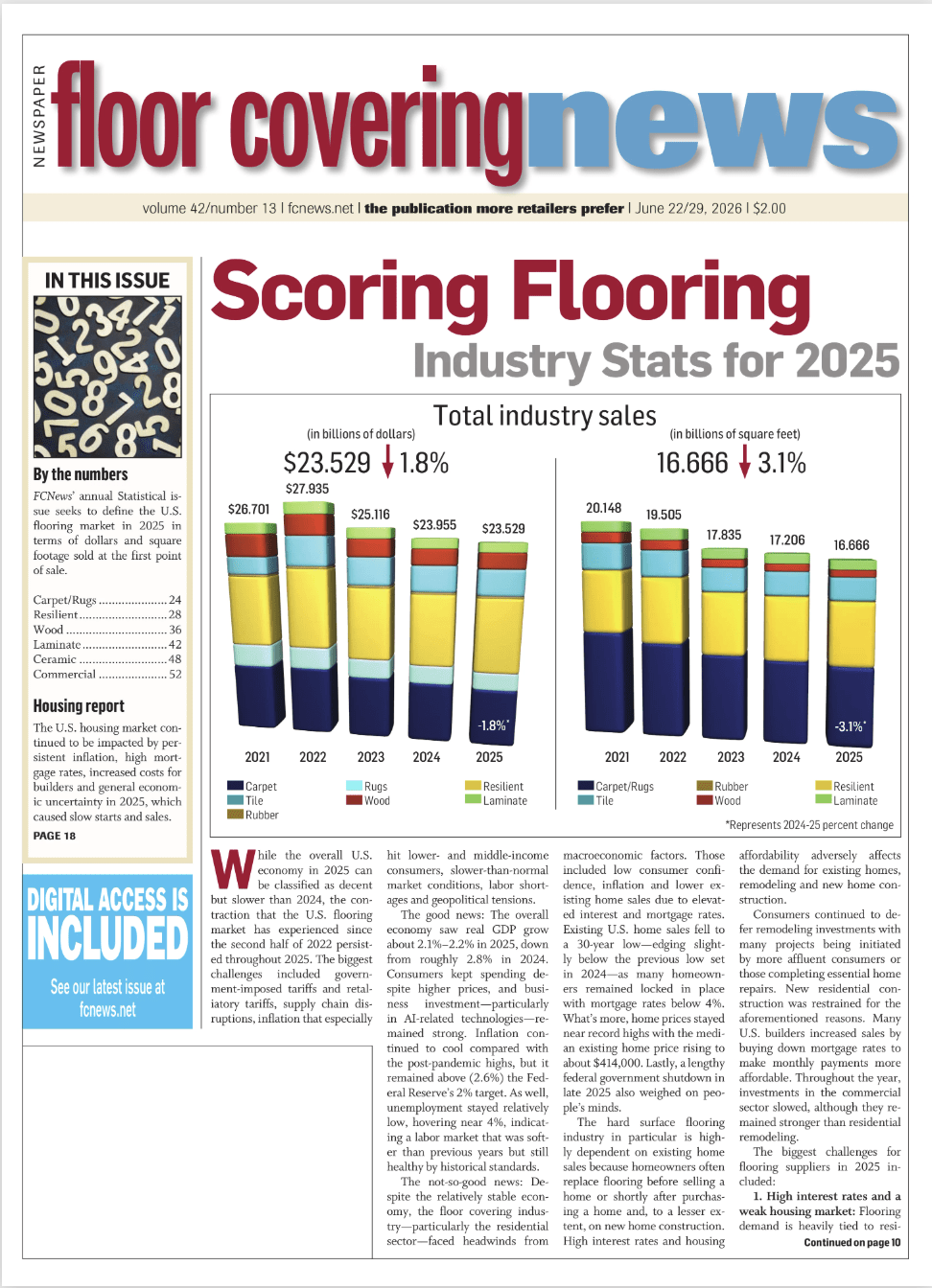
 Another stats issue in the can, another two years off our lives. When the dust cleared, dollars were down a little less than 2% and volume off a little more than 3%. If you would have asked for my projections prior to embarking on this arduous task a couple of months ago, I would have predicted declines of about 3.5% in dollars and 5% in volume. So yes, I was somewhat pleasantly surprised by our findings.
Let’s face it: The flooring industry has been in a recession since the latter part of 2022. The huge gains we experienced post-pandemic have evaporated. Dollars are pretty much where they were in 2019. Volume continues to plummet to depths not seen in 15 years. I am going to blame the depressed housing market (deadly combo of higher home prices and higher interest rates post-pandemic) and the high cost of everyday goods—at least over the last few years. But the silver lining is that the dollar and volume declines were not as precipitous as seen in prior years.
I certainly underestimated the impact of the tariffs as well as how much the product mix trended toward the high end. But the fact that volume dipped 3.1% vs. 3.5% last year and 8.6% the year before suggests that maybe people are open to renovating again. Or maybe we are just working off smaller numbers.
I’ll offer my observations, but before we delve in, let me spew my annual housecleaning. There are a bunch of statistical reports out there. Everyone works hard to come up with their numbers. Often they are similar; sometimes they are not. Accumulating the information is not an exact science by any means. Everyone also chooses their own parameters. For example, we don’t include stone flooring. We also don’t include ceramic wall tile. And when it comes to rubber flooring, we are only looking at sheet and tile products, but not cove base. But the work we do—the research, the endless conversations with execs who share confidential information—lead us to believe this report is the most accurate.
Some reports have what we believe to be a ridiculous number for wood because they rely primarily on government numbers. But those figures can include things like tractor trailer flatbeds and a host of imported engineered products (such as plywood, paneling, lumber, etc.) that are routinely misclassified by U.S. Customs and the Commerce Dept. Not one manufacturer with whom we have ever spoken believes U.S. hardwood flooring is a $3 billion industry at the wholesale level.
Back to my observations, resilient first. The category commands 36.5% of the flooring market, 37.5% if we want to include rubber here. This was the only segment to post a gain after two years of slight losses. The fact that units were down reveals the impact of tariffs as well as a bit of a pivot from SPC to WPC. WPC is making a comeback, up 4.2% last year in dollars and 2.5% in volume. Consumers have been burned by lower-priced, thinner SPC imports that failed due to faulty locking systems, giving SPC somewhat of a black eye. WPC was the beneficiary, especially since the ASP is much lower than it was in 2020.
Residential glue-down LVT is becoming more of a niche product in terms of where it goes vs. the floating options, like property management. As well, those resilient suppliers with domestic capabilities picked up share due to the tariff uncertainty.
Don’t call it a comeback, but VCT was actually up significantly as some school districts have flipped from LVT back to VCT. As well, some big retailers who sat on the sidelines in 2024 came back strong in 2025. VCT offers durability in heavy use instances where some have experienced damage occurring sooner than expected with LVT. VCT offers the ability to fix gouges or damages easier than LVT.
Some words about carpet: We have been hearing for the last few years about the high end driving the market. And that is definitely true. Talk to the mills and Karastan, Anderson Tuftex, and Masland and Fabrica are outperforming their sister brands. Why? The affluent consumer is not as impacted by the $100 stop at the gas station. They like patterns, they like heavier weights, they are more apt to purchase nylon and wool. However, the stats reveal this represents only a small piece of the carpet market as evidenced by the fact that residential sales were down 5.3% in dollars and 5.5% in volume. That makes res carpet the only category that did not post a higher ASP than the prior year. Makes sense. A very high percentage of the carpet sold in the U.S. is domestically made and immune from tariffs.
Commercial carpet performed much better than residential, down 2% in dollars and 3.7% in volume, according to FCNews research. Like every other category, the ASP went up. The story was the same for commercial resilient, which was up 6.4% in dollars and 3.7% in units. Manufacturers cited education and healthcare (including assisted and senior living) as the primary drivers, but corporate, which at one time held a 40% share of the market but has suffered post-pandemic, is reported to have shown signs of life in the second half of 2025 as companies are making concerted efforts (or demands) to get their people back in the office.
Enjoy the issue.