 While the overall U.S. economy in 2025 can be classified as decent but slower than 2024, the contraction that the U.S. flooring market has experienced since the second half of 2022 persisted throughout 2025. The biggest challenges included government-imposed tariffs and retaliatory tariffs, supply chain disruptions, inflation that especially hit lower- and middle-income consumers, slower-than-normal market conditions, labor shortages and geopolitical tensions.
The good news: The overall economy saw real GDP grow about 2.1%–2.2% in 2025, down from roughly 2.8% in 2024. Consumers kept spending despite higher prices, and business investment—particularly in AI-related technologies—remained strong. Inflation continued to cool compared with the post-pandemic highs, but it remained above (2.6%) the Federal Reserve’s 2% target. As well, unemployment stayed relatively low, hovering near 4%, indicating a labor market that was softer than previous years but still healthy by historical standards.
The not-so-good news: Despite the relatively stable economy, the floor covering industry—particularly the residential sector—faced headwinds from macroeconomic factors. Those included low consumer confidence, inflation and lower existing home sales due to elevated interest and mortgage rates. Existing U.S. home sales fell to a 30-year low—edging slightly below the previous low set in 2024—as many homeowners remained locked in place with mortgage rates below 4%. What’s more, home prices stayed near record highs with the median existing home price rising to about $414,000. Lastly, a lengthy federal government shutdown in late 2025 also weighed on people’s minds.
The hard surface flooring industry in particular is highly dependent on existing home sales because homeowners often replace flooring before selling a home or shortly after purchasing a home and, to a lesser extent, on new home construction. High interest rates and housing affordability adversely affects the demand for existing homes, remodeling and new home construction.
Consumers continued to defer remodeling investments with many projects being initiated by more affluent consumers or those completing essential home repairs. New residential construction was restrained for the aforementioned reasons. Many U.S. builders increased sales by buying down mortgage rates to make monthly payments more affordable. Throughout the year, investments in the commercial sector slowed, although they remained stronger than residential remodeling.
The biggest challenges for flooring suppliers in 2025 included:
- High interest rates and a weak housing market: Flooring demand is heavily tied to residential construction, home sales and remodeling activity. Elevated mortgage rates and affordability issues slowed both new home construction and existing home turnover, reducing demand for flooring products across nearly every category. Remodeling held up better than new construction, but even that segment softened as consumers—especially in middle income segments—delayed discretionary spending due to inflation, higher borrowing costs and fears of recession. Throughout 2025, most central banks took actions intended to stimulate economic growth and housing markets, including multiple rate cuts by the U.S. Federal Reserve. As the year progressed, U.S. builders completed fewer projects as they focused on reducing inventories, lowering the construction of new homes. Currently, U.S. mortgage rates are near their lowest levels in years, hovering around 6.5%.
- Tariffs and trade uncertainty: Tariffs on imported raw materials and finished goods created major pricing volatility. The industry faced uncertainty around lumber, aluminum, steel and vinyl-related imports, especially from China, Canada and Southeast Asia. Flooring manufacturers struggled with constant price resets, inventory planning and sourcing decisions because tariff policies changed frequently throughout the year.
- Raw material inflation and commodity volatility: Costs for lumber, PVC resins, adhesives, etc., remained unstable. Hardwood producers were hit by lumber fluctuations, while resilient flooring manufacturers dealt with resin and petrochemical volatility. These higher costs squeezed margins and forced manufacturers and distributors to either absorb costs or raise prices into a price-sensitive market.
- Labor shortages and installation bottlenecks: One of the industry’s most persistent issues was the shortage of skilled flooring installers. Even when product demand existed, installation capacity often lagged. The aging workforce, lack of younger trade entrants and long training timelines created delays and increased labor costs.
- Consumer price sensitivity and margin pressure: Consumers became increasingly value-driven in 2025. Many traded down from premium hardwood or tile into lower-cost LVT, laminate or entry-level vinyl. At the same time, manufacturers faced intense competition from low-cost imports, compressing margins throughout the supply chain. Retailers and distributors also had to manage cautious purchasing behavior and inconsistent showroom traffic.
- Supply chain instability and inventory management: Although supply chains improved from peak-pandemic disruption levels, companies still struggled with long lead times, inconsistent freight costs and sourcing shifts caused by geopolitical tensions and tariffs. Many flooring companies spent 2025 aggressively managing inventory levels to avoid overstocking during a slower-demand cycle.
Each category had its own specific challenges as well. For example, carpet continued losing share to resilient flooring. Hardwood suffered from high costs and weaker housing turnover. Ceramic tile faced installer shortages and slower project timelines. Resilient flooring, particularly rigid core, remained the strongest category, but even it experienced slower growth and pricing pressure.
Despite these headwinds, the industry’s brighter spots in 2025 included resilient flooring growth and investments in domestic manufacturing and sourcing diversification. Companies that focused on operational discipline, premium products and supply chain flexibility generally performed best. Commercial outperformed residential throughout the year with strength in healthcare, corporate, education and hospitality.
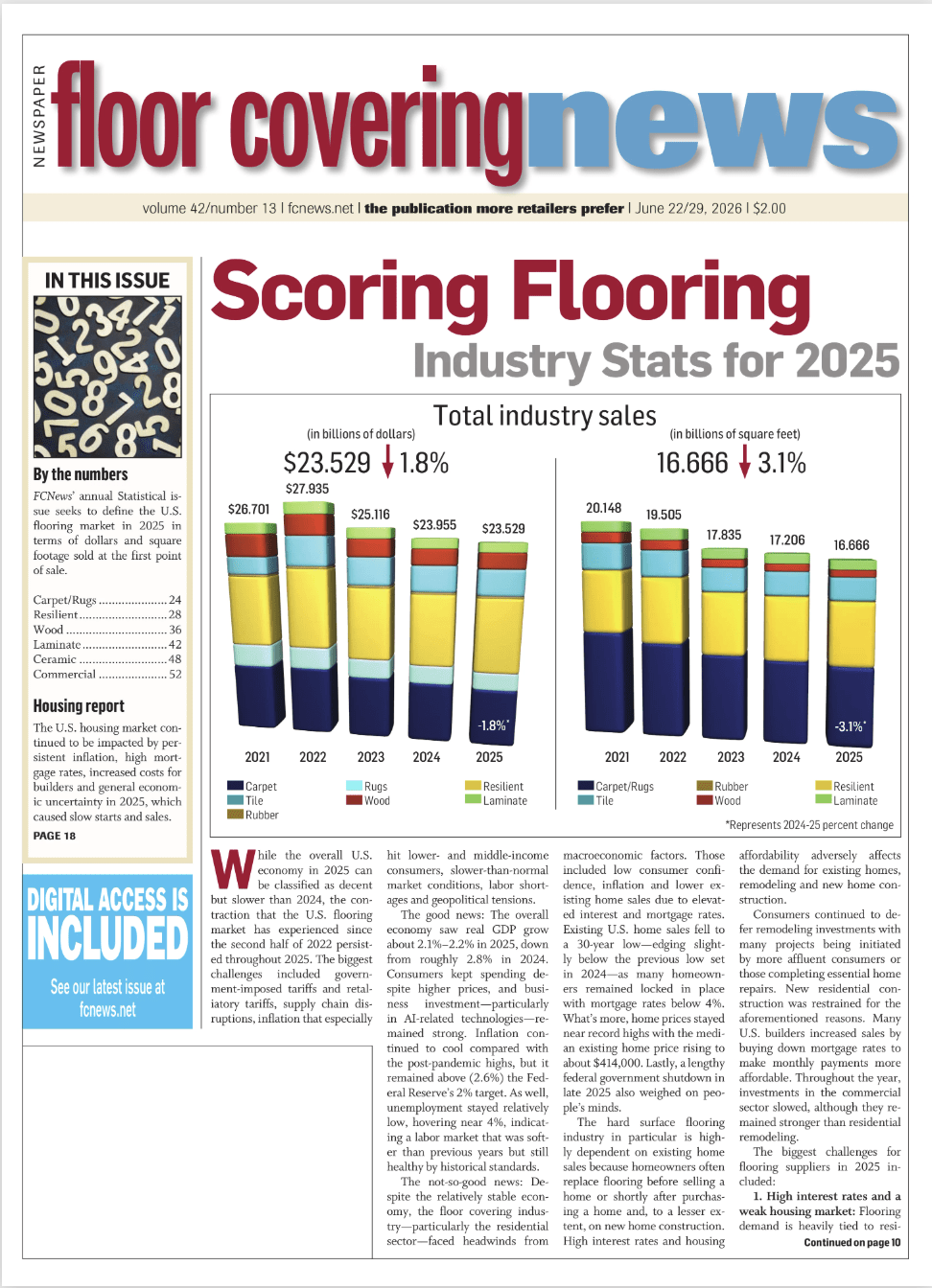
After posting dollar growth in 12 of 13 years (the industry was down 0.5% in pandemic-ridden 2020), sales dollars in 2025 retreated for the third year in a row and volume dipped for the seventh time in the last eight years. However, those looking for a silver lining will take note of the fact that the losses were about half of 2024’s decline and about a fifth of 2023’s drop. The fact that volume is dropping more precipitously than dollars suggests two things: The higher-end consumer continues to drive sales and, as such, is purchasing better goods, and the dollar drop would have been significantly worse if not for price increases due to the fluctuating tariffs.
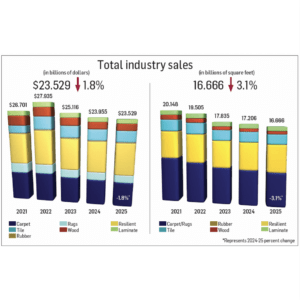
When the dust cleared and all the numbers were counted and run through the wash multiple times, total industry sales in 2025 dropped 1.8% to $23.529 billion compared to 2024’s $23.955 billion. That number is still up 2.4% from 2020’s $22.975 billion. And for means of comparison, until 2021 and 2022’s record-setting years, the high-water mark for the industry was in 2006 when it reached $24.715 billion. The industry is down only 4.8% from that point. Thus, despite all the challenges, the flooring industry posted its sixth-highest dollar volume ever. (Note: These numbers are in wholesale dollars reflecting the first point of sale. They also do not include stone flooring—nor do they account for ceramic wall tile, cove base and rubber accessories.)
The story is not as bright when looking at volume/square footage. FCNews research reveals that the industry went from 17.206 billion square feet sold in 2024 to 16.666 billion square feet in 2025, a 3.1% decrease. This marks the seventh decline in the last eight years and represents the lowest volume total since 16.625 million square feet were sold in 2010. Only in pandemic recovery year 2021 did the industry post growth in units (6.2%). That is also when volume reached its peak with 20.148 square feet of flooring being sold. So we have witnessed a 17.3% drop over that time. Moreover, every category showed a sharp decline in volume except resilient, which was only down 1.2%. If not for a solid commercial segment, particularly healthcare, assisted living and education, the dip would have been greater.
What does this tell us about 2025? Three things: 1. The market is being driven by the higher-end consumer buying better goods; 2. Price pressures due to a litany of factors, not the least of which were tariffs, resulted in higher prices in every category except carpet and rugs due to the latter’s high concentration of domestic mills; and 3. The mid-range consumer remained on the sidelines.
While many will not be excited about 2025 given the 3.1% decline in volume and 1.8% drop in dollars, it is better than 2024, when the industry was off 3.5% in volume and 4.6% in dollars. And it is significantly better than 2023, when the industry was off 9.1% in volume and 10.1% in dollars. The average selling price of all flooring increased from $1.39 to $1.41, just a shade lower than the ASP apex of $1.44 in 2022. To put things in perspective, when we were recovering from the Great Recession 15 years ago, flooring sales were $16.221 billion and 16.625 billion square feet for an ASP of $0.98. Fifteen years later, the industry is up 45% in dollars but only 2.5% in volume. So the average selling price of one square foot of flooring (wholesale) has increased $0.43 in the last 15 years. As mentioned, the average wholesale price of all flooring in 2025 was $1.41. But in 2021 the ASP was $1.33 vs. $1.21 in 2020 and 2019, which was up from $1.17 in 2018 and $1.11 in 2017.
For historical purposes, in 2022 the industry was up 4.85% in dollars but down 3.4% in volume. This came on the heels of a 16.3% increase in dollars and 6.2% rise in volume in 2021 as the U.S. climbed out of the pandemic; 0.5% decreases in dollars and volume in COVID-19-marred 2020; a 0.4% gain in dollars and 2.8% decline in volume in 2019; 4.6% growth in dollars and a decline of 0.6% in volume in 2018; 3.85% growth in dollars and 3.2% in volume in 2017; 5.1% growth in dollars and 3.8% in volume in 2016; and 4.4% and 3.2% growth, respectively, in 2015.
Keep in mind average selling prices dropped heavily in 2020 because of the pandemic but escalated greatly in 2021 as excessive freight/logistics costs were passed on to retailers.
Against that backdrop, each segment of the flooring industry in 2025 aside from vinyl posted declines in dollars ranging anywhere from 1.2% (ceramic) to 5% (carpet). In terms of units, every category took a step back with vinyl (-1.2%) the only category with a percentage loss under 4.2%. In terms of pricing, every category posted a higher ASP than the prior year. The highest ASP increase on a percentage basis in the last six years belongs to ceramic, which has moved from $1.20 in 2019 to $1.43 in 2025. The only category that has noticeably dropped in ASP since the pandemic years is rigid core as the segment has been inundated with cheap imports.
Interestingly, for the second consecutive year, commercial fared better than residential. While total industry dollars were down 1.8% to $23.529 billion, commercial was actually up slightly (1%) from $7.019 billion in 2024 to $7.091 billion in 2025. Even more pronounced is the fact that the overall flooring industry is down 6.3% over the last two years in dollars but commercial is down only 1.9% in that span. Even more good news: that $7.091 billion is 8.7% higher than 2021’s $6.5 billion. Commercial is growing in the face of some headwinds, namely surging construction materials costs, a decline in the labor pool and some lingering supply chain issues. Financing rates seem to have stabilized although much higher than the 2015-2021 period. The segments that are leading the way are healthcare (including assisted and senior living) and education and, to a lesser extent, retail. Executives say corporate has begun to show signs of life, particularly in the latter half of 2025.
Commercial was truly the bright spot for both carpet and resilient. While carpet overall was down 5% in dollars and 4% in volume, those numbers retracted to 2% and 3.5% declines, respectively, when only considering commercial, which accounts for more than 40% of carpet sold (including Main Street). On the resilient side, a 2.5% increase in dollars became a 6.4% increase when taking only commercial into account. And commercial LVT, which comprises more than three-quarters of commercial resilient, was up over 7.5% in dollars (due in large part to price increases) and about 1.6% in volume.
On the subject of resilient, it’s hardly a secret how rigid core has been driving the category, posting increases every single year except 2023. The category in 2025 was driven by WPC, up 4.2% in dollars and 2.5% in volume vs. SPC, which was up 2.9% in dollars and 1.8% in units. This reflects consumers choosing better goods and a shift away from SPC as some experienced failures with some of the lower-end, thinner, imported SPCs. SPC dollars remain on par with 2020 numbers. The average SPC selling price dipped from $1.68 to $1.61 as companies sought to sell off excess inventory. WPC has dropped from $2.60 to $2.15 in the last six years. SPC average selling price is now on par with 2020 before the inflationary years of 2021 and 2022.
Speaking of which, no product has been victimized by inflation more than ceramic tile, which since 2021 is down 4.1% in dollars but four times that amount (16.4%) in volume. The average selling price hovered around $1.20 for nearly a decade, sitting at $1.24 in 2021, but saw its ASP leap to the $1.40s in 2022. It currently sits at $1.43. This category in 2022 experienced more price hikes than any other due in large part to freight increases. Ceramic is more import-driven than other hard surface categories and is the heaviest of all flooring products on a square-foot basis. So it stands to reason that it would be most impacted by increases in freight costs.
The category that is suffering the most due to the decline in housing sales and new home construction is hardwood. Dollar sales and volume were down 3.8% and 6.8%, respectively, in 2025 to $1.774 billion and 630 million square feet. That’s the lowest level since 2012, when wood sales fell to $1.64 billion and 685 million square feet. Since 2021, when wood reached its pinnacle of $2.67 billion and 1.03 billion square feet, the category is down 33.6% in dollars and 38.8% in volume. Hardwood experienced an unprecedented rise leading up to 2021 partially due to stimulus money and a redirection of consumer spending away from travel, leisure, dining out and toward home renovation projects. At the same time, hardwood experienced significant price increases due to escalating demand for European white oak, which impacted wholesale pricing.
Over the course of the last four years, hardwood has also been victimized by widespread inflation, which has led those consumers who had the itch for renovating their homes to opt for more price-sensitive hard surface alternatives like laminate and rigid core. With the advent of technology, consumers are finding they can purchase a wood look for a fraction of the cost of the genuine article. The only portion of the wood flooring market that seemed to be immune to this phenomenon was the upper-mid to the high end of the market.
Laminate, which had been on the comeback trail up until 2022, has faced some headwinds on said trail these last three years dropping nearly 20% in dollars and nearly 21% in volume. Since 2019, laminate is up 2.7% in dollars but down 7% in volume, making the average selling price 13 cents higher. Three issues here: 1. Home centers, a key channel for laminate, experienced softer sales of DIY products in 2025; 2. We saw a double-digit decrease in shipments from European manufacturers, according to EPLF, over the last year due to higher tariffs, lower demand and diminished global production; and 3. Swiss Krono, which supplies more than a third of the HDF to U.S. manufacturers, scaled back fiberboard production during the latter half of 2025, which impacted overall domestic production. Earlier this year, the company announced massive layoffs.
Much of the comparisons are to 2019 and 2022 because 2019 was the last “normal” year before COVID-19 threw the economy into flux, nearly $2 trillion of stimulus money that created inflation, and the ensuing supply chain disruptions, and the dollar growth the industry achieved in 2022 was attributed to multiple rounds of price increases as suppliers tried to keep pace with rising costs. Container costs remained high before abating toward the end of the year. And freight expenses once product reached these shores were through the roof. To further illustrate the impact of price increases in 2022, the average selling price of all flooring (wholesale) went from $1.21 in 2019 to $1.44 in 2022. It’s dropped only 2 cents since.
No category has been challenged more than SPC when it comes to ASP. After peaking at $1.85 in 2021, the category’s ASP now sits at $1.61. One more fact about SPC: Those average selling prices are driven down by the Home Depots and Floor & Decors of the world, which buy less expensively because of their sheer volume. Home Depot is supplied primarily by HTMX and MSI. Floor & Decor is supplied heavily by CFL and Novalis. Lowe’s has a higher-end product mix with a bunch of suppliers in there. Novalis has significant share there. When you look at the cost to retailers and distributors, it is well over $2.
For a full overview of categories (carpet, resilient, tile, hardwood, laminate), see the June 29, 2026 print edition of FCNews or fcnews.net.