
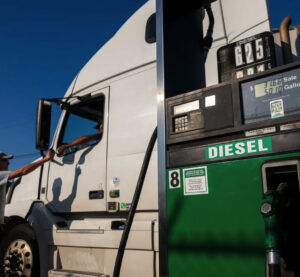
Flooring distributors are contending with a severe financial squeeze as record-high diesel prices—$6.35 per gallon nationally as of Oct. 26—compound broader operating and compliance costs.
Diesel prices alone have spiked substantially year-over-year, severely impacting thin-margin operators like regional distributors. “It is a unique time where distribution faces a particularly tight squeeze because their costs are hit from multiple directions at once: supplier price increases, tariffs, diesel fuel 70%+ increase in just past 12 months for both incoming and outgoing freight, electricity cost up over 60% in past five years, rising labor cost and inventory carrying costs,” said Jeff Striegel, president of Elias Wilf, a top 20 distributor based in Owings Mills, Md. “There simply isn’t a one-answer solution, but rather a broad-based approach is required across the entire organization that also accepts some degree of rising cost absorption with lower profits as part of the answer.”
Distributors acknowledge that the entire cost simply cannot be passed along to customers; they must be able to reduce cost and overhead while not compromising service or operational excellence. “It’s now time to fully squeeze and derive the benefits out of all the various forms of technology that distributors have embraced over the recent decade,” Striegel said.
Fully embracing technology has not only provided Elias Wilf with substantial cost savings but also improves customer satisfaction simultaneously.

For example, according to Striegel, 96% of its invoices are now sent electronically; 53% of accounts receivable come in electronically though online ACH payments; 100% dealer updates and notifications on order status are sent automatically and 33% of all orders are now placed online by Wilf’s customers. “All pricing is communicated electronically, offering both improved speed and major savings,” Striegel explained.
Leveraging the latest technology is just one area distributors are being proactive. Carrollton, Texas-based Adleta has increased its fuel surcharge by 66%, roughly in line with the rise in diesel since the start of the Iran war. But their strategy goes beyond raising prices. “We have started managing routes much tighter and combining runs so that our tractor trailers leave with full loads on each run,” said Matt Hafer, president. “A huge challenge for us is the inbound freight increases we are receiving and how we recoup some or all of those increases.”
As with many distributors, FlorStar Sales in Romeoville, Ill., has been closely monitoring diesel pricing and is passing along related product increases from its vendors to the marketplace. “Likewise, we have worked to help customers consolidate deliveries to create more efficiency,” said Scott Rozmus, president/CEO. “We always are working to reduce our cost of service without compromising quality. Nonetheless, we have had to raise delivery charges for the first time in years this year to help offset the rapidly rising cost of diesel.”

Big D Floor Covering Supplies in Phoenix has been making small adjustments to its delivery program to ensure its cost metrics are covered appropriately. “We are beginning to see vendors come to us with price increases related to transportation costs,” said Andrew Kleinhans, director of business development. “As those prices are implemented, we will continue to evaluate our procedures to ensure profitability as we had to do in the past when freight challenges occurred.”
Jacksonville, Fla.-based distributor Cain & Bultman, which contracts with a common carrier rather than operating its own fleet of trucks, has had to respond to a significant increase in costs recently. “We have no choice but to pass this on to our customers in the form of an increase in delivery charge,” said Paul Walker, president. “We have also experienced a significant increase in ocean freight surcharges for our incoming imports from Southeast Asia. We are told that this is driven by lower capacity as a result of the Iran war and higher fuel costs for the same reason. To date, we have been absorbing this; however, we are monitoring very closely as current levels are not sustainable over the long period.”
NRF Distributors, Augusta, Maine, acknowledged that rising fuel prices have had a significant impact on their transportation costs, making freight one of their biggest business challenges.
