
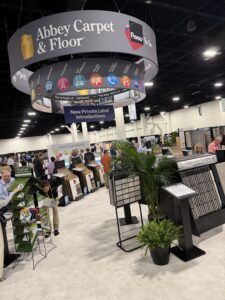
 Fort Lauderdale, Fla.—Nearly three-quarters of Abbey Carpet & Floors To Go’s membership gathered here earlier this month for the group’s annual convention, and if one theme defined the event it was forward progress. From an expanded vendor lineup and deeper private-label investment to accelerated membership growth, the organization made a clear statement: leadership is positioning its independent dealers to win in today’s market.
Just as notable was the tone on the show floor, where leadership pointed to a level of optimism that suggests retailers are ready to grow despite continued uncertainty. “I’m seeing how upbeat all of these members are,” said Dave Hardy, executive vice president of merchandising and member services, Abbey. “The optimism is out there. I feel pretty encouraged about what I see.”
It wasn’t just attendance but overall member growth that told a powerful story. The group is up 12 new members in just the last 40 days. “Within six months we opened up double the number of members that we did all of 2024,” Hardy explained. “I think astute retailers really know today that in order to grow they have to change. They need partners who can help them change, partners to help show them the way, partners to help deliver the tools they need. They can’t do it on their own.”
One unique aspect to Abbey is its steadfast refusal to demand conformity. Unlike most other groups in the industry, Abbey does not dictate what its members sell or how they sell it. The strategy has been touted by many new members as invaluable.
One such member is Infinite Floors in Burnsville, Minn. The store owners said it was left out to dry by its previous group and immediately saw the benefits of shifting to Abbey. “We saw how our margins were going down [with our previous group] and we wanted something to protect us—and to be a part of something bigger than ourselves,” explained Jestin Kemp, owner. “So it was a no-brainer when we came here instead of other groups. The others also wanted more money out of us in order to join, and that wasn’t something we were able to do [because we’d already invested so much into merchandising with our previous group]. It was almost nothing upfront to us, and that was a big kicker to push us over the edge.”
Phil Kersten, owner of Woodstock Flooring & Design Center in Birnamwood, Wis., is also a new member who came from a competing buying group. “We were looking for a better situation,” he explained. “We liked the fact that we didn’t have to change out our showroom, displays, anything, if we didn’t want to, and still earn rebates. We’d already invested so much [with the other group.]”
Filling gaps in product

Another major driver of retailer interest in the group is its continued focus on strengthening its product assortment—with intention. The group is known for its focus on better-end goods, an area of the market that has done particularly well despite economic challenges like interest rates and inflation.
Keith Johnson, vice president of merchandising, emphasized that supplier additions are less about volume and more about that strategic coverage. “We’re not willy-nilly when we add suppliers, but this year we added seven. We worked hard to find suppliers that, one, could meet the specs; two, could execute in the field; and three, have differentiated product that is really meaningful as opposed to just adding another supplier.”
The focus this year was expanding the group’s tile and hardwood offering, which highlights its focus on better-end goods. “I can’t think of a better tile selection in the industry than what we can offer our members now with the addition of MSI and ROCA,” Johnson said. In hardwood, Johnson said the new vendors offer “more differentiated looks—works of art for the floor in wood. We’re happy with them, and the feedback we’ve gotten so far has been fantastic.”
The sentiment is anything but one-sided. MSI said it found the group’s focus beneficial to its own goals. “As we’ve evolved as a company into higher-end products, we’re trying to find ways to connect with customers that specialize in higher-end products,” explained David Raymond, senior director of sales and marketing, MSI. “And the Abbey group generally is selling better goods to a more affluent customer base where price isn’t the driving factor in the decision-making process, so this was appealing to us. And it’s a group that’s been around for a really long time. So for us, as we continue to proliferate into the flooring business, this was a natural fit.”
But it wasn’t just the group’s product focus that drew the vendor. “They’re very accessible,” Raymond added. “We’re involved in a lot of these different groups, and some are very standoffish, very arm’s length. This group has been very warm, very inviting. The members are all very gracious and excited that we’re here, and we’re excited to be here.”
The group’s members also continuously tout its product strategy. “One of the biggest benefits was getting in with some of the manufacturers that maybe you couldn’t get in on your own; product lines you wouldn’t have access to on your own,” said Bill Taylor, owner, Taylor Flooring, Point Pleasant Beach, N.J. “Our inventory has gone from base grade to middle to higher end, and it’s worked out very well for us, and that’s because of Abby gives us access to those products. And the rebates are nice but that’s not what this is about.”
Private label makes the difference

Central to Abbey’s value proposition is a private-label strategy designed to help retailers protect margins while selling with greater confidence. Johnson was direct about the strategy behind the program. “We have a game plan for our members,” he said. “There are processes that we have to help them make more money. That’s one of the reasons they come to us. And a key part of that is our private label. What it allows them to do is raise their margin and have some confidence that they’re not going to get shopped.”
Exclusivity is the differentiator. “If they’re going to do that, they can’t have something that everybody else has,” he said. “Our program is very well done. It really eliminates all the competition, both up and down the street as well as on the internet.”
Hardy reinforced the financial upside. “I think in a perfect world, we would tell you that we’d love for our members to be at 55% margin,” he said. “If we can move a new member who’s currently making 35%-40% margin up to 55%-60% margin, it’s pretty easy to guess what that’s going to do to their profitability.”
Private-label growth is also being reinforced on the showroom floor through expanded destination merchandising designed to elevate presentation while simplifying the selling process. Hardy pointed to the success of the group’s Infinity display, calling it “by far the best-selling, most productive display in our carpet line.” He noted the exclusive fiber helps members avoid direct price comparison while presenting a higher-performance story to consumers.
Members attest to the power of the soft surface offering. “I’ve been in the flooring industry for 25 years,” said Ben Henwood, owner, Designer’s Home Gallery, Wichita, Kan. “Early on I understood the importance of private labeling and selective merchandising. The beauty of [Floors To Go] is there’s such an amazing private-label soft surface program. I’m able to take that and incorporate it into gaps we have within our showroom and private labeling. So now we’ve got a beautiful showroom that covers every style and price point, fully incorporating the value of the private label and then giving a customer an excellent shopping experience.”
Kersten, a new member, agreed, noting, “We’d been shopped before. There’s a lot of customers that we bid or our designer does all the work and then they take it to our competitor and undercut us. So private label is huge to us.”
The destination strategy is now extending beyond soft surface, with new hard surface presentations and the expansion of Pet Defense into additional categories after proving itself as “an incredibly good brand for us, specifically on carpet,” Johnson noted.
Together, the updated merchandising platforms are built to drive higher tickets, stronger margins and a more compelling in-store experience without requiring constant reinvestment from members.
Digital marketing for the (younger) ages
Digital strategy remains another core pillar driving member performance, with leadership emphasizing the importance of precision over volume. Hardy explained that the group’s approach has evolved from broad outreach to highly targeted campaigns. “The money these members spend on advertising is more a rifle shot today than it is a shotgun blast,” he explained. “It’s feasible for people to seek out consumers who are in the market to buy floor covering and aim that advertising at those people.”
Bill Wilson, chief operating officer, added that the organization is continuously auditing its technology stack to ensure members have access to the strongest tools available. Some of that has to do with the generational transition happening within the membership. “What we’re noticing and seeing within our own membership is youth,” he noted. “We’re having some transition from parent to child, grandparent to grandchild—second, third generation. All of these younger people are challenging us and pushing us to offer more services. We need to sharpen our pencils and evaluate the services that are out there. They’re saying, ‘We can’t think about it like we did 30 years ago. We need to have somebody who’s keeping up with technology,’ and they see that in us.”
Wilson said Abbey is also focused on aligning its digital infrastructure to support long-term member growth as technology evolves at a rapid pace. “It’s always good to take a look at what you’ve put together,” he said. “We’ve dumped a lot of services on our members. They don’t always have time to understand all that’s being offered.”
Wilson noted that search engine optimization remains essential but that the team is actively evaluating emerging programs to ensure members stay competitive. “We want to make sure we have the best tools in our toolbox to offer to the members. Things are changing. SEO continues to be important, but we’re looking at some of these newer programs, too.”
For new Abbey members the benefits are already paying off. “There’s no reason why we shouldn’t have their website and have them helping us with our marketing because obviously they know those products the best and the brand the best,” Infinite Floors’ Kemp said. “They’ve helped us with print materials already. And they’re just super open and easy—and doing it all for free. It’s really a game changer for us.”
Long-time Abbey members, too, are touting the group’s focus on the continual advancement of its digital marketing platform. “We do some social media advertising with them. They do all of our Google ads and of course they keep our website up—and you can change your website so easily. The website’s a great vehicle. Then there is FloorHub—it makes [data analysis] really easy. How much LVT am I selling? How much wood am I selling? How much of each supplier am I selling? So it’s easy to look at my showroom floor and say this space is not equaling what it should for sales. That’s something new they added this year that’s going to be very helpful.”
Networking seals the deal

For independent retailers, the true value of a buying group often extends far beyond pricing programs and vendor access. Direct support from leadership—whether in strategy, operations or problem-solving—can mean the difference between surviving and scaling. Just as important is peer networking. The ability to speak candidly with fellow members who face the same market pressures creates a trusted sounding board, accelerates learning and prevents costly missteps.
“We did a lot of vetting because we had come from a group that didn’t really do so well for us,” Kemp stated. “We asked a lot of questions to the members. Every single person had nothing but positive things to say.”
Taylor emphasized the value of those peer relationships. “I enjoy this. I enjoy meeting dealers from around the country. You become friends with them and you can bounce things off them. You’re not comparing things with the next store that your competitor.”
For Janice Clifton, owner, Abbey Carpets Unlimited, Napa, Calif., the consistency of leadership has been equally impactful. “We’ve been a member for 38 years. I think the biggest thing is the support. A lot of that comes from Phil. It comes from top down. He’s always supported us as a store and he really cares about the stores. So that comes through his staff that they care about the stores. They help you. Well, when I first started, I knew nothing about flooring. So they helped me learn. They helped me learn what a good profit margin was. I didn’t know anything about selling. Over the years they’ve helped with just many things.”
