The general vibe among attendees at the Starnet spring conference was cautiously upbeat, despite challenges facing the economy at large. Among the key bellwether end-use sectors, healthcare, education and office markets are spending more on projects, while retail and hospitality are experiencing some softness. By and large, many Starnet members report a healthy backlog of projects, although contract sign-offs remain a sticking point.
FCNews executive editor Reginald Tucker sat down with Mark Bischoff, Starnet president and CEO, at the convention to talk about the growth of Starnet and the general state of the contract commercial flooring market.
Let’s talk first and foremost about the theme of this year’s conference and the messaging. What was the inspiration for that? What do you want to convey to members this year?
The theme this year is “Red Zone Ready” and “Built on Trust.” So there’s two parts to that. One is our keynote speaker, David Horsager; he has written a few books on the concept. One is “Trusted Leader” and the other one is “Daily Edge.” Many people think that trust is touchy-feely, but it’s more than that—your credit score is trust, for example. And so there are a lot of things in life that create a metric around trust in addition to the emotion. And a lot of things our members are dealing with as far as industry change and managing their employees—all of that is related to trust. So if you want people to change behavior or change your business or do great things, they have to trust you as a leader to be able to accomplish that.
And then on top of that, we have this “Red Zone Ready” concept that we’ve been working on with the members over the years. So that is helping them with talent development, both in their own organization and with their manufacturing partners that are part of Starnet. Operational excellence, which is both internally with their white-collar workforce in addition to their field labor, blue-collar workforce. The last point is technology deployment. Most people think about that as the digital part of the business, but we also view new machinery, new tools and new methods as part of that technology development that the members have to be deploying to.
So if you do all those things well, you’re ready to run a Red Zone business all the time. You put yourself in the place to be successful, just like an athlete would do inside the 20-yard line. You want to score all the time consistently.
Against the backdrop of those themes, how important is it for members to check all those boxes, if you will, particularly in this current climate?
Ideally you want them to check them all, but depending on the size of the organization or the complexity, some of them can deploy and some of them can’t, or incrementally they’ll focus on their priority that fits their business model.
We’re human beings and we’re dealing with change management and they’re different scales of companies. So if you’re a single location, family organization that has a tight group, it’s a bit easier to make that change happen because you can go face to face with your associates and you can be alongside them. Some of our members are much larger in scale. They have multiple branches across multiple states and, therefore, they have to have more robust systems in place of communication and networking and middle management to accomplish those things.
How does membership in Starnet help facilitate this?
Part of the advantage of being in Starnet is members get a view of lots of other examples of success. And if they want to adopt something quickly, they have membership peers that are willing to share their experience and keep them from making big mistakes. So you can kind of lean on the experience of others if you want to accomplish it. We try to put members together that are in different geographies but have similar structures so that they can learn from each other. So a member that is hourly in one market would love to talk to another member that’s hourly in another market. Or a member who focuses on healthcare—they may want to pick up the best practices from someone that’s working in a different state or a different part of the country. So that’s the advantage, that Starnet makes that connection really easy.
While we’re on the subject of members, can you talk about your membership trends over the last few years?
We have five new members that we’ve invited to our spring meeting and it’s a combination of Canada and the United States. Some of the members are new owners, not necessarily new members from organic growth. We had one of our original members, Dixie Contract, who was a founding member from 1992— that ownership changed from the founding member family to employees, longtime employees. We love those kinds of stories where we keep the member in the network and there’s a successful exit for that owner. We also have companies that are family owned where the family passes that business to their sons, daughters, etc.
Then the next trend we’re seeing is where holding companies have interests in multiple different businesses—they may be investing in manufacturing and other types of businesses—but they’re also owning members. Some examples are the ADG Great Floors organization, which was acquired by Lowe’s.
The other profile we have are private equity firms that are buying into the membership. A couple of examples include: Diversify and Fabulous Floors. And then the last, and this is rare, but we think we might pick up another one in the next 12 months. Bonitz, one of our largest members, is an employee-owned company.
We’re seeing private equity acquisition and interest on the distribution side of the business from discussions with people at NAFCD. Your thoughts on what that means for the contract flooring commercial side?
We’ll continue to see these various types of ownership enter the business. Private equity and investors view our business as a good target—because, for one, it’s steady. The construction business is a new build and renovation business, so they see it as a steady stream of revenue and people work in buildings. So it’s not an industry that’s going to be changed dramatically by AI or automation. It’ll be enhanced, made more efficient.
Second, a lot of these private equity firms or investors see shared services as the way to optimize these companies, but they also know that physical labor in the field and the work that has to be done can’t be unwound by dramatic developments in technology over the short term—maybe the long term, but not the short term. They see them as heavy asset, low obsolescence businesses, or “HALO.” That’s a trend in investing right now. HALO companies are hot.
Where does total Starnet membership stand to date?
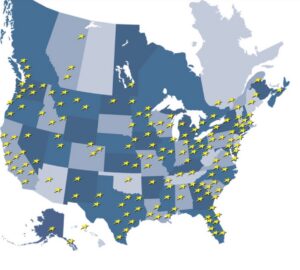
We’re just over 170 shareholders in the Starnet cooperative. That’s 170, plus or minus, because they changed a little bit over the months. We’re currently over 425 service locations now across Canada and the United States. So this trend of branch proliferation is somewhat new, but it’s really starting to accelerate now. Even some of our early members, our traditional members, might have four or five branches. That was very unusual a decade ago, but it’s much more common now. And the members are able to scale their businesses across multiple states, multiple branches, multiple markets,etc.
How does that translate into revenues?
Starnet members generate upwards of $4.3B in annual sales.
What end-use segments are most active for your members today?
In terms of volume, the workplace segment continues to be the leading segment for our members. However, it’s very closely followed up by the combination of K-12 and university work. There was a bigger gap in the past, but that volume has become much closer. Two years ago, education, K-12 and university was a little bit higher than corporate, but of course we were in the middle of the lockdowns and there were a lot of different things happening at that time. As the market starts to look a little bit more like 2019, corporate is taking the lead again—but not by much.
What about data centers? That was seen as the next frontier in commercial.
There’s not a lot of traditional finished floor covering in those facilities, but certain parts of the country, you see it—the research triangle area around Raleigh; Boston; Austin, Texas; parts of California. There’s a concentration of data centers and technology-driven facilities. There’s not a lot of finished flooring in them, but our members have picked up static-control products. It’s a bit of a closed market.
What’s your outlook among members for the remainder of the year?
We think it’ll be comparable to last year. We know there’s going to be cost increases coming through, but our hope is that the cost increases carry the numbers and the members are able to pass those along. The project backlog is steady for some of our members, although some are experiencing some frustration getting contracts released. They have the contract, but they can’t take any action because of delays. Or they don’t have the drawings or there’s myriad challenges. It’s not as clean as it was a few years ago.