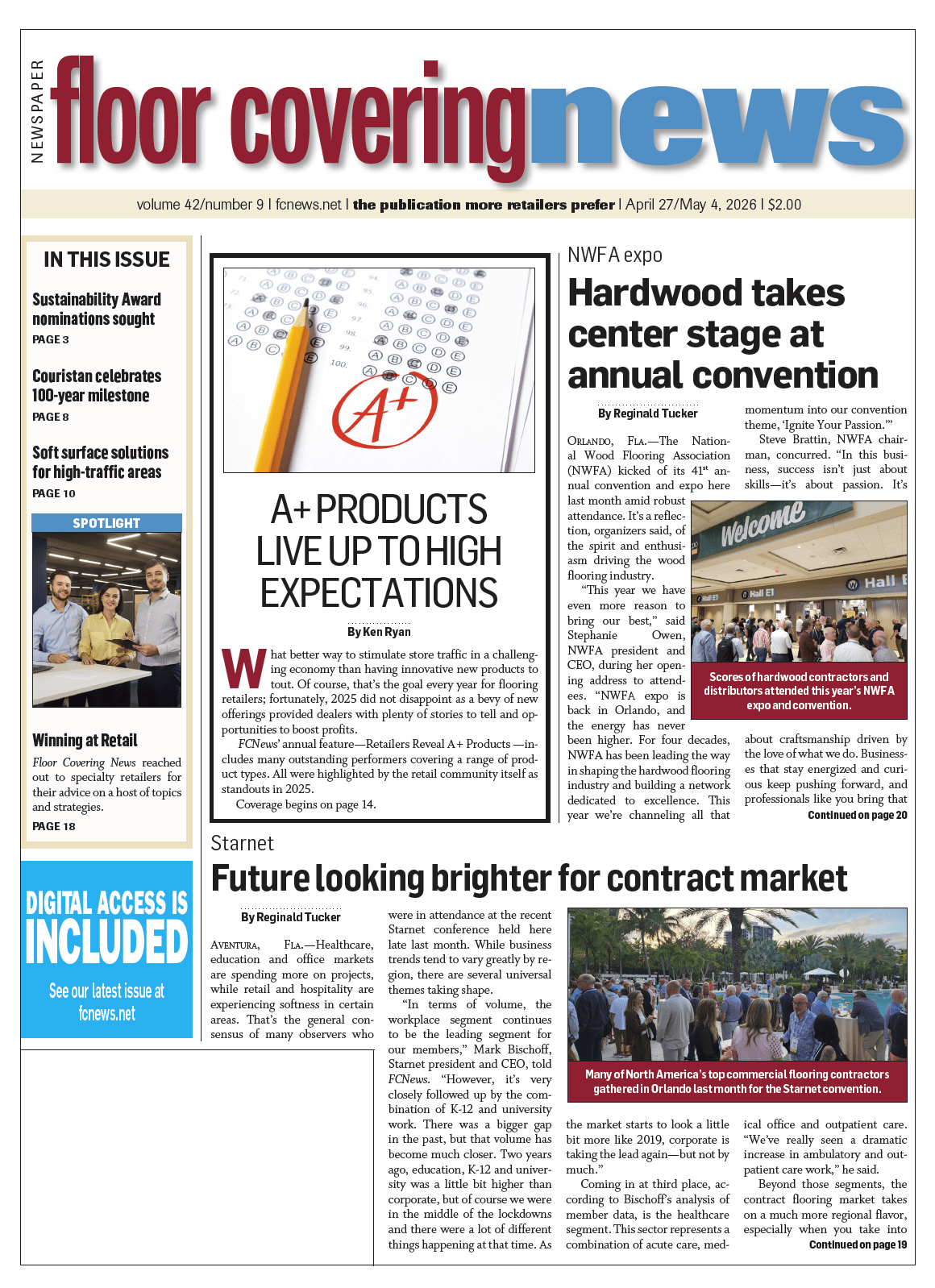
Aventura, Fla.—Healthcare, education and office markets are driving more contract flooring project activity, while retail and hospitality remain softer in some areas. That’s the general consensus of many observers who were in attendance at the recent Starnet conference held here late last month. While business trends tend to vary greatly by region, there are several universal themes taking shape.
“In terms of volume, the workplace segment continues to be the leading segment for our members,” Mark Bischoff, Starnet president and CEO, told FCNews. “However, it’s very closely followed up by the combination of K-12 and university work. There was a bigger gap in the past, but that volume has become much closer. Two years ago, education, K-12 and university was a little bit higher than corporate, but of course we were in the middle of the lockdowns and there were a lot of different things happening at that time. As the market starts to look a little bit more like 2019, corporate is taking the lead again—but not by much.”
Coming in at third place, according to Bischoff’s analysis of member data, is the healthcare segment. This sector represents a combination of acute care, medical office and outpatient care. “We’ve really seen a dramatic increase in ambulatory and outpatient care work,” he said.
Beyond those segments, the contract flooring market takes on a much more regional flavor, especially when you take into account activity at the hospitality and retail sectors. “Here in Florida, for example, hospitality is huge, but if you go to Kansas, it’s not as big a market,” Bischoff explained.
And what about the data center market? That’s the sector commercial flooring contractors were eyeing as the next frontier given not only the massive space requirements AI data centers typically entail, but also the tremendous electricity consumption utilized by those facilities. Again, largely regional and specialized.
“There’s not a lot of traditional finished floor covering in those facilities, but in certain parts of the country, you see it in the headlines,” Bischoff explained. “There’s the research triangle area around Raleigh, N.C.; the Boston market; Austin, Texas; and parts of California. There’s a concentration of data centers and technology-driven facilities. While there’s not a lot of finished flooring in them, some of our members have picked up static-control products for those applications. We’ve certainly made a big push recently on resinous flooring, which ends up being a good application for a lot of those facilities.”
Members take market’s pulse
The activity that Starnet members are seeing is largely in line with Bischoff’s research. Take Huntsville, Ala.-based Commercial Flooring Services, for example. Here, the bellwether sectors are leading the way. “Our 2026 backlog is as diversified as it’s been in several years,” Grant Petruzzelli, president and managing partner, told FCNews. “Education (K-12 and higher ed), healthcare and government/defense are driving the majority of activity in 2026. The largest active bid opportunities seem to be concentrated in education and public-sector environments.”
Where Commercial Flooring Services has been the most effective, according to Petruzzelli, is in segments that demand technical expertise and carry higher installation risk. “Our investment in manufacturer certifications and specialized training, particularly as an Ardex LevelMaster Elite Installer, has allowed us to expand our scope and compete differently,” he explained. “That’s been a meaningful advantage in healthcare and more complex government and defense work, where performance and accountability carry more weight than a low bid.”
At Consolidated Flooring, which in recent years has expanded beyond the New York/New Jersey Tri-State area and into parts of the Southeast and Midwest, contract commercial activity represents a mixed bag.
“Here in the Northeast/New York Metro area, we’ve seen a resurgence, finally, of the corporate market space,” said David Meberg, president and CEO, Consolidated Flooring. “We’ve been down since the COVID-19 pandemic, and last year was the first year that matched commercial office leasing levels from 2019. So, we’re the beneficiary of that now.”
More importantly, Consolidated Flooring reports its backlog is back to normal. “We’re on pace to even have a bigger year than we had in 2019, so we’re really optimistic,” Meberg said. “We’re seeing the same thing in the Midwest. We’re just a little bit more diversified in market segments in the Midwest, just because we’re so highly concentrated in corporate here in New York Metro area.”
Consolidated Flooring also continues to win bids at the major New York area airports, especially the retail shops and lounges located within the terminals. “The airlines have been spending a lot of money building out their lounges, so we’re hitting on those opportunities a lot more than the larger scale terminal opportunities,” Meberg stated.
Consolidated Flooring also expects to see growth in the contract markets its serves in Florida and Texas as well. “Times are good right now,” Meberg said. “Right now we’re climbing up; we’re not sliding down.”
In the Pacific Northwest, the tide is shifting as well. Randy Rubenstein, CEO of Seattle-based Rubenstein’s Contract Carpet, said he has witnessed a move away from corporate tenant improvement—a market that was humming prior to the pandemic.
“The tenant improvement business has essentially dried up in our market, but now we’re seeing more activity in government projects, healthcare, leisure/hospitality, K-12 and even multifamily applications,” he said.
Outlook for remainder of 2026
On the whole, many commercial flooring contractors are banking on continued strength in the sector.
“All things considered, I left Starnet optimistic,” Commercial Flooring Services’ Petruzzelli said. “The fundamentals across our core segments are intact, and the themes from this year’s meeting matched where we’re focused as a business: building trust with customers and partners, embedding technology into our processes, and capturing the efficiencies that come from doing both well.”
Consolidated Flooring’s Meberg is predicting business will stay strong through the rest of year and into the beginning of next year. “We feel very optimistic through the first half of ’27, based on the backlog we’re generating right now,” he said. “After that, my crystal ball gets a little foggier. We’ll see how it goes from there.”
Starnet’s Bischoff feels business in 2026 will be comparable to last year when all is said and done. At the same time, he said challenges persist. “We know there’s going to be cost increases coming through, so our hope is that the cost increases carry the numbers and the members are able to pass those along.”
And while many Starnet members report a steady backlog of business, they report contracts are not moving along as quickly. “Some of our members are having frustration getting contracts released; they have the contract, but they can’t take any action,” Bischoff stated. “The overall decision-making process is much more fragmented and more difficult to get to a contract release. And then on top of that, many of the general contractors are gun shy in moving forward because they would pre-order materials to either manage supply chain or pre-order to beat cost increases because of the inflation, but they were burned on some of these projects. So now they’re going the opposite direction. They’re being very conservative on letting contracts, very conservative on pre-ordering because of that pain they felt when they made a bad call during the go go years of ’22 to ’24.”