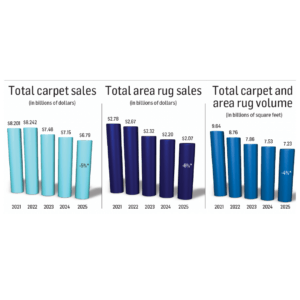
 It was déjà vu for the soft surface industry in 2025 as total sales and volume declined mid-single digits for the second consecutive year—dragged down by a host of factors, most notably a fickle housing market that thwarted any hope of a comeback.
In the end, there were no “the second half will be better” outcries from carpet executives as inflation, mortgage rates above 6% and tepid housing results conspired to keep the category in check.
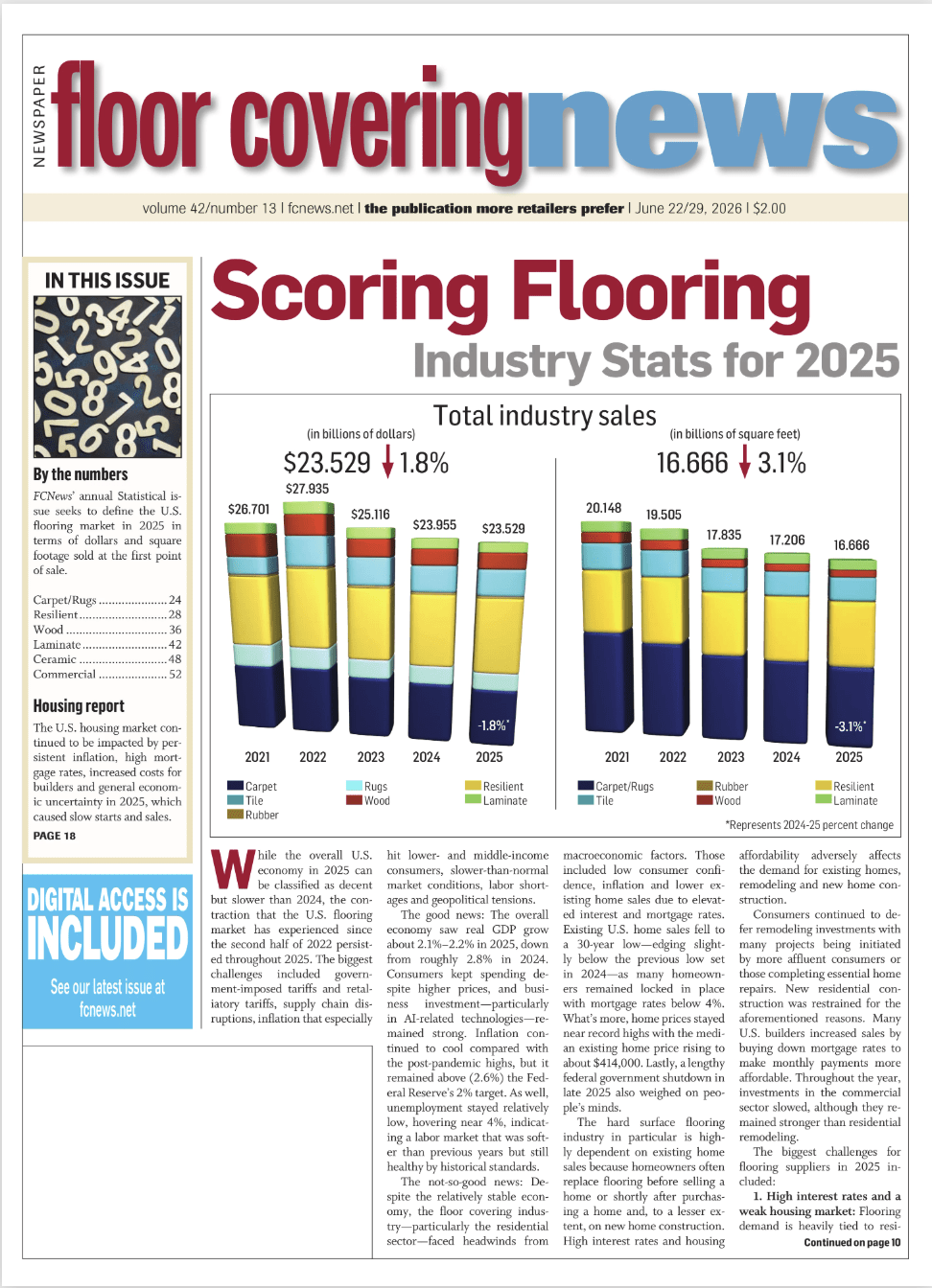
When all the numbers were tabulated, FCNews research showed total carpet sales down 5% to $6.79 billion, area rugs (not fabricated) off 6% to $2.07 billion, while volume (carpet and area rugs combined) declined 4% to 7.23 billion square feet.
Residential carpet sales declined 5.3% and volume was down 5.5%. Commercial carpet sales (including Main Street) fared much better than residential, off 2% while volume was down 3.5%.
Despite another down year soft surface (carpet and rugs) remains the largest flooring category by volume, accounting for 43.4% of the overall 16.666-billion-square-foot flooring market in 2025. However, contrast that to 2015 (soft surface was at 60%) and 2010 (66%), and it’s clear to see soft surface’s erosion is unmistakable. Another reality check: Total carpet sales have now dipped below the $7 billion mark, a stark contrast to 20 years ago when total carpet sales stood at $12.587 billion just before the Great Recession hit. Although the rate of soft surface’s decline vs. hard surfaces has slowed somewhat in recent years, it continues unabated, nevertheless.
Wash, rinse, repeat
 As the housing market goes, so goes the carpet industry; that’s been the mantra for many years, and 2025 was no exception. Sales of previously occupied U.S. homes totaled 4.06 million in 2025, essentially flat vs. 2024 when sales sank to the lowest level since 1995, the National Association of Realtors reported. All told, existing U.S. home sales have declined on an annual basis since 2022.
Mill executives say the lackluster housing data, coupled with higher borrowing costs, has contributed to consumer uncertainty. “Elevated mortgage rates continued to slow existing home sales and new home construction, both of which are important drivers of flooring purchases,” said Joe Semaan, president of residential carpet, Mohawk. “At the same time, inflation and higher everyday living expenses caused many consumers to postpone home improvement projects or scale back discretionary spending.”
Specifically, high interest rates impacted new and existing home sales and also impacted consumer willingness to take out home equity lines of credit for home renovation projects. As T.M. Nuckols, president of the residential division of The Dixie Group, explained, “Existing home sales is what leads to most residential carpet activity, and it remained near the historical low mark of 4 million units for the fourth consecutive year. This is the main driver for residential replacement carpet, which is the largest subsegment.”
The industry also faced ongoing geopolitical uncertainty and broader economic challenges that impacted consumer confidence. Consequently, retailers and manufacturers were competing for fewer active buyers. “While demand remained present, many consumers chose a wait-and-see approach before making larger investments in their homes,” Semaan said.
While imported carpet products did see tariff-related price increases in the 15%+/- range, that segment is a relatively small part of the North American residential carpet industry. Many decorative products, including flatweaves, hand looms and hand tufted, are imported and therefore subject to the increased tariffs. However, the greater issue related to tariffs is their overall impact on consumer confidence; tariffs, executives concurred, impacted the consumer mindset in general, with fears of higher prices on imported consumer goods and uncertainty in the future.
“Domestic manufacturing helped mitigate some exposure, while ongoing productivity improvements and supply chain efficiencies helped offset certain inflationary pressures,” Semaan explained. “Overall, the industry saw modest and selective pricing movement, but increases were generally below the significant inflation-driven increases experienced in prior years.”
A shining bright spot for carpet continues to be at the high end, loosely defined as wholesale $16 and above, which would retail for $23 a square yard, although some executives would label that upper-middle class. A spike was seen in the $40-$50 wholesale price range where premium fibers and colors flourished. “There’s the realization that carpet has been relegated to bedrooms, so people are spending their money on hard surface and are looking at high-end carpet after doing the rest of their home in hard surface; they see the value in carpet and can put their personal stamp on their home décor,” said Jamie Welborn, vice president of carpet for Shaw.
Unfortunately for the industry, not enough higher-end carpet is being sold to get the segment over the hump. Perhaps one reason is that consumers view carpet much differently than they once did. “Twenty years ago, most carpet installations were a whole house project where most of the home floor was being covered by carpet,” TDG’s Nuckols said. “So, the consumer was looking for something safe that would work in every room throughout the home. Today, hard surface is covering most of the home floor, and carpet is being considered on a room-by-room basis. This shift allows for different styles to be considered for different rooms. Instead of a solid color cut pile, the consumer is considering patterns, loops and other differentiated styles.”
Against the backdrop of declining market share vs. hard surface, the residential carpet market has also experienced sustained contraction over the years with names like Lexmark and Beaulieu going by the wayside; 2025 continued that trend when Mannington Mills shuttered the Phenix Flooring brand. Mannington had acquired Phenix in 2020 in what seemed like the perfect pairing between a hard surface-dominant manufacturer and a well-respected soft surface brand. But it was not to be. The departure of Invista and the Stainmaster brand from the carpet fibers business in 2022 sent the residential carpet segment reeling and proved to be a turning point for Mannington’s residential carpet hopes. That development, coupled with the fact residential carpet struggled after the COVID-19 boom period in late 2020/2021, made the Phenix acquisition look less rosy by the day. In late 2025, Mannington finally pulled the plug.
Carpet’s perception problem
 For years now carpet’s reputation as a healthy flooring product has suffered. In fact, if you Google the phrase “does carpet have a reputation problem,” one response read: “Yes, carpet absolutely has a reputation problem. While it remains popular for its comfort, warmth and sound absorption, it suffers from significant public relations and functional struggles. The biggest knock against carpet is sanitation. Because of its three-dimensional fiber structure, it acts like a giant sink that traps dust, pet dander, mold and bacteria. Critics argue it is difficult to truly clean down to the padding.”
That’s a damning portrait. Mill executives are well aware of the perception and acknowledge the industry needs to do a much better job conveying the story that today’s carpet is significantly healthier than products manufactured in the past.
Mohawk’s Semaan said education is critical to turn the tide. “Many consumer perceptions about carpet are based on outdated information and do not reflect the significant advancements in fiber technology, stain resistance, allergen management and ease of maintenance,” he said. “This year, we launched our brand-new Pur-Ease allergen control technology on SmartStrand Color Wall styles. This innovation is an important step forward for carpet because it is designed to help reduce allergen exposure in the carpeted environment and support a cleaner, more comfortable home.
“Today’s carpet products are engineered very differently than products from decades ago. As an industry, we need to continue investing in innovations that support healthier indoor environments while also doing a better job communicating the benefits of modern carpet to consumers, retailers and trade partners.”
Jason Surratt, president of Tarkett Home, said it is important to remember that every flooring surface has some type of maintenance needed to keep the floors looking their best. “The key is helping homeowners choose the right floor for their lifestyle and expectations,” Surratt said. “Critics may point to cleaning as a concern with carpet, but much of that perception is based on how older carpet was manufactured. Today’s residential carpets are often made with advanced stain-resistant fibers that make cleaning carpet much easier than consumers realize. Most spills can be cleaned quickly when addressed promptly and vacuuming is an easy way to keep your carpet looking good. Homeowners may be making flooring decisions based on outdated assumptions about carpet rather than the products that are available today, so the industry’s biggest opportunity is to demonstrate how carpet performs in real-life scenarios.”
Commercial carpet
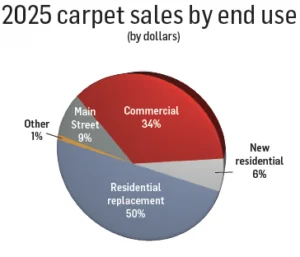 Commercial continued to be a relative bright spot. Total commercial carpet sales (including Main Street) came in at $3.087 billion, with specified at $2.42 billion, down 2%. Meanwhile, volume was off 3.5%. In both dollars and units commercial fared slightly better than residential in what has been a years-long trend.
[Note: For years, a large percentage of mills considered level-loop polypropylene a Main Street product, mostly installed in rental space/tenant improvement and low-end apartments and basements. Today, much of this business has been lost to low-end polyester cut piles. These cut-pile sales are reported as residential, not Main Street. As well, some mills break out Main Street from their specified business, for example, identifying smaller K-8 to K-12 schools as Main Street.]
Certain commercial segments, particularly healthcare, education and hospitality, continue to specify carpet for its acoustic benefits, comfort and aesthetic appeal, often prioritizing durable, high-performance soft surfaces. While overall commercial demand was down, these segments showed resilience.
Specifically, corporate, the largest segment, is starting to regain some ground in renovations and redesigns after lagging for several years. Corporate environments—especially those with open-concept layouts—benefit immensely from carpet’s ability to absorb noise and reduce echoes. There is also the issue of safety and ergonomics as carpet provides a non-slip, forgiving surface that is comfortable for employees who stand for long periods or navigate offices in hard-bottomed shoes.
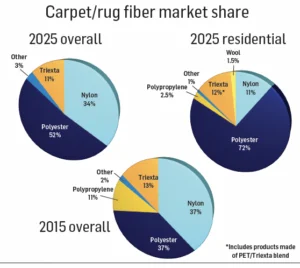
In terms of fiber, nylon remains the gold standard for corporate spaces, accounting for more than 40% of the commercial carpet market due to its exceptional resilience, abrasion resistance and stain resistance.
Outlook
Several subsegments within carpet show promise for the immediate future. The premium and decorative segments remain healthy as consumers seek products that offer style, comfort and personalization. The Dixie Group and Stanton Design are among the mills that have made major commitments to the decorative subsegment in recent years as they look to tap into that opportunity.
Custom rugs and fabricated rug programs, meanwhile, are also on the upswing, giving consumers more flexibility in how they incorporate soft surfaces into their homes. Most flooring retailers sell fabricated rugs today—rather than traditional area rugs—while some also offer serging and binding onsite.
What’s more, ongoing product innovation around performance, sustainability, indoor air quality and design continue to create excitement within the residential segment. “While the market remains challenging, soft surface continues to have a clear and important role in the home where comfort, warmth, sound absorption and design matter most,” Mohawk’s Semaan said.
The catalyst for this is tufting technology, which has transformed the modern carpet industry in several ways: speed and affordability, intricate computerized design and allowing for versatile textures and piles. The result: end users have greater options for expressing their personal design taste in each room of the home. “The bright spot for residential carpet is really driven by the timeless appeal of comfort, style and performance,” Tarkett’s Surratt said. “Consumers investing in their homes seek products that enhance everyday living; as such, we see premium carpet continue to do well.”
The evolution of tufting technology has also ushered in a world in which luxury fibers and vibrant colors are more prevalent than ever. “The one thing we’re seeing is it’s not a beige world anymore,” Shaw’s Welborn said. “In just the patterns and colors, it’s like a piece of artwork in a lot of ways; it’s something designers are starting to figure out—that the color story can brighten up your room and change your mood.”
And that might just change the carpet segment’s trajectory.