If you can’t beat them, emulate them. That’s the approach that many laminate suppliers are taking when it comes to competing with the category that ironically inspires the bulk of laminate visuals today.
Thanks to advances in embossed-in-register technology, digital printing and thicker core constructions, today’s laminates have made strides in simulating not on the appearance but also the surface texture and heft of real wood. Here’s how:
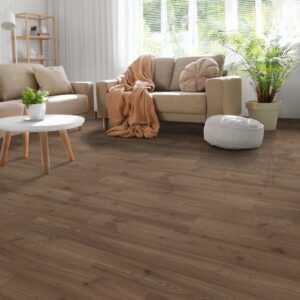
High-resolution imaging
Early generations of laminate suffered from obvious repetition, where the same plank pattern would appear frequently across an installed floor. Today’s products dramatically reduce that issue through expanded “pattern banks,” where dozens or even hundreds of unique plank faces are created within a single collection. Standout examples include Mohawk’s RevWood, Mannington’s Restoration Collection, Hallmark Home Waterproof Laminate, and US Mills, to name a few. Suppliers have also become more adept at replicating custom patterns originally rendered in hardwood. These include popular herringbone patterns offered by suppliers like Inhaus and Classen.
The improvements didn’t stop there. Using advanced color technology, designers can now specify visuals that reflect everything from lightly whitewashed Scandinavian oak to heavily stained, character-rich walnut. These visuals are no longer flat or one-dimensional; instead, they include depth cues that enhance realism under both natural and artificial light.
Embossing elevated
EIR is certainly not new to laminate flooring, but the industry has certainly seen dramatic improvements in this regard. While early laminate floors often featured smooth or uniformly textured surfaces that seldom aligned with the visual grain beneath the wear layer, improvements in printing technology now seeks to deliver a more tactile experience.
Modern manufacturing techniques now allow for the surface texture to be more precisely aligned with the printed wood grain. For instance, if a knot is visible in the design layer, the surface will physically feel like a knot. If a grain line curves across a plank, the embossing follows that exact path. This synchronization significantly enhances realism and is one of the primary reasons laminate can now be mistaken for engineered hardwood at a glance. Some premium laminate lines even replicate the subtle “handscraped” or “wirebrushed” finishes seen in artisan hardwood flooring. These textures add another layer of depth and imperfection, which is essential for achieving a truly natural aesthetic.
Low-gloss still sparkles
Another key factor in laminate’s replication of hardwood is the shift away from high-gloss finishes. Early laminate floors often had a shiny, plastic-like surface that immediately distinguished them from real wood. Today’s products typically feature ultra-matte or low-sheen finishes that better replicate the natural oil or satin finishes found in site-finished hardwood floors.
Early iterations of aluminum-oxide coatings—the material that helps protect laminate flooring against scratches, stains and wear—often provided a cloudy, less-than-desirable appearance. But thanks to advanced aluminum oxide coatings, consumers can still enjoy the durability these coatings provide without compromising overall visual appeal. Furthermore, more manufacturers are incorporating anti-glare technologies that ensure the floor does not reflect excessive light, further enhancing realism in brightly lit environments.
All about the bevels
Laminate suppliers didn’t stop at improved digital printing or surface texturing. Dimensional realism is also achieved through improvements in edge detailing, specifically bevels. Micro-beveled and painted bevels along plank edges help define individual boards, mimicking the slight gaps and shadows that naturally occur between hardwood planks.
According to suppliers, these bevels serve two purposes. Visually, they break up the floor into distinct planks rather than a continuous sheet, reinforcing the impression of real wood boards. And from a functionality standpoint, they help conceal minor installation irregularities and reduce the appearance of wear along edges over time.
Heft sells
Beyond surface visuals, laminate flooring has also advanced in terms of physical construction. Thickness plays a key role in how closely laminate can replicate the feel and performance of hardwood underfoot. Traditional laminate flooring typically ranged from 6mm to 8mm in thickness, which often resulted in a hollow or less substantial feel underfoot. However, many mid-to-high-end laminate products range from 8mm to 12mm, with some premium offerings extending to 14mm or more. (Case in point are products from HF Design and BHW Floors.) This increased thickness contributes to a more solid, stable walking surface that better approximates the density and resilience of engineered hardwood.
Thicker laminate also improves sound absorption, reducing the hollow “click” sound once associated with earlier products. Combined with modern underlayment systems—often made from foam, cork or rubber composites—laminate now delivers a quieter, more cushioned acoustic experience that closely resembles wood installed over a subfloor.
Another factor contributing to the overall heft of laminate floors is the incorporation of more substantial core material. In fact, some of the laminate floors on the market today feature innovative core materials that fall outside of the traditional HDF/MDF realm, wading into rigid core or hybrid materials.
All these advancements not only improve the product’s overall visual design and performance, but they also aim to provide increased profit opportunities for retailers and distributors while helping maintain overall market share in a highly competitive hard surface segment.