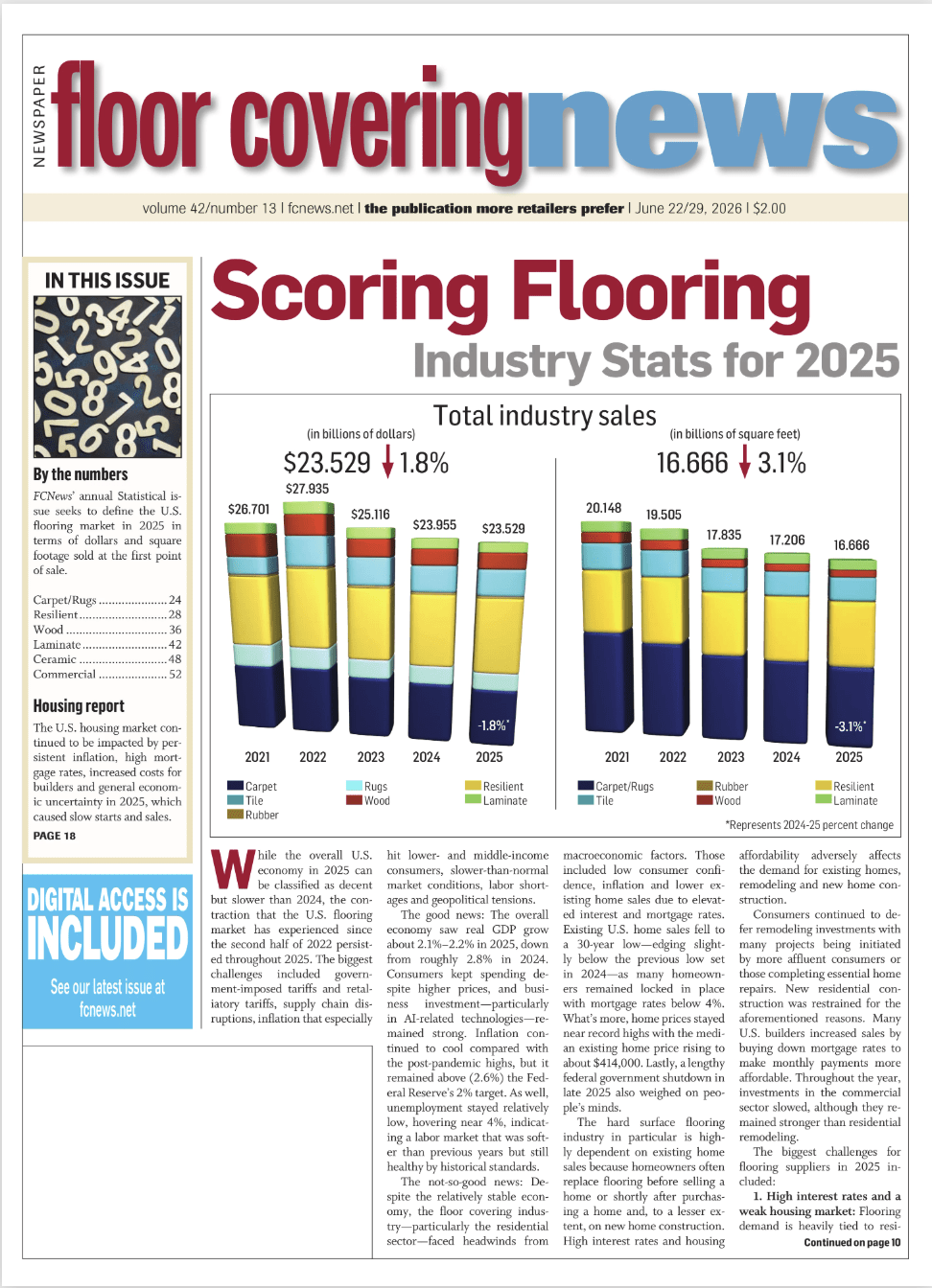
 The primary challenges impacting U.S. housing market activity in 2024—persistent inflation, high mortgage rates, increased costs for builders and general economic uncertainty—spilled over into 2025, putting a slight drag on overall starts for the year.
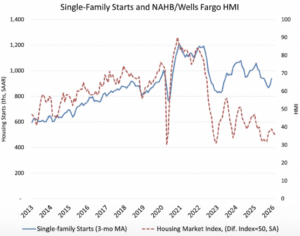
U.S. Census Bureau construction data put total 2025 U.S. housing starts (including single-family and multifamily construction) at 1.36 million units, down 0.6% compared to 2024. But within that number, single-family starts fell by roughly 6.9%.
That’s the bad news.
Here’s the silver lining: While the overall number was down, the falloff wasn’t as pronounced as it was in 2024. That year, housing starts fell nearly 4% from 2023, meaning the industry is slowly heading in the right direction. More good news: multifamily starts—which plummeted by 25% in 2024—reversed course and actually increased by 17.4% in 2025. Historically, speaking, single-family construction has been the primary driver of U.S. housing growth, while multifamily activity tends to fluctuate more dramatically with capital markets and rental demand.
Buddy Hughes, immediate-past chairman of the National Association of Home Builders (NAHB), attributed the decline in single-family construction to affordability pressures in the ownership market amid sustained demand for rental housing.
“Market conditions remain challenging with two-thirds of builders reporting they are offering incentives to move buyers off the fence,” Hughes, a Lexington, N.C.-based home builder, stated at the close of 2025. “Meanwhile, builders are contending with rising material and labor prices as tariffs are having serious repercussions on construction costs.”
While single-family builders continued to face affordability pressures for the bulk of 2025, multifamily developers managed to prosper courtesy of a large pipeline of projects initiated during the post-pandemic housing boom. At the same time, new-home builders aimed to capture market share by offering incentives, mortgage-rate buydowns and product redesigns aimed at affordability.
Looking past new home construction activity and into the existing home sales market, research showed activity remained below long-term historical averages. Anecdotal data showed many homeowners remained reluctant to relinquish mortgages obtained during the low-rate environment of 2020-2022. Regional performance varied significantly, with the Northeast and Midwest posting increases while the South and West experienced declines.
On the whole, housing demand remained fundamentally supported by demographics, household formation, employment growth and a persistent nationwide housing shortage. While inflation eased compared with the peaks experienced earlier in the decade, mortgage rates remained elevated enough to keep monthly housing payments near record levels in many markets around the country.
Following is a deeper dive into some of the key factors that impacted the U.S. housing market in 2025:
Mortgage movement
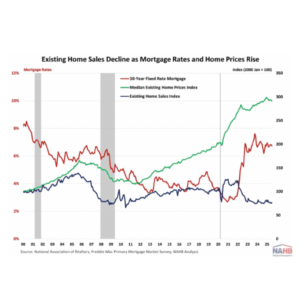
 The housing industry entered 2025 with expectations that lower interest rates would stimulate demand. “Just wait—demand will pick up in the second half,” they said. However, mortgage rates remained higher than many economists anticipated, limiting affordability for first-time buyers and move-up purchasers alike. Rates fluctuated in the mid-to-upper 6% range before settling slightly lower late in the year, heavily influenced by persistent inflation and cautious Federal Reserve policy.
“The rising federal budget deficit continues to put pressure on long-term interest rates, including mortgage rates,” Lawrence Yun, chief economist at the National Association of Realtors (NAR), wrote in a 2025 report.
Builders and real estate professionals spent much of the year adapting to these realities. Rather than relying solely on price appreciation, many builders responded to market conditions by introducing a variety of affordability-focused strategies, including:
- Mortgage-rate buydowns
- Closing-cost assistance
- Smaller floor plans
- Reduced lot sizes
- Expanded townhouse offerings
- Simplified product packages
These approaches enabled many builders to continue generating sales despite affordability constraints.
Builders also reported the inventory picture improved modestly compared with 2024. Realtor.com reported growing levels of housing inventory in many markets, helping ease some of the supply shortages that had characterized the post-pandemic era. However, inventory levels remained below long-term norms in several key metropolitan areas.
Realtor.com economists noted that the market was gradually moving toward a better balance between buyers and sellers as inventory expanded and price growth moderated. The result was a housing market that remained active but subdued. While sales occurred and construction continued, prices generally remained stable.
Danielle Hale, chief economist for Realtor.com, described the housing market in mid-2025 as a study in contrasts. “Buyers are seeing more choices than they’ve had in years, but many sellers—anchored by peak price expectations and upheld by strong equity positions—are deciding to step back if they don’t get their number,” she explained.
Hale noted that rising inventory was one of the defining housing trends of 2025. Active listings exceeded 1 million homes nationally for several months during the year, providing buyers with substantially more choices than were available during the inventory-starved years immediately following the pandemic.
The increase in available inventory helped shift negotiating leverage away from sellers and toward a more balanced market environment, even as affordability challenges continued to constrain overall sales activity, Hale noted. Inventory levels rose nearly 29% year-over-year by mid-2025, reaching the highest post-pandemic levels on record.
“After years of constrained conditions, the housing market is giving buyers something they haven’t had in a long time: options,” she stated in a mid-2025 report.
Housing start swings
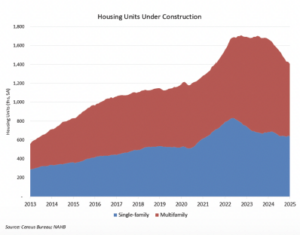
 New residential construction remained one of the most closely watched indicators of housing market health throughout 2025. Data collected through the Cen
sus Bureau’s New Residential Construction program tracked permits, starts, completions and units under construction across the nation. (Note: The Census Bureau defines a housing start as the beginning of construction on a privately owned residential structure.)
Single-family housing—while down less than 1% last year—remained the largest segment of new residential construction in terms of total physical units. NAHB reported that single-family housing starts totaled approximately 943,000 units in 2025 compared to approximately 417,000 multifamily starts. While single-family construction struggled, multifamily housing demonstrated greater resilience. Apartment developers entered 2025 with a large pipeline of projects already underway. Many of these developments were initiated during the surge in apartment demand that followed the pandemic.
It was that pipeline activity, observers note, that contributed to the high-double digit growth seen in the multifamily segment last year. Although some high-density urban markets experienced slower activity, “low-rise” multifamily projects in particular remained active in many regions. According to Jing Fu, senior director of forecasting and analysis, NAHB, multifamily construction performance varied significantly by market type. High-density urban markets generally cooled, while lower-density apartment development remained comparatively healthy.
According to Fu, the multifamily sector benefited from several factors:
- Ongoing affordability challenges for prospective homebuyers
- Strong rental demand
- Population growth in Sun Belt markets
- Continued household formation among younger adults
At the same time, developers faced challenges from higher financing costs and rising insurance expenses. These pressures led many developers to delay new projects, even as existing projects continued toward completion.
While national housing statistics provide an important benchmark, regional performance often reveals the underlying dynamics driving the U.S. housing market. In 2025, significant differences emerged among the Northeast, Midwest, South and West as local economic conditions, affordability levels, migration patterns and land availability influenced construction and sales activity.
Throughout much of 2025, the South remained the nation’s largest single-family construction market, although activity slowed compared with prior years. Builders in Texas, Florida, Georgia, North Carolina and Tennessee continued to account for a substantial share of national production. However, population growth alone was insufficient to offset affordability pressures in some of these markets.
Here’s how things shook out by region:
Northeast
NAHB’s analysis of Census Bureau construction data showed the Northeast was one of the stronger-performing housing regions during 2025 despite continuing affordability challenges and limited land availability. In fact, the Northeast recorded one of the largest increases in total housing starts among the nation’s four major regions. NAHB research showed housing starts in the Northeast increased 8.7% to 178,000 units.
It should come as no surprise that development in the multifamily segment played a significant role in the region’s gains, particularly in metropolitan areas surrounding Boston, New York City, Philadelphia and Washington, D.C. Developers continued to pursue higher-density projects to address chronic housing shortages and rising rental demand.
Overall, builders throughout the Northeast increasingly focused on townhomes, smaller-lot developments and mixed-use communities designed to improve affordability while maximizing land utilization.
Existing-home sales also strengthened. According to NAR, sales activity in the Northeast improved during portions of 2025 while home prices continued to post some of the strongest gains in the nation. Median home prices in the region exceeded $500,000 during several months of the year, reflecting the ongoing imbalance between supply and demand.
“The Northeast—previously held back by limited inventory—is now seeing increased buyer activity,” NAR’s Yun stated in a third-quarter 2025 report. The data, he noted, suggests that improving supply conditions were helping unlock pent-up demand among prospective buyers.
Midwest
The Midwest region emerged as one of the most stable housing locales in 2025. Compared with coastal markets, Midwestern housing remained relatively affordable, allowing the region to avoid some of the severe affordability pressures experienced elsewhere. States such as Ohio, Indiana, Michigan, Wisconsin and Minnesota benefited from lower median home prices and a comparatively balanced supply-and-demand environment.
Housing starts in the Midwest increased modestly during 2025, with both single-family and multifamily development contributing to growth. NAHB research showed housing starts in the Midwest increased 7.2% to 210,600 units. Builders reported that affordability advantages continued to attract first-time buyers who were increasingly priced out of coastal markets. Among the region’s strongest markets were Indianapolis, Columbus, Cincinnati, Minneapolis and portions of suburban Chicago, where population growth and employment expansion supported residential development.
The Midwest also recorded year-over-year gains in existing-home sales during several periods of 2025. NAR data showed sales activity generally outperforming the national average, supported by healthy labor markets and relatively stable mortgage qualification conditions.
Although construction costs remained elevated, Midwestern builders faced fewer land constraints than their counterparts in the Northeast and West, anecdotal research showed. This enabled many markets to continue adding inventory and helped moderate home price appreciation.
South
The South, historically a hotbed (pardon the pun) for new home construction activity, actually slid in 2025. NAHB statistics show new home construction was down 4% last year, culminating in 722,000 units.
Many southern cities continued to attract population growth from other regions. Migration trends established during the pandemic remained influential, although they moderated compared with previous years. Single-family construction remained concentrated in major Sun Belt markets, including Dallas-Fort Worth, Houston, Austin, Atlanta, Charlotte, Nashville, Tampa and Orlando. Builders continued to introduce smaller floor plans and more affordable product offerings to maintain sales momentum.
Meanwhile, multifamily construction remained especially active throughout the South. Large apartment projects continued to be delivered in many metropolitan markets, helping increase rental inventory and moderate rent growth.
NAR data indicated that existing-home sales in the South remained the largest of any region, representing nearly half of all U.S. transactions. However, year-over-year sales growth lagged behind some other regions as affordability challenges intensified.
West
The West region—typically associated with a high cost of living and restrictive regulations—continued to face some of the nation’s most significant housing affordability challenges in 2025. Several states, including California, Washington, Oregon, Colorado, Nevada and Utah, experienced elevated housing costs, limited inventory and ongoing land-use constraints. These factors contributed to weaker housing activity compared with other regions. NAHB data showed housing starts fell 0.8% to just under 300,000 units.
Looking more closely, single-family housing starts declined in many Western markets as builders grappled with high land prices, labor shortages and regulatory requirements. High mortgage interest rates approaching 7% further reduced affordability for prospective buyers.
construction remained relatively active in several large metropolitan areas. Developers sought to address housing shortages through apartment projects and mixed-use developments located near employment centers and public transportation corridors.
Existing-home sales in the West generally underperformed other regions during 2025. NAR reported that sales declined on both a monthly and annual basis in several reporting periods, reflecting continued affordability concerns. Nevertheless, home prices remained among the highest in the country, with median prices frequently exceeding $600,000.
New home sales—a bright spot
 Amid the challenges facing the broader U.S. housing market, the new-home sales market served as one of the brighter spots in 2025. According to data released jointly by the U.S. Census Bureau and the Department of Housing and Urban Development, new-home sales reached an annualized pace of 743,000 units by the start of the first quarter in 2025 and climbed as high as 800,000 units in August before moderating later in the year. By December 2025, new-home sales were running at a seasonally adjusted annual rate of 745,000 units, approximately 4% above December 2024 levels.
Sales of newly constructed single-family homes generally outperformed expectations during much of the year despite elevated mortgage rates, as builders successfully attracted buyers through mortgage-rate buydowns, price incentives and closing-cost assistance. Texas, Florida, Georgia and North Carolina remained among the nation’s leading new-home sales markets. Overall inventory increased, with Census Bureau data showing approximately 472,000 new homes available for sale at the end of 2025, representing a 7.6-month supply. This level of inventory was substantially higher than that typically found in the existing-home market and provided buyers with more options.
Existing home sales activity
While existing home sales trended upward in select markets in 2025, they remained the weakest segment of the aggregate housing market last year. The Northeast recorded year-over-year sales gains and some of the strongest price appreciation, and the Midwest posted relatively stable sales activity and continued affordability advantages. However, the South remained the largest existing-home market but experienced softer growth. Meanwhile, the West continued to struggle with affordability challenges and weaker sales activity.
When all was said and done, existing-home sales totaled approximately 4.06 million units during 2025, matching the lowest annual sales pace in roughly three decades, NAR research showed. So, what gives? Observers said high mortgage rates and limited inventory continued to suppress activity throughout much of the year.
A key challenge remained the so-called “lock-in effect.” Millions of homeowners continued to hold mortgages with rates below 4%, making them reluctant to sell and purchase another home carrying a significantly higher interest rate.
NAR’s Yun repeatedly noted throughout the year that inventory levels were gradually improving and that additional supply would be necessary to support stronger transaction volumes. By year-end, approximately 1.18 million existing homes were available for sale nationwide.
Although sales remained subdued, home prices proved remarkably resilient. The national median existing-home price reached approximately $414,400 during 2025, reflecting continued supply constraints and steady buyer demand.
Mitigating factors
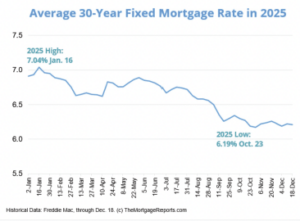 Although housing activity stabilized in several areas during 2025, affordability remained the single most important issue confronting homebuyers, builders and policymakers throughout the year. Even though inflation moderated compared with the peaks experienced earlier in the decade, home prices remained historically elevated in many markets. Combined with mortgage rates that generally hovered between 6% and 7% during much of the year, monthly housing payments remained beyond the reach of many first-time home buyers.
Robert Dietz, NAHB chief economist, frequently emphasized that affordability challenges were constraining housing demand while simultaneously limiting builders’ ability to increase production. “Elevated financing costs reduced purchasing power and contributed to slower single-family construction activity during much of the year,” he stated.
The affordability problem was particularly acute for younger households, NAHB research shows. Many prospective first-time buyers remained renters longer than previous generations, delaying homeownership and contributing to continued strength in the apartment sector.
Throughout 2025, uncertainty regarding interest rates continued to influence housing decisions. Although many economists entered the year expecting significant rate reductions, mortgage rates remained higher than anticipated. This created challenges for both buyers and sellers. For buyers, higher rates reduced affordability. For sellers, elevated rates reinforced the lock-in effect, discouraging homeowners from listing properties financed during the ultra-low-rate period of 2020 through 2022. As a result, both new-home and existing-home markets operated below their long-term potential despite strong underlying demographic demand.
Affordability wasn’t the only issue impacting housing construction activity in 2025. NAHB surveys throughout the year consistently identified labor availability as one of the industry’s most persistent concerns, with builders across the country reporting difficulties finding tradesmen—particularly framers, electricians, plumbers, HVAC technicians and other skilled tradespeople like flooring installers. NAHB estimates that a persistent shortage of approximately 250,000 skilled workers is causing extended project timelines negatively impacting project completions.
The labor shortage, according to the association, is particularly prevalent in high-growth markets throughout the South and West. The shortage also affected multifamily construction, where larger and more complex projects often require specialized trades and extended construction schedules. While wage growth helped attract new workers to the construction industry, labor demand continued to outpace supply.
Land availability remained another significant challenge for builders in 2025. In many metropolitan areas, builders faced rising land prices, restrictive zoning regulations and lengthy permitting processes. These issues were particularly pronounced in the Northeast and West, where geographic constraints and regulatory requirements often limited development opportunities.
Builders and housing advocates increasingly called for local governments to streamline regulations and encourage higher-density development where appropriate.
Constraints on inventory also factored heavily into the housing equation for 2025. While housing inventory generally improved, it remained below historical averages. Realtor.com’s Hale said increasing inventory levels were helping restore balance to the market after several years of extreme shortages, although inventory growth varied significantly by region. Many Sun Belt market experienced meaningful increases in available homes, while inventory remained constrained in portions of the Northeast and Midwest.
On the whole, Realtor.com economists generally characterized 2025 as a year of gradual normalization. Hale observed that inventory conditions improved substantially compared with the severe shortages that characterized the pandemic housing boom. Moreover, increased supply gave buyers more choices and reduced some of the competitive pressures seen in recent years.
Outlook for remainder of 2026
Entering 2026, most housing economists expected the market to improve modestly, though not dramatically. The outlook among many industry analysts, economists and heads of housing associations suggested that lower interest rates, gradually improving affordability and expanding inventory would support increased activity across much of the housing sector.
NAHB, for its part, expects the single-family construction portion of the market to rebound modestly during 2026. Housing starts, NAHB analysts said, should benefit from easing mortgage rates and continued demographic demand from millennials entering prime homebuying years.
“The housing outlook in 2026 is one of cautious optimism as builders contend with rising material and labor prices and policy uncertainty, while builders and buyers alike should benefit from anticipated fiscal and monetary easing that will moderate housing finance costs and mortgage rates,” NAHB’s Dietz said.
To that end, NAHB is anticipating slim single-family construction growth for the remainder of the year. Single-family starts are expected to increase 1% to 940,000 units and move 5% higher in 2027 to 984,000. Meanwhile, townhouse construction gains continue, with market share at a multi-decade high of more than 18%.
Multifamily starts, meanwhile, are anticipated to fall 5% by year end to an annual pace of 392,000 units, and decline an additional 6% in 2027 to 367,000 units. These figures follow a pandemic-era boom, when multifamily production hit 547,000 in 2022 with record-high completions. The market has slowed due to tighter financing and rising construction costs and is moving towards a more constrained development environment.