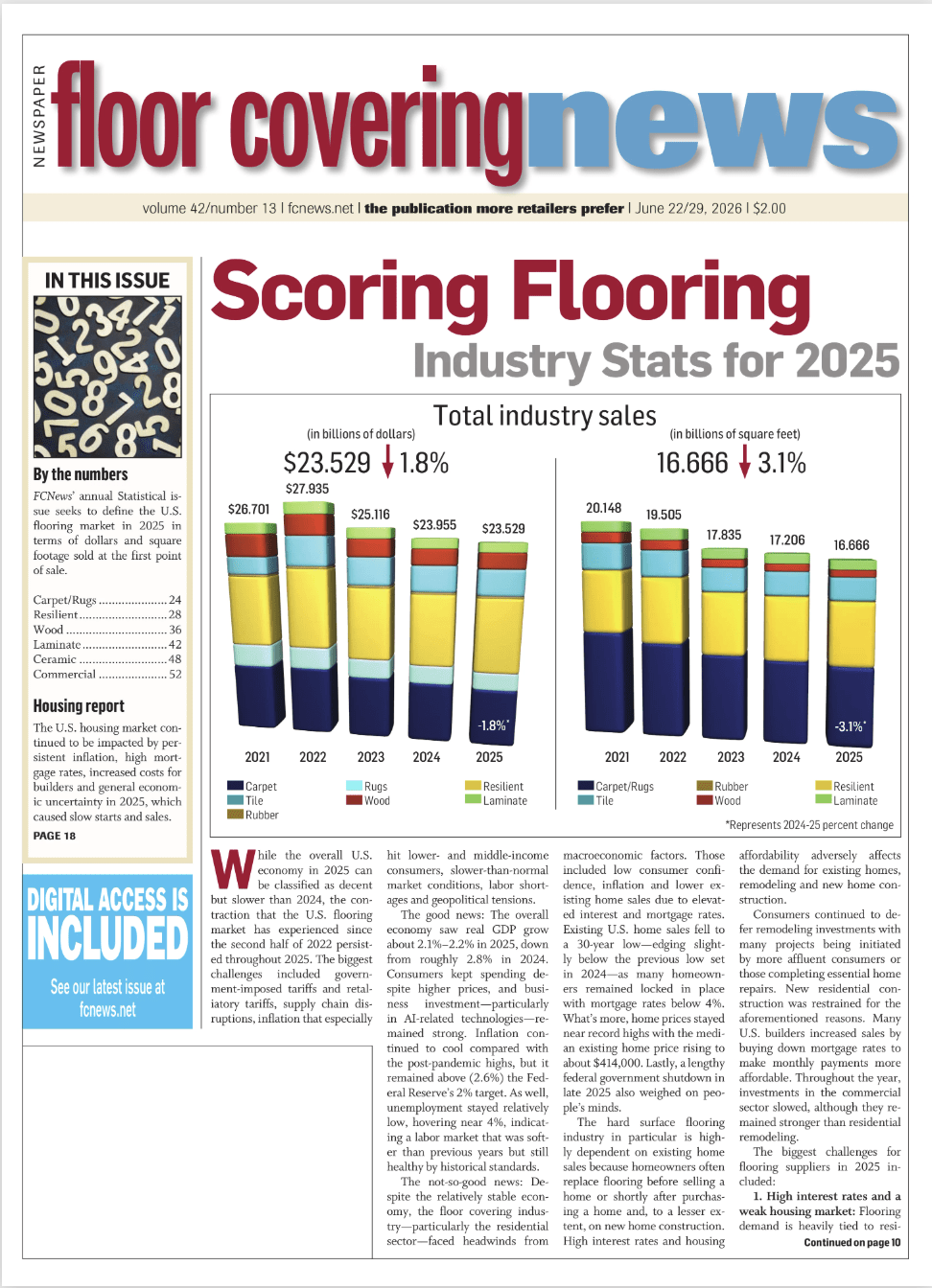
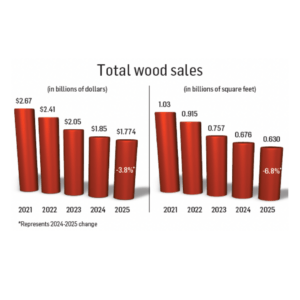
 History continues to repeat itself as the U.S. hardwood flooring segment increasingly cedes more market share to competing hard surfaces, particularly LVP, rigid core and laminate. FCNews research shows hardwood flooring sales at the first point of distribution totaled $1.774 billion last year, a 3.8% decrease from 2024. Meanwhile, volume shipments decreased 6.8% to 630 million square feet. That’s the lowest level since 2012, when wood sales fell to $1.640 billion and 685 million square feet.
To put those numbers in greater perspective, hardwood accounted for just 7.5% of total industry value in 2025 and a mere 3.7% of total industry volume when taking all flooring segments into account. In 2024, hardwood accounted for 8.2% of total industry sales and 4.3% of volume. And five years prior, hardwood represented 9.6% of total industry sales and 4.7% of volume.
Hardwood’s struggle to retain and/or regain market share is also evident when looking at how the category stacked up against competing hard surfaces in 2025. FCNews research shows hardwood accounted for just 12.1% of total hard surface value and just 6.67% of total hard surface volume last year. That’s down slightly from 12.6% in value and 7% in volume in 2024.
Going back even farther, to 2015, hardwood flooring sales at the first point of distribution totaled $2.059 billion with shipments reaching 815 million square feet. That represents a drop of 13.8% in sales and 22.6% plummet in volume over the course of 10 years.
Looking at the glass half full, though, the respective rates of the category’s sales and volume declines were not as steep year over year. In 2024, for instance, hardwood sales fell 9% to approximately $1.845 billion and 10.7% in volume to 676 million square feet. That’s just a little over a third of the percentage rate of the decline in sales compared to 2023. When looking at the category’s performance over the past few years, that percentage decrease continues to trend in the right direction. For example, in 2023 U.S. hardwood flooring sales at the first point of distribution fell 15%, and square footage shipped in 2023 was off more than 17% from 2022.
Regardless of how you stack it, hardwood’s ongoing loss of market share is irrefutable. “Categories such as water-resistant laminate and WPC have been gaining market share at a rapid pace,” said Louie Wang, senior vice president of sales, Johnson Hardwood. “These products resonate strongly with today’s consumers due to their durability, color consistency, on-trend visuals and ease of maintenance. As a result, they are increasingly competing with—and in many cases replacing—traditional hardwood options in a wide range of end-use applications.”
These competitive dynamics, industry experts say, are changing the way hardwood is being positioned in the marketplace. Specifically, it’s altering the mix of product tiers at retail. “Hardwood has lost ground in the ‘good/better’ middle of the market,” said Jamann Stepp, senior vice president, hard surfaces, Stanton Design. “When hardwood pricing jumps, consumers generally trade down. This is especially true in the remodel/multifamily category.”
The result, observers say, is hardwood being pushed into a narrower premium niche category—“where the average price point at retail is much higher than LVT/rigid core, and the average square footage per order is also substantially higher,” Stepp added.
Johnson Hardwood cited sales data showing what Wang called “a bifurcation” in performance: higher-end engineered products (featuring thicker wear layers, 5/8– to ¾-inch profiles and premium grades) continue to perform well, as do entry-level options such as 3/8-inch products. “However, mid-tier products have experienced a noticeable decline in volume, suggesting that constrained spending power is influencing purchasing decisions,” he explained.
But some say slower hardwood flooring sales activity at the opening price point might not necessarily be a bad thing for the hardwood category. As Wade Bondrowski, director of sales, U.S. at Mercier, explained: “The popularity of less expensive wood look-alikes has reduced demand for entry-level wood flooring, and that has benefitted companies like ours that focus on the upper-mid to high end of the market.”
The key to recouping lost market share, wood proponents say, lies not so much in playing the pricing game but rather emphasizing wood’s unique attributes. “The challenge is not just demand, but ensuring the long-term value of real wood remains clearly understood in a more price-sensitive environment,” said Jerome Goulet, vice president of marketing, Mirage.
Industry executives by and large agreed. Yvette Shroyer, director of marketing, Urbanfloor—another supplier that’s focused on the upper end of the market—also attested to the competitive margin pressures created by the increased consumption of today’s popular resilient flooring options.
“As lower-cost hard surface alternatives like SPC and laminate continue to improve in both performance and aesthetics, they are capturing share at the more price-sensitive end of the market,” she explained.
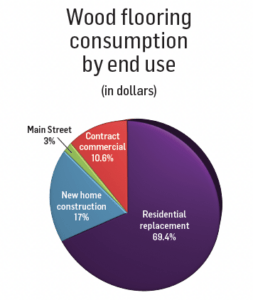
 These changing dynamics are reflected in the shifts seen in terms of wood flooring consumption last year. FCNews research shows the residential replacement sector accounted for 69.4% of wood flooring sales in 2025, up slightly from 66.4% the year prior. Meanwhile, wood consumption in the new home construction sector continues to drop, dipping to 17%.
Commercial wood consumption barely budged, falling only slightly to roughly 10.6% of sales. This is based largely on the strength of specified products going into restaurant, hospitality and higher education projects like university libraries, with slightly less usage in corporate office applications.
In terms of product type, prefinished wood flooring held on to its dominant share in 2025. FCNews research showed the prefinished portion of the domestic wood flooring market accounted for roughly 82% of sales last year, with unfinished accounting for roughly 18%. In that same vein, engineered wood saw its share of the total wood flooring pie grow from about 75% in 2024 to 77% last year. And with respect to species, white oak (much of it European) and domestic red oak accounted for the lion’s share of species sold last year.
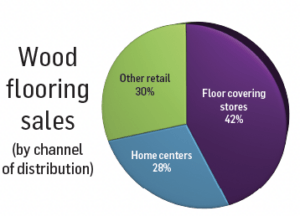
Regarding wood flooring sales by channel, specialty floor covering stores represented about 42% of overall wood sales, up only slightly from 2024’s 41%, while home centers’ share fell slightly from 32% in 2024 to about 28% last year. Both Home Depot and Lowe’s reported lower overall flooring sales in 2025, with anecdotal data showing more big-box customers gravitating toward products like waterproof resilient and entry-level laminate. But it’s the pro-contractor shoppers that tend to purchase the bulk of hardwood products at the big boxes, particularly unfinished wood flooring.
Large-format retailers like Floor & Decor, which says it does not compete with the nation’s major home center chains, actually reported an increase in its hardwood flooring sales. Statistics show Floor & Decor grew its hardwood flooring sales by 19.2%, although it continues to open new stores at a faster clip than the boxes, thereby skewing the overall numbers a bit.
Tariff impacts
 It’s not just changing channel dynamics and increased pressure from competing hardwood flooring segments that are impacting the hardwood flooring segment. High on the list of concerns is the impact that tariffs are having on the U.S. hardwood flooring market. Increasingly, suppliers have to become more strategically (and fiscally) minded when sourcing product.
“Importers are now required to manage cash flow more conservatively, which directly impacts purchasing and inventory strategies,” Johnson Hardwood’s Wang said. “High-cost engineered wood products, in particular, must be forecast with greater precision. This has, in some cases, led to tighter inventory positions and potential shortages.”
Indeed, some companies are making progress in solving that puzzle. Take Mohawk, for example. Although the company sources its wood program, it was able to adjust quickly in a tariff-driven environment.
“We didn’t have to do a lot of moving product from point A to point B or a different country, and that’s been helpful for us,” said David Moore, vice president, product management, Mohawk. “But we have seen the impact of tariffs. We planned that through and we certainly absorbed as much of it as we could and tried to offset it as best we could, but we did have to pass some of that on to the retailer. It’s not something that anyone wants to do, but it’s just a situation of there not being enough margin in the supply chain to absorb incremental increases of 20%.”
Shaw, which also sources some of its wood flooring products, is taking a strategic view. “We are a firm believer that a balanced approach in sourcing and manufacturing hard surface is important,” said Benjamin Liebert, president, residential, Shaw. “We do source a number of products with select partners abroad, which gives us a ton of flexibility in what I call the ‘make vs. buy.’ You can make it or you can buy it, but ultimately our goal is to own the innovation, to have the IP and work with our partners and to do that.”
At the same time, Shaw is also making investments domestically. “We have a hardwood facility in the Northwest Georgia area that continues to play a huge role in our hardwood with investment and product launches,” Liebert added.
For some companies, including AHF Products, tariffs don’t present much of a challenge. But then again, few domestic hardwood flooring suppliers can tout the stateside manufacturing footprint that AHF has—even though the company does import some engineered products. “Domestic manufacturing delivers real advantages for our customers,” said Milton Goodwin, senior vice president. “It means shorter lead times, better service consistency and the ability to support projects without disruption.”
Competition for raw materials
Tariffs aren’t the only issue vexing suppliers. The battle for premium hardwood species—particularly white oak, red oak and hard maple—remains a significant factor for suppliers, as they influence overall lumber pricing. Demand from multiple industries has created a highly competitive marketplace for raw materials, placing upward pressure on log and lumber costs and challenging manufacturers across the hardwood supply chain.
White oak has experienced the most pronounced pricing pressure, executives say. Flooring manufacturers, cabinet producers, furniture companies, architectural millwork firms and barrel manufacturers have all competed aggressively for available supplies. The bourbon and whiskey industries, in particular, have become a major driver of white oak demand because U.S. law requires bourbon to be aged in new charred oak barrels.
 Industry analysts note that cooperages continue to consume large quantities of stave-quality white oak, often paying premiums for logs suitable for barrel production. At the same time, flooring manufacturers have increased their utilization of white oak as consumer preferences have shifted away from traditional red oak toward lighter, contemporary wood visuals. These overlapping demand streams have kept white oak among the highest-valued domestic hardwood species.
Hard maple has also faced sustained pricing pressure due to demand from flooring, cabinetry, furniture, sporting goods and industrial applications. Its hardness, durability and clean appearance have made it a preferred species for both residential and commercial products. Similarly, red oak remains widely used throughout the furniture and flooring sectors, although pricing increases have generally been less dramatic than those seen in white oak.
Supply-side constraints have amplified these demand pressures. White oak trees require decades to mature, limiting the industry’s ability to rapidly increase supply when demand rises. Concerns about long-term white oak availability have become significant enough that lawmakers and forestry organizations have proposed initiatives aimed at improving regeneration and long-term forest sustainability. “The forest is only going to give you 30% white oak; the other 70% is red oak,” AHF Products’
Goodwin explained. “Those trees get used in primarily three different segments; the high grade goes into furniture and cabinets and case goods, and those markets aren’t using as much white oak anymore. So, less is being harvested because the mills can’t sell that premium wood at a high price like they used to. Flooring’s there in the middle tier, with railroad in the lower tier.”
That leaves the bourbon barrel and the whiskey barrel manufacturers, who are taking more than their share. “And they can pay more for it than we can sell it for, and so that’s driven us and others to look for alternate solutions,” Goodwin noted.
Suppliers, regardless of their home base of operation, attest to how the hardwood lumber market is being influenced by demand from unrelated product segments. “This diversified demand is putting additional pressure on the lumber supply, thereby impacting pricing not just for the hardwood flooring sector but across multiple industries that rely on these raw materials,” said David Lauzon Jr., president, Lauzon Hardwood Flooring. “The compounded effect of increased global demand across various sectors, and the slowed production capabilities may lead to significant price volatility and supply constraints in the near future.”
As a result, hardwood manufacturers are facing higher raw material costs, especially in recent years. Flooring producers, furniture manufacturers, cabinet makers and millwork companies have either absorbed these increases, implemented price hikes or adjusted product offerings to maintain profitability. In many cases, manufacturers have sought alternative species or lower-grade lumber to offset rising costs.
Although some hardwood markets have shown signs of stabilization, white oak continues to command a premium due to competition from other segments. Industry observers expect high-quality white oak lumber to remain relatively expensive compared to historical norms, reflecting the ongoing imbalance between strong demand and limited long-term supply.
In lock-step with housing
In spite of the numerous challenges facing the U.S. hardwood flooring market, executives remain largely optimistic—if cautiously. “Interest rates and slower housing activity continue to weigh on demand, particularly in new construction,” Mirage’s Goulet said. “At the same time, global conflicts and trade tensions are creating volatility in energy, transportation and raw material costs.”
Still, Goulet remains confident in the medium- to long-term outlook. “While the market is currently impacted by economic uncertainty, these are cyclical factors,” he explained. “As conditions stabilize and housing demand recovers, we expect the category to regain momentum.”
No doubt all eyes will be on the bellwether housing market. That’s the key segment that virtually all executives agree will have the greatest impact on business. “We recognize that external market forces will play a pivotal role in shaping business outcomes this year,” said Danielle Lancianese, director of hardwood & laminate, Shaw. “The performance of the housing market is the most significant factor impacting the industry.”
AHF Product’s Goodwin agreed. “If lower interest rates convince more builders to start building houses, that’s going to help our engineered wood business,” he said.
At the end of the day, industry observers say it all boils down to affordability. Statistics provided by the National Association of Home Builders (NAHB) shows shelter costs are running at a 3.6% annual rate and continue to outpace broader consumer prices. “With a nationwide shortage of roughly 1.2 million housing units, the best way to ease the housing affordability crisis is for policymakers to remove barriers that are hindering builders from building more homes and apartments,” said Robert Dietz, NAHB chief economist.
At the same time, builders are facing persistent labor shortages themselves, with the U.S. government reporting nearly 300,000 job openings in the construction industry. NAHB estimates that the residential construction sector will need to add roughly 740,000 workers a year just to keep pace with the industry’s growth, retirements and departures.
Then there are those perennial cost concerns. NAHB research shows residential building material prices continue to experience elevated growth despite continued weakness in the new residential construction market.
One silver lining, according to Dietz, is along the interest rate front, where the rate for 30-year fixed mortgages dropped 13 basis points earlier this year to 6.2% following the announcement of $200 billion in mortgage-backed securities buybacks by Fannie Mae and Freddie Mac. NAHB expects mortgage rates to remain slightly above 6% for the balance of the year. “A sustained sub-6% mortgage rate will likely wait until 2027,” Dietz projected.
One area of the housing sector that continues to thrive, according to NAHB, is the remodeling sector, with the home improvement spending share for residential construction rising from 33% in 2007 to 45% in the third quarter of 2025. Residential remodeling activity is expected to increase 3% by the close of 2026 and an additional 2% next year.
“The surge in home equity has allowed more homeowners to finance remodeling projects that meet their needs, which include growth for aging-in-place remodeling projects,” Dietz stated. “NAHB expects robust long-term remodeling growth and projects overall remodeling expenditures will be 19% higher in 2030 and 32% higher by 2035.”
That’s longer term. In the meantime, builders are expected to continue emphasizing affordability-oriented product designs, including: smaller floor plans, townhomes, attached housing, build-to-rent communities and entry-level housing products. In particular, the South is expected to remain the primary growth engine for single-family construction, while selected Midwest markets may also outperform due to favorable affordability conditions.
Conversely, the multifamily sector is expected to experience more moderate growth over the course of 2026. After several years of elevated apartment development, many markets are working through substantial new supply. As a result, economists anticipate slower multifamily starts compared with the levels recorded during the post-pandemic boom. Apartment occupancy rates are expected to remain relatively stable, particularly in major Sun Belt metropolitan areas.
 One telltale sign of future construction activity is building permits. If filings are any indication, observers will be closely watching activity throughout the year. NAHB reported that total residential permits issued during 2025 totaled approximately 1.43 million units, a 3.6% decline from 2024. Statistics show single-family permits fell approximately 7.4%, suggesting builders remained cautious regarding future demand. Anecdotal data suggests builders expect challenging conditions to continue for the balance of 2026, especially if costs are not reigned in.
During testimony in a January 2026 hearing before the Committee on Oversight and Government Reform (“Housing Affordability: Saving the American Dream”), NAHB principals offered their thoughts and expertise. The best way to ease the nation’s housing affordability crisis, NAHB members said, is for policymakers to eliminate excessive regulations that are preventing builders from increasing the housing supply.
Testifying at a congressional panel hearing focusing on housing affordability, Buddy Hughes (NAHB’s immediate-past chairman) said that in order to ease housing constraints for home buyers and renters, it is imperative to eliminate excessive regulations that hinder the construction of new homes and apartments.
“Regulations account for nearly 25% of the cost of a single-family home and more than 40% of the cost of a typical apartment development,” he told lawmakers during the hearings. “The time and costs associated with complying with a multitude of government regulations can be significant for small- and medium-sized builders and ultimately limit housing supply.”
Increased regulations, including overly stringent mandatory energy code requirements, are impeding the ability of builders to boost housing production. In particular, Hughes cited an April 2024 final determination by the Department of Housing and Urban Development (HUD) and the U.S. Department of Agriculture (USDA) that required new single-family and multifamily homes financed by these agencies to comply with the 2021 International Energy Conservation Code (IECC) or ASHRAE 90.1-2019, respectively. The Trump Administration has delayed the effective date for both single-family and multifamily housing until further notice.
“NAHB urges Congress and the administration to prohibit HUD and USDA from enforcing a minimum energy standard that increases housing costs during a nationwide affordability crisis,” Hughes implored. “We also urge policymakers to respect state and local authority over code adoption and to reject mandates that most states have not determined are appropriate for their communities.”
For multifamily projects with federal assistance, a key challenge for builders and developers is the requirement to source domestically for construction. “While our members try to use products made within the U.S., it’s not always practical because of price or availability,” Hughes explained. “Multifamily housing needs an exemption from this requirement to help avoid construction delays and additional costs.”
Most analysts expect sales of new homes to remain one of the strongest segments of the housing market. By and large, builders are expected to continue to benefit from their ability to offer financing incentives and rate buydowns unavailable to most existing home sellers. Surveys show many economists anticipate new home sales could exceed 800,000 units on an annualized basis over the course of 2026 if mortgage rates decline as many hope.
Favorable conditions for new construction activity is only part of the solution. Industry observers agree that there needs to be much more improvement as it relates to existing home sales. With higher existing home sale activity—the logic goes—the greater the likelihood that new homeowners will replace the flooring that came with the house.
Again, it all hinges on lowering mortgage rates. A gradual reduction here, experts say, could encourage more homeowners to list properties, easing the so-called “lock-in effect” that constrained inventory throughout 2024 and 2025. Economists generally expect existing home sales to rise above 4 million units and potentially approach 4.5 million units if financing conditions improve.
While these levels would remain below historical averages, they would represent meaningful progress toward a more balanced market. Economists projected that further inventory gains and modest mortgage-rate relief could support improved market conditions in 2026.
“We expect higher inventory, modest improvements in affordability and more accommodating monetary policy from the Federal Reserve will help more Americans buy their next home,” said Lawrence Yun, chief economist with the National Association of Realtors. “We project an 8.9% increase in active listings in 2026, marking a third consecutive year of gains.”