The ongoing love affair with laminate flooring continues, particularly among retailers and distributors seeking alternatives to lower-quality SPC and entry-level to mid-range hardwood. However, the passion seems to be cooling a little.
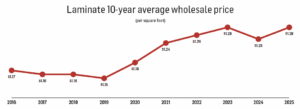
FCNews research shows U.S. laminate flooring sales at the first point of distribution in 2025 totaled $1.11 billion, down 3.2% over the prior year. With respect to volume, shipments fell 5.6% to 871 million square feet. That put laminate at 4.7% of total industry sales (and 5.2% of total volume) in 2025. The category hasn’t seen numbers that low since 2018, where sales at the first point of distribution reached $1.103 billion.
Going back even further to 2015, laminate flooring generated $1.137 billion in sales and 1.034 billion square feet. Compared to 2025, that represents a decrease of only 2.3% in sales but a drop-off of nearly 16% in terms of volume.
Laminate flooring’s lackluster performance in 2025 is also evident when compared to competing hard surface categories. Last year laminate accounted for roughly 7.5% of total hard surface dollars (down from 7.9% in 2024) and 9.23% in hard surface volume (down slightly from 9.5% of total hard surface volume in 2024).
However, just as we’ve witnessed in the hardwood flooring category, the rate of sales decline is slowing. In 2024, for instance, laminate flooring sales fell 7.5% over 2023. This after falling 9.8% from 2022.
The same cannot be said for volume, unfortunately. In 2024, square footage at the first point of sale declined 4.8% to approximately 923 million square feet. Last year, laminate square footage was off 5.6%. The higher percentage in volume decrease, analysts say, is a reflection of a significant drop-off in imports from Europe, a bastion for laminate flooring production. This coupled with an ongoing decline in laminate flooring shipments out of China.
Still, the momentum that the U.S. laminate flooring category has generated since its well-documented resurgence began anew several years ago cannot be overlooked. Industry observers cite a variety of factors driving that renewed interest: more visually appealing products offering improved realism, enhanced water resistance and stronger durability characteristics. As a result, laminate flooring has regained relevance among specialty retailers, distributors and consumers seeking performance-oriented hard surface products at competitive price points.
At the same time, the U.S. laminate flooring category faces mounting challenges. Tariff uncertainty, aggressive pricing strategies from big box retailers, inflationary pressures and relentless competition from other hard surface categories—particularly luxury vinyl plank (LVP) and SPC flooring—continue to shape the marketplace.
“Laminate flooring continues to represent a terrific value to the consumer; however, the LVT category seems to be evolving at a much quicker pace in terms of style and design,” said Jeff Striegel, president, Elias Wilf, a top 20 distributor. “The new innovations in edge profiles, surface textures and tile visuals within LVT are eclipsing laminate at a surprising rate. This is especially notable within the tile visuals.”
Over the past decade in particular, laminate flooring lost momentum as waterproof vinyl products surged in popularity. Consumers gravitated toward rigid core and SPC flooring because of their waterproof attributes and relative ease of installation. Retailers followed suit, allocating more showroom space to vinyl offerings.
“In recent years LVT has grown at an incredible rate vs. laminate as a result of select product features/benefits like water resistance,” Striegel added. “While laminate has closed the gap on the waterproof aspect and some of the performance attributes, LVT growth continues to outpace laminate as a result of the improvement in the authenticity in LVT visuals, plank/tile size options and installation options, including the ability to grout dry-back LVT.”
Channel activity
 In 2025, the industry continued to see slight shifts in how laminate flooring is sold in the U.S. market. FCNews research shows the specialty retail segment grew its share of laminate flooring sales from 30% in 2024 to roughly 32% last year. It’s a clear sign, observers say, of how dealers embraced the category and are moving away from low-priced, entry-level SPC imports.
Home centers, historically laminate flooring’s domain, saw their market share fall slightly in 2025. FCNews research shows the laminate market share attributed to Home Depot and Lowe’s fell to 24% and 13%, respectively, down from 27% and 16%, respectively, from 2024. This is on par with financial reports released by the big boxes, showing single-digit declines in both their flooring department sales—with Home Depot total flooring sales off by 5.29% and Lowe’s down slightly by 0.58%.
Conversely, share of sales in the “other” category of laminate flooring—which includes IKEA, Floor & Decor, Lumber Liquidators, etc.—grew from 18% in 2024 to approximately 22% last year. Floor & Decor financials show the retailer grew its laminate and vinyl revenues 4.5% to $1.154 billion.
Anecdotal research also shows laminate flooring sales at some of the nation’s largest warehouse clubs maintained their pace, accounting for approximately 5% of laminate sales in 2025.
Industry observers attribute the lopsided activity to a much better mix of product at the specialty retailer level. At the very least, specialty retailers are increasingly promoting good/ better/best strategies to more effectively compete with big boxes without negating higher-margin opportunities.
This multi-tier approach, experts say, not only goes a long way in organizing a seemingly endless product assortment at retail, but it also helps guide customers through a clear decision-making journey, provides trade-up opportunities and gives specialty dealers ammunition to battle the boxes—all while still reinforcing the value proposition of laminate as a category.
Make no mistake, though: A successful good/better/best strategy is not solely about price—it’s about clearly aligning features and benefits with real-world use cases. For sales associates, it also creates a natural roadmap. Rather than jumping randomly between products, they can guide shoppers through a logical progression. That might mean starting with the most expensive offering and working down based on the consumer’s budget (the method many professional RSAs prefer). Another option entails taking the “stair-step” approach by referencing the opening price point (very effective if the consumer has already shopped the big box stores) and explaining why each successive tier costs more money.
This structure, experts say, gives customers a starting point. Instead of asking, “What should I buy?” they begin to think in terms of, “Which level fits my needs and budget?” When customers can clearly see the incremental benefits between tiers, they are more willing to stretch their budget. The conversation then shifts from, “What’s the cheapest option?” to “What do I get for a little more?”
That shift is critical, and it reframes the conversation from confusion to greater clarity. “The idea behind our strategy is to try to be as simple as we possibly can,” said David Moore, vice president, product management, Mohawk, which markets the RevWood, Pergo, Karastan and Quick-Step brands to targeted audiences. “The idea is that once the RSA qualifies the consumer and understands what they’re looking for from a performance perspective as well as from a budget perspective, then they know very quickly what section of the portfolio to walk that consumer through.”
The simpler the selection/ specification process for RSAs, the logic goes, the easier it is for them to sell and close the customer. At present, Mohawk offers RevWood in four tiers, but plans are under way to narrow that selection down to three: Essentials, Select and Plus. Within the Pergo lineup, there are three tiers: Originals, Preferred and Ultra. Ditto for Quick-Step—the brand that goes through distribution. This line comprises Select, Plus and Premier. Karastan, which has its own distinct sales force, resides at the top end of the spectrum.
More importantly, according to Moore, the entire offering is structured in such a way as to not have one brand cannibalize the others.
“The idea is that we design the lines to be complementary,” he explained. “We typically don’t cross over same spec for same spec.”
End-use consumption
 Given the way consumers shop for laminate, it should come as no surprise that the residential replacement sector continued to account for the bulk of laminate flooring sales last year. FCNews research shows the segment grew its share slightly to 82.6% of sales.
Several factors continue to drive residential replacement’s dominance. First, laminate offers homeowners a cost-effective alternative to hardwood while delivering increasingly realistic wood visuals through advanced digital printing and embossed-in-register technologies. Second, modern click-lock installation systems make laminate particularly attractive for DIY projects and fast-turnaround renovations. Third, laminate’s scratch resistance appeals to households with children and pets, making it a practical replacement flooring option.
By comparison, the new residential construction market grew from roughly 12.7% of the market in 2024 to 15.4% last year, as builders shopped for lower-priced products.
Meanwhile, fewer laminate floors are being specified for high-traffic commercial applications as evidenced by the falloff in share from 1.3% of commercial sales in 2024 to less than half a percent in 2025. Commercial environments present different performance requirements. Offices, retail stores, healthcare facilities and educational buildings often prioritize long-term durability, moisture resistance, ease of maintenance and compliance with stringent specification standards. As a result, commercial specifiers frequently select LVT, sheet vinyl, rubber flooring, ceramic tile or carpet tile, products that generally offer superior moisture performance and proven life-cycle costs in high-traffic environments.
Note: FCNews’ laminate commercial estimates do not include Main Street applications— which are not typically specified by architects, designers or facility managers. Anecdotal research put the Main Street market at about 1.5% of total laminate flooring end use last year.
Declining imports
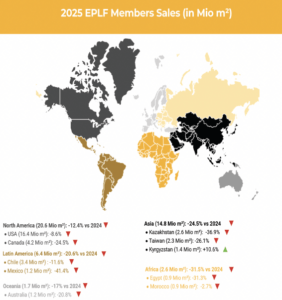
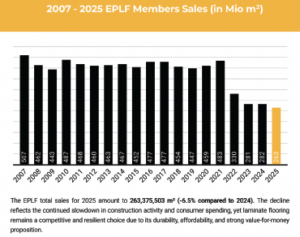
One of the more notable shifts with respect to U.S. laminate flooring sales in 2025 was a sizeable reduction in the amount of product shipped to American shores from Europe. Statistics provided by the European Producers of Laminate Flooring (EPLF) showed shipments to North America were off by 12.4% last year, with volume down 8.6% to the U.S. specifically. That’s a reduction of more than 176.6 million square feet.
It also represents a dramatic turnaround from 2024, when EPLF shipments to customers in North America increased nearly 9%. Looking at the U.S. in particular, EPLF shipments to America were up 7.3% in 2024. In fact, EPLF’s global shipments were up nearly across the board in 2024, with only several exceptions.
Still, European countries remain the largest exporters of laminate flooring to American shores. FCNews research shows Germany accounted for 40% of laminate imports last year. Meanwhile, research shows fewer and fewer laminate flooring imports from China. In 2024, laminate imports from China accounted for roughly 19%, down from 26% in 2023 and way down from roughly 70% in 2017. Last year, that share fell to approximately 15%. At the same time, industry observers have been tracking increased laminate flooring shipments from Southeast Asian countries, especially Vietnam, Cambodia and Indonesia.
One of the biggest factors impacting lower laminate import activity, experts say, has been U.S. trade policy. Since 2018, tariffs imposed on a broad range of Chinese-made products have increased the landed cost of imported laminate flooring. Additional anti-dumping and countervailing duty investigations involving wood-based products have further complicated sourcing decisions for importers, industry observers note. As a result, many distributors and retailers have shifted toward domestic suppliers or manufacturers located in some of the aforementioned Southeast Asian countries and other lower-tariff regions.
At the same time, North American laminate manufacturing capacity has grown as a result of the pivot. Major producers have invested heavily in U.S.- based manufacturing facilities, allowing them to shorten lead times, reduce freight expenses and provide more reliable inventory availability. The COVID- 19-era supply chain disruptions exposed the risks associated with long-distance sourcing, encouraging retailers and distributors to favor domestic supply chains whenever possible.
European laminate suppliers face a different set of challenges. While European manufacturers continue to produce some of the industry’s most technologically advanced products, they often struggle to compete on price in the value-oriented segments that drive much of the U.S. residential replacement market. Higher labor costs, energy expenses and trans-Atlantic shipping costs have widened the price gap between European imports and domestically produced alternatives.
Currency fluctuations have also affected competitiveness. A stronger euro relative to the U.S. dollar can increase the cost of imported flooring, while volatile freight rates have made budgeting more difficult for importers. In addition, some U.S. distributors report that longer transit times and larger minimum-order requirements associated with European suppliers reduce their flexibility in managing inventory. As a result, the U.S. market is becoming increasingly reliant on domestic production.
Down but not out
 Much like other hard surface categories, laminate continues to strive to hold on to its share of the pie. Since its inception, the category has maintained at least $1 billion in sales. More importantly, it continues to evolve to include more features and benefits consumers and end users desire. It’s that drive, experts note, that will continue to propel the category forward.
“While modern laminate has evolved significantly in water resistance, durability, realism and overall performance, many consumers and even some retail sales associates still hold outdated perceptions of the category,” said Tom Wright, president of the North American Laminate Flooring Association (NALFA) and vice president of product management & innovation, laminate & hardwood, North America, Mohawk. As such, he emphasized the need for U.S. laminate flooring to differentiate in an increasingly crowded and competitive hard surface flooring market.
Indeed, the competitive landscape is changing the way laminate suppliers go to market. The combination of the influx of poor-quality, ultra-thin, entry-level SPC imports, and the focus on domestically produced laminate in a post-COVID-19 era, drove many retailers and distributors back into the arms of many retailers and distributors in search of more reliable shipments. In response, laminate flooring manufacturers have invested heavily in technological advancements that significantly improved laminate’s performance profile. Today’s premium laminate products feature enhanced water-resistant technologies, embossed-in-register visuals, attached pads and longer, wider plank formats that better replicate natural hardwood aesthetics.
That’s welcome news for laminate suppliers that maintain a significant stateside manufacturing footprint. For instance, Mohawk—with operations in Thomasville and Garner, N.C.— continually leverages its capabilities on both the manufacturing and design fronts. Whether it’s WetProtect, the latest click system or advancements in digital printing (i.e., Signature Technology), the goal is to continue to build upon its signature RevWood laminated wood line as interest in the laminate category remains high.
“We’ve always been, from a feature and benefit perspective, positioned at the ‘better’ and ‘best’ part of the market,” Mohawk’s Moore said. In particular, he cited the various RevWood tiers that provide retailers with trade-up opportunities. And it’s all made in the U.S.A. “That’s really where RevWood has made a name for itself. And then we’ve continued to expand that with our Pergo Elements products.”
Equally important, laminate has benefited from growing concerns surrounding PVC-based flooring products. As consumers become more educated about sustainability and indoor air quality, many suppliers are positioning laminate as a PVC-free alternative that still delivers durability and affordability.
“The environmentally friendly aspects of laminate flooring make it an ideal choice for today’s eco-conscious consumer,” Moore added, citing the amount of recycled content that goes into the fiberboard cores of most laminate flooring solid today.
Another key factor supporting laminate’s resurgence is durability. While some consumers continue to associate laminate with older-generation products prone to moisture damage, many modern laminates offer superior scratch and dent resistance compared to certain vinyl products. Proponents cite laminate’s wear resistance as a major selling point, especially for active households with pets and children. And in more recent years, the category has made strides in the battle to boost the product’s resistance to water damage and moisture incursion.
Tariff troubles
 While internal and external competition continues to impact the category’s performance, perhaps no issue is creating more angst throughout the laminate flooring supply chain than tariffs. The U.S. flooring industry has spent several years adjusting to evolving trade policies, but recent tariff developments involving imported wood products and laminate flooring have intensified concerns among manufacturers, distributors and retailers alike. Several imported laminate and engineered wood products that were previously exempt from tariffs are now subject to reciprocal duties that can reach as high as 20%, depending on country of origin.
For an industry operating on relatively thin margins, these additional costs are substantial. Many laminate flooring products sold in the U.S. rely on globally sourced raw materials, including decorative papers, melamine resins and fiberboard cores. Tariffs on these imports are increasing manufacturing costs while simultaneously disrupting supply chain planning. Executives throughout the flooring industry note that rapidly changing tariff policies make forecasting landed costs extremely difficult.
Outlook
Despite these challenges, the outlook for the U.S. laminate flooring market over the medium to long term appears measured. While challenges related to tariffs, inflation and competitive pressures will likely persist, laminate flooring is benefiting from renewed consumer interest and meaningful product innovation. Industry executives generally expect the category to post modest growth as economic conditions stabilize and remodeling activity gradually improves.
“We were very bullish on the laminate market for 2025, and we remain with this sentiment for 2026,” said Derek Welbourn, CEO of Inhaus. “Last year, we expected the laminate business to be up on volume and prices over the previous year, which was arguably not supported by industry data. However, we feel that the category, which comes in new forms, has been under-reported. We expect laminate to be up in volume and revenue.”
In particular, Welbourn said he sees continued growth opportunities in the residential remodel sector and, by extension, the specialty retail base. “We will continue to focus and support this sector with our best products. As the market starts to rebound, we are confident that consumers will gravitate toward great products complemented by great service, which means the independent retail dealers. We are excited about the future.”
Other manufacturing executives, including Alex Decarie, business development manager, Egger North America, is also predicting an increase for the category when 2026 is in the books. “U.S. laminate should post low-to-mid single-digit growth this year,” he said. “With tariffs and cost inflation pressuring imported SPC, laminate is positioned to outperform the broader hard surface average on both units and mix.”