
Digital printing has long been a cornerstone of innovation in the tile category, but today it represents far more than simply printing a realistic image on a surface. What began as a way to expand decorative possibilities (remember those pesky repeats?) has evolved into a suite of complementary technologies designed to create a more immersive flooring (and wall) experience.
“While similar digital print technologies are emerging within LVT and hybrid rigid core categories, those applications are still in relatively early stages of adoption,” said Paulo Pereira, vice president, MSI. “The concept that excites consumers about digital print is ‘next-generation’ realism—the idea that surfaces can look and feel indistinguishable from the natural materials that inspire them.”
To do that, modern tile systems combine high-definition digital imaging with advanced surface techniques that allow manufacturers to synchronize texture with the printed visual beneath it. The result is tile that not only looks like natural materials—say, wood, marble or stone—but also feels similar to the materials it mimics. “In addition to being at the forefront of effectively utilizing digital printing to continuously enhance the realism and overall beauty of a tile product, Daltile is also adept at pairing additional innovations with digital printing,” said Laura Grilli, director of product design, Dal-Tile. “A perfect example of this is Daltile’s proprietary RevealSync3D technology. RevealSync3D synchronizes the graphic with the texture for an even more authentic look and feel.”
By pairing visual realism with tactile detail, suppliers are transforming digitally printed tile into a multi-sensory surface— one that engages both sight and touch while continuing to push the boundaries of what manufactured materials can achieve.
All this without the maintenance headaches of old. “Around when the technology was transitioning from the old style of printing to [digital printing], [the tile industry decided] to put texture into the actual body of the tile itself,” said Dave Godlewski, vice president of sale and marketing, Wonder Porcelain. “Let’s say you were making a wood plank out of porcelain or ceramic, there were deep grooves and knots actually put into the punch of the tile. They did that because they wanted it to look realistic—which is great—but the industry found very quickly that all those little grooves didn’t have the longevity that manufacturers would hope. So the texture was removed. The new direction that Wonder Porcelain and some other early adopters are taking is with new technical ink, like our Sinking Ink technology. The texture is not in the body of the tile but in the ink. Today, if you ran your finger over the ink, you would feel the texture and you would say, ‘Oh, this feels like a real piece of slate or a real piece of stone or wood.’ But in fact, the tile itself is very smooth.”
Following are several new collections from tile suppliers merging advanced digital printing with surface technologies for texturally enhanced tile designs.
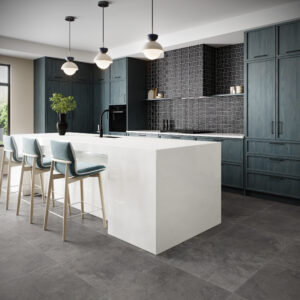
Haddonstone
Daltile’s Haddonstone is a ColorBody porcelain series inspired by the organic look of Portland stone. Haddonstone offers two distinct visuals: a refined vein-cut design available in matte and satin finishes and a raw crosscut option that exudes a naturalistic aesthetic. Both visuals are enhanced with RevealSync3D technology.

Portland Cliff
Inspired by stone from England’s Isle of Portland, Crossville’s Portland Cliff collection delivers soft, organic character. Visual Touch Technology provides a realistic stone-like tactile experience designed for indoor and outdoor use.

Arterra Pavers
MSI’s TileTouch Surface Technology delivers harmony between texture and graphics, ensuring every tactile detail aligns with the visual design. Even outdoor tiles, like its Arterra Pavers, benefit from this technology.
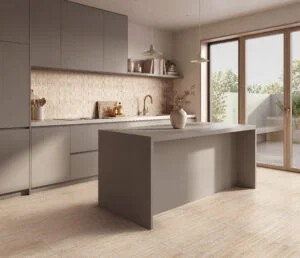
Ivorynn Stone
Wonder Porcelain’s Ivorynn Stone recreates the look of natural travertine using high-performance porcelain. The company uses advanced digital graphics and 3D digital structure printing to achieve the effect—via its Sinking Ink technology. This dual process captures the linear movement and organic variation found in natural stone. The collection is produced at its production facility in Lebanon, Tenn.

Sabi
The Sabi collection by Portobello America is a study in how digital decoration can bridge the gap between traditional materials and modern technical control. By utilizing an exclusive digital glue process, the collection reinterprets classic-origin granilla through a contemporary, data-driven lens.

Porcelain 6mm
Caesarstone’s new Porcelain 6mm collection offers a comprehensive array of visual aesthetics, finishes and configurations, including 21 colors + finish innovations, including three entirely new Caesarstone hues, two in a leather texture (Creamy Leather seen here) and five available in both standard and new glossy finishes.
