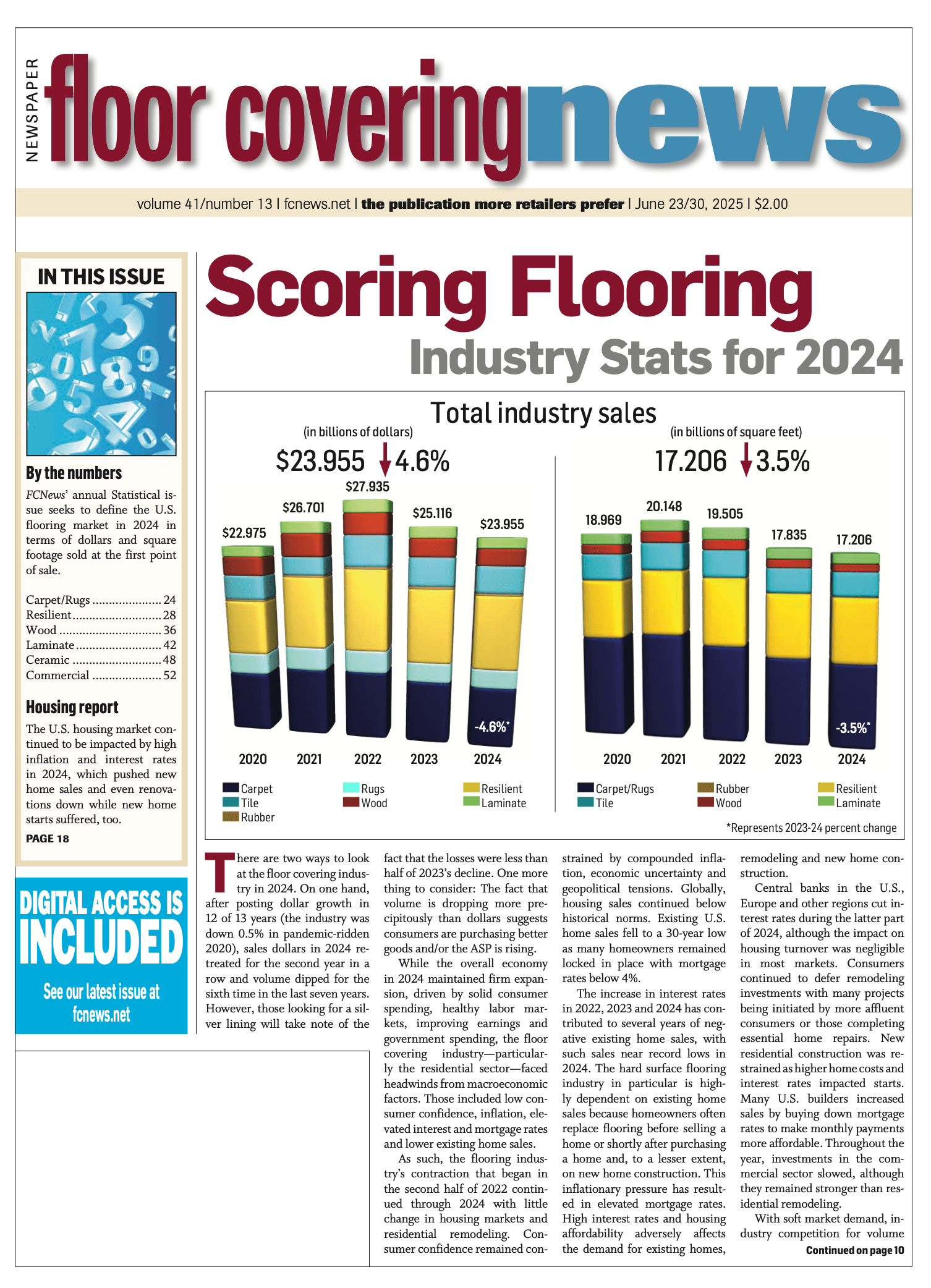
 There are no moral victories or participation trophies when it comes to statistical years. As NFL coaching legend Bill Parcells used to say: “You are what your record says you are.”
In that same vein, carpet “lost” in 2024, with total sales and volume down mid-single digits, an improvement when compared with double-digit declines the previous year.
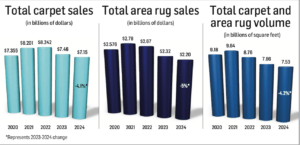
When all the numbers were tabulated, FCNews research found that total carpet sales declined 4.1% in 2024 to $7.15 billion vs. $7.46 billion the year prior. Volume (carpet and area rugs combined) was down 4.2% to 7.53 billion square feet from the previous year.
Total commercial carpet fell 1.3% in dollars and 3.7% in square yards. Residential carpet sales were down 6.2%. Area rug sales (not including customized rugs fabricated from broadloom) decreased an estimated 5% to $2.2 billion, according to industry estimates.
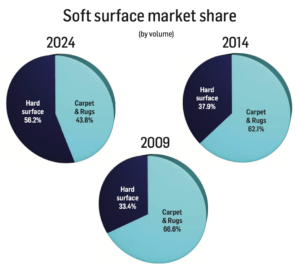
Despite another year in the red, carpet remains the largest flooring category by volume, accounting for 43.8% of the overall 17.206 billion square-foot flooring market in 2024. For the last three decades, carpet has been losing share to hard surface, although the rate of decline has slowed recently.
Confluence of factors
Mill executives pointed to a multitude of factors that led to carpet’s middling results in 2024, starting with the main culprit: a soft housing market.
U.S. existing-home sales fell to their lowest level in nearly 30 years in 2024, recording a total of 4.06 million transactions—the lowest annual sales since 1995. Of all housing metrics, existing-home sales is the most important as it typically yields two or more renovations for each transaction. However, 2024 failed to deliver as 30-year fixed mortgage rates averaged around 6.7%, well above the desired 5% threshold that many mill executives say is needed to unleash demand.
Despite the Federal Reserve lowering interest rates beginning in September 2024, there was no meaningful decline in mortgage rates or home equity lines of credit, analysts noted. It’s worth noting that the 30-year mortgage rate is closely linked to the yield on the 10-year Treasury note. When Treasury yields rise, borrowing becomes more expensive —potentially leading to higher monthly payments for those taking out new mortgages.
“High rates dampened new home purchases and discouraged aged existing homeowners from selling and subsequently buying, thereby limiting the natural churn that drives replacement flooring sales,” said James Lesslie, chief operating officer, Engineered Floors. “Existing homeowners, even if not moving, often had less disposable income for remodeling projects due to higher mortgage payments or general inflation.”
This stagnation comes at a time when America faces an historic shortage of homes. According to Realtor.com, the U.S. housing market required as many as 3.8 million more homes to meet the demands of homebuyers in 2024.
This shortage has been a persistent issue, with new home construction struggling to keep pace with the number of households being formed. Meanwhile, multifamily construction starts in 2024 saw a significant decline, falling 25% to a rate of 355,000 units, according to the National Association of Home Builders (NAHB). On a positive note, 588,000 multifamily units were completed, the highest figure since 1974.
 “Despite higher interest rates influencing replacement cycles for some, the multifamily market remains a consistent demand driver for soft surface, particularly for its cost-effectiveness, sound dampening and comfort in rental units,” said Drew Hash, president and CEO, Southwind.
If elevated mortgage rates and lower inventory of re-sale homes weren’t enough of a drag on the carpet economy, there was also the matter of a presidential election in 2024. As Len Andolino, president of Couristan, noted: “The political climate during an election year is always an unknown, and this past year it added to our stagnant climate. When you add all of this together you end up with a year like 2024. Too much uncertainty in the average person’s life.”
Soft lands at the high end
Soft surface does have its strong suit—the high end. The sweet spot of activity seems to be in the $18.99-to-$21.99-per-square-yard wholesale range (and higher), where carpet offers a strong balance of quality, durability and designer looks that appeal to those financially resourceful homeowners interested in a flooring upgrade. “The wealthy consumer segment is less impacted by interest rates, inflation and economic downturns,” said T.M. Nuckols, president of the residential division of The Dixie Group. “If affordability is not an issue, they are more inclined to proceed with a renovation project than a consumer who must borrow money to complete the project. And wealthy consumers appreciate higher-end luxury products. Additionally, over the past several years, carpet has become a room-by-room purchase for most consumers. When buying carpet for one room at a time, the consumer can personalize each room with unique colors, patterns and differentiated styles. The higher end carpet segment offers great options, too.”
What’s more, according to Nuckols, with hard surface flooring now covering most of the home, the consumer psyche around price points has changed. “For the same price per square foot of a typical hard surface installation, you can get a really nice, high-end carpet,” he explained. “All of these factors have paved the way for higher-end carpet to outperform the market. I believe this trend will continue moving forward.”
Indeed, the growth of higher-end carpet is consistent with broader consumer trends showing that the top 10% of income earners, with annual incomes of $250,000 or more, are driving the market, accounting for nearly half of all consumer spending. What they seek, experts say, are often luxury goods.
“Homeowners who are investing in their homes are opting for quality and design, seeking products that elevate their spaces and reflect their personal style,” said Joe Semaan, president of residential soft surface, Mohawk. “These consumers aren’t just buying flooring; they’re making a design statement. We believe this trend will continue, especially in premium segments where performance, aesthetics and brand stories are all crucial.”
Engineered Floors’ Lesslie echoed the sentiment that the affluent consumer’s desire for elevated aesthetics and customization is playing a key role in their willingness to step up on purchases. “Higher-end products often offer more sophisticated patterns, textures, colors and the ability for customization, aligning with a growing consumer desire for personalized and luxurious interiors,” he said. “This includes the increasing use of broadloom for custom rugs, runners and decorative applications … this trend is likely to continue as long as economic conditions remain somewhat constrained.”
Based on his four decades as a carpet executive with high-end brands, Couristan’s Andolino said the affluent has always been insulated from economic dips. “This is why during these downturns the higher-end segment becomes a talking point for most companies—the ones that cater to it and the ones that desire to cater to it. It’s a safe bet that the higher-end consumer still has the capital to proceed with most home purchases or home improvement projects. Those consumers fuel our economy in the good and bad times on several levels.”
When market conditions improve, mill executives said it will be the high-end segment that leads the charge. “Just as we saw higher-end carpet outperform the broader market in 2024, we see this segment continuing to grow in 2025 as quality, comfort and style that lasts remain top priorities,” said Megan Simmons, senior product manager – soft surface, Tarkett Home.
Finding its equilibrium?
 Carpet’s market share decline vs. hard surface has been well documented, dating back more than three decades. As recently as 10 years ago, carpet and rugs made up 62.1% of the flooring market; today, that percentage is 43.8%, a decrease of nearly 30%, or about 3% a year. And yet, there is a growing sentiment among mill executives that soft surface is reaching its equilibrium—a point where it will no longer lose much, if any, market share to hard surfaces.
There is data to support that argument. Between statistical years 2022 and 2023, for example, carpet’s market share decline vs. hard surface was 0.7%. Between 2023 and 2024, it was just 0.5%, a sign that carpet is on firmer footing. “I do believe soft surface has found its equilibrium—or at least very close to it,” said Quentin Quathamer, director residential carpet, Mannington Mills. “Carpet continues to hold a dominate share in the more private areas of the home where comfort and quiet are desired such as bedrooms and home offices. That represents 25%-30% of the living space. Hard surfaces simply cannot bring those values to the table when compared to carpet.”
This appreciation for comfort and acoustics was prevalent during the pandemic when more people worked from home or sought comfortable living spaces. “I think that dynamic back then allowed carpet to reach its equilibrium point,” TDG’s Nuckols said. “Most bedrooms are carpeted. Other rooms where carpet is considered include basements, home offices and family rooms.”
As an example of modern carpet’s elevated stature, executives say it is being used as a design element in the home, not just as a default option. “Decorative and designer-driven styles continue to gain traction, especially in the high end where aesthetics and texture drive purchase decisions,” Mohawk’s Semaan said. “Even with the growth of hard surface, we’re seeing more homeowners use broadloom carpet to create custom rugs that add warmth, texture and stylistic flair to their spaces. So, while we don’t expect to regain lost share, we do believe it’s carving out a well-defined role, particularly in higher-end and multi-functional spaces.”
Continued innovation in design and sustainability has also helped maintain carpet’s relevance in the overall flooring mix. “Higher-end carpet has performed well because consumers with the means are prioritizing quality, comfort and style in their home investments,” said Bob Hardaway, vice president of carpet, Shaw Floors. “This segment is less price-sensitive and more focused on long-term value and aesthetics.”
Pricing trends
In 2024, pricing across the industry remained relatively stable, with some selective pressure in the more competitive segments. While higher end performed well, the bulk of the market still operates at more affordable price points, between $12 and $14 per square yard (wholesale), where polyester holds sway as the dominate fiber on the residential side.
“We saw strength at both ends of the spectrum: entry-level price points held up well, driven by strong demand from builder and multifamily while the high end performed strongly as consumers continued to invest in premium, design-forward carpet,” Mohawk’s Semaan said. “The middle of the market has been more challenging, as value expectations have shifted. Customers are either trading down or stepping up based on their priorities.”
Commercial
For the seventh year out of the last eight, commercial sales were down in 2024—1.3% in dollars (compared to 3.9% in 2023) and 3.7% in volume (vs. down 9% in 2023). FCNews estimates the commercial carpet market at $3.15 billion for 2024, with specified contract at $2.47 billion and Main Street at $680 million.
[Note: For years, a large percentage of mills considered level-loop polypropylene a Main Street product, mostly installed in rental space/tenant improvement and low-end apartments and basements. Today, much of this business has been lost to low-end polyester cut piles. These cut-pile sales are reported as residential, not Main Street. As well, some mills break out Main Street from their specified business, for example, identifying smaller K-8 to K-12 schools as Main Street.]
 While commercial carpet has fallen a little more than 5% in value over the last two years, volume has declined more than 12%. Average price points have increased, in part due to carpet tile continuing to gain share over broadloom.
Certain commercial segments—particularly healthcare, education and hospitality—continue to specify carpet for its acoustic benefits, comfort and aesthetic appeal, often prioritizing durable, high-performance soft surfaces. While overall commercial demand was down, these segments showed relative resilience.
Specifically, corporate, the largest segment, is starting to re-gain some ground in renovations and redesigns after lagging for several years following the pandemic.
Hospitality, meanwhile, continues to be the largest segment for broadloom, observers say. Despite the industry seeing a shift toward incorporating hard surface flooring in guest rooms, broadloom remains a significant player for its comfort underfoot and ability to create a luxurious and seamless look in large areas.
Within hospitality, the senior living sub-segment relies more on soft surface than other commercial areas. It has shown strong growth potential due to a surge in demand driven by an aging population.