
For decades, flooring adhesives were something of an afterthought—chosen for function rather than formulation. But today, in an era defined by health consciousness, green building codes and consumer demand for transparency, adhesives are in the spotlight. Low-VOC, solvent-free and even bio-based formulations are increasingly becoming the standard, as manufacturers invest heavily in sustainability without compromising on performance.
To better understand the shift, Floor Covering News spoke with leaders from six adhesive manufacturers—Taylor Adhesives, Roberts, TotalWorx, Performance Accessories, Sika Corporation and Divergent Adhesives—each offering a window into how sustainability is reshaping the category and what flooring professionals can expect moving forward.
Compliance to commitment
At one time, “eco-friendly” meant little more than checking the VOC box. Today, it signals a broader commitment to health, safety and environmental responsibility.
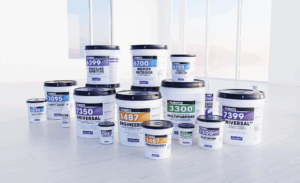
For Roberts, compliance is a foundational step—but one the company continues to evolve. “Many Roberts adhesives are zero or low VOC, and all comply with federal and state air quality requirements, including California and New Jersey,” explained Ed Wittbold, senior product manager – adhesives. “We’re also moving packaging from plastic to paper cartridges to reduce our carbon footprint.”
At Sika Corporation, sustainable practice entails a multi-criteria assessment. “We look at everything from bio-based materials and recyclable content to third-party certifications and how a product measures up against LEED or California building code requirements,” said John Lio, director of marketing, Interior Finishing at Sika. “Our most recent hardwood adhesive launch, SikaBond T-85, contains zero VOCs, solvents or isocyanates, contributes to LEED credits and meets EPA and California codes. It’s sustainable and high performing, proving this is the direction the industry is going.”
At Taylor Adhesives, the commitment to sustainable chemistry is also far reaching. “Our entire Signature Line of adhesives is low-VOC, solvent-free and low odor, with certifications from leading sustainability organizations such as FloorScore, CRI Green Label Plus and Greenguard,” said Shawn Smith, marketing manager. “Several products in the line also carry Material Health Bronze and Silver certifications, underscoring our commitment to healthier, more sustainable solutions.”
And for Sonny Callaham, technical director at Divergent Adhesives, the stakes go beyond compliance. “Beyond VOCs, we need to look forward at chemicals that may not yet be listed as harmful,” he said. “It’s about staying ahead, protecting installers and ensuring we’re building healthier spaces for the long term.”
Leading with performance
One of the longest-running concerns around green chemistry is whether it can perform as well as—or better than—traditional formulations. Across the board, manufacturers insist the days of trade-offs are gone.
“Every product in [Taylor’s] Signature Line is engineered to meet or exceed the strength, durability and reliability of traditional formulations,” Smith said. “Sustainability was a focus, but never at the expense of performance.”
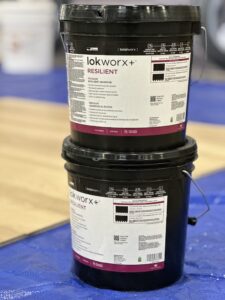
TotalWorx’s Adam Sartain, senior marketing manager, agreed. “Today’s eco-friendly adhesives are every bit as capable and, in many cases, more advanced than older, solvent-heavy formulations,” he said. “Through improved chemistry, we’ve created adhesives that match or exceed traditional performance in bond strength, moisture resistance and longevity.”
Even for companies not fully converted to bio-based chemistries, performance has been validated. Performance Accessories’ Karl Danzer explained, “When we researched bio-based options, we made sure that performance would remain equal. The concern customers have is always, ‘Am I going to lose something?’ We’ve done the work to ensure that when the market is ready, the performance will be there.”
However, performance goes beyond bond strength and moisture resistance. One of the most impactful improvements for installers has been the elimination of harmful chemicals and odors, allowing them to work more safely and effectively without compromising their health.
“Not only does performance need to be top tier, but the health and safety of installers must be paramount,” Divergent’s Callaham said. “Our adhesives dry faster, have more grab and are always installer friendly. Opening a pail and not having any offensive odors is a key performance characteristic.”
Sartain of TotalWorx added that the benefits are tangible on site: “Low-odor, solvent-free formulas mean safer, more comfortable working conditions. Many also offer improved open times and faster cure rates, which keeps jobs on schedule.”
Mark Long, Stauf technical director, agreed, noting, “Our products spread as easy if not easier than traditional adhesives. Our products do have a faster cure time. With low or zero VOCs, our adhesives give installers a much safer environment to work in.”
Market challenges remain
While sustainability is rising, the degree of adoption varies by market and economy strength. Roberts’ Wittbold estimated that acrylic latex and SBR adhesives already represent more than half of the market, with silane-based chemistries are on the rise. “Innovation in chemistries will continue to support growth of eco-friendly products,” he said.
Callaham of Divergent noted, however, that demand is uneven. “The commercial market is driving the eco-friendly initiative—especially education, healthcare and hospitality, which have stricter guidelines. Residential is still far behind.”
Economic factors also play a role. “We have the ability to move to bio-based, and we’ve proven the performance,” Performance Accessories’ Danzer said. “But right now, it costs more, and in today’s economy, even pennies more can send a customer elsewhere.”
Still, manufacturers see regulation and consumer awareness pushing the market forward. “Eco-friendly adhesives make up a rapidly growing share,” TotalWorx’s Sartain said. “Within five years, low-emission, solvent-free adhesives will be the standard rather than the exception.”
RSA engagement matters most
Retailers and RSAs are a critical piece to the broader adoption puzzle. It is here—at least on the lagging residential side of the business—where it’s possible to convey sustainability benefits to customers.
“We’ve seen demand increase from flooring retailers who want to market sustainability to their customers,” Taylor’s Smith said. “We put significant effort into communicating our sustainability story so RSAs can confidently highlight health, safety and environmental benefits.”
TotalWorx takes a similar approach. “Retailers and dealers are more aware than ever of how sustainability influences purchasing decisions,” Sartain said. “We provide in-depth training, demos and bilingual resources so RSAs can communicate the value.”
And at Divergent, training goes beyond sales associates. “We focus on educating installers, RSAs, project managers and even end users,” Callaham explained. “Podcasts, webinars and in-person classes all help carry the message.”
Suppliers agree the future is bright. As Taylor’s Smith put it: “Market demand for sustainable, low-emission, non-toxic adhesives continues to grow each year, and all indicators suggest this trajectory will only accelerate.”
