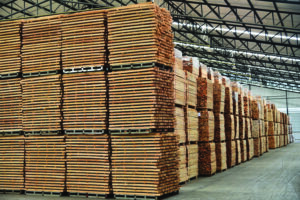
Hardwood flooring remains one of the most strategically important—but operationally complex—product categories. While consumer demand for authentic wood continues, sourcing that product profitably has become increasingly difficult due to tariffs enacted during the Trump administration. These trade measures, especially those targeting China and certain Southeast Asian countries, have reshaped cost structures, supply chains, pricing strategies and competitive dynamics throughout the distribution channel.
Tariffs applied to hardwood flooring and related wood products function as direct cost increases, often ranging from 10% to well over 25% and, in some cases, much higher when anti-dumping/countervailing duties apply. For distributors operating on relatively thin profit margins, these increases fundamentally alter product economics.
Key business impacts include:
- Margin compression when distributors absorb costs to remain price-competitive.
- Reduced promotional flexibility because price increases limit sales incentives.
- SKU rationalization as slower-moving imported products become financially risky to stock.
- Retail resistance to price hikes, especially when competing products such as LVT continue to fall in price.
Even when costs are passed through, higher retail prices often result in trade-down behavior, especially in mid-market remodeling and multifamily segments. For import-dependent distributors, the real impact of tariffs is visible in the form of margin compression, inventory risk, retailer pricing resistance and long-term sourcing uncertainty. Understanding both the challenges and the available solutions is essential for maintaining growth and protecting long-term profitability.
Distributors, suppliers react
Ahead of the latest round of tariffs, the U.S. distribution arm for Denali Hardwood—which is produced by a family-run manufacturing operation in Vietnam—significantly increased its U.S. inventory levels. So much so that, according to Bill Schollmeyer, vice president of sales, the company does not plan to increase any prices in the near future.
“Given the volatility and inconsistency of the various tariff policies, we’re simply going to continue with business as usual and work from our existing inventories,” he said.
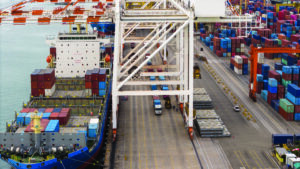
In response to tariffs on Chinese hardwood and engineered flooring, many importers have shifted sourcing to Vietnam, Cambodia, Indonesia, Thailand and Malaysia. While this diversification was necessary, it has created a new set of operational challenges.
For distributors, these include:
- Inconsistent quality standards between factories and countries.
- Longer lead times and less predictability.
- Limited capacity for certain constructions and species.
- Higher minimum order quantities, increasing inventory exposure.
Even more concerning, U.S. authorities have intensified enforcement against transshipment—products routed through third countries to avoid China tariffs. If suppliers are found to be circumventing duties, importers can face retroactive penalties, unexpected cash liabilities and supply disruptions with little warning. This creates legal and financial exposure that many distributors are not equipped to manage without tighter supplier controls and stronger compliance protocols.
Other impacted companies include Stanton, which sources both its hardwood and laminate flooring from suppliers in Southeast Asia. Tariffs ranging from 18% to 20% have hit the region, adding to a pre-existing 8% duty.
Jamann Stepp, senior vice president of hard surfaces, said the company plans to pass a portion of the increases to its customers while absorbing some of the costs. Since Stanton focuses on the high end of the flooring market, he’s hopeful that consumers who are active in this segment won’t resist the higher prices.
Then there’s TrueTouch Floors. The company produces its MonoTech engineered wood floors in China, one of the countries most impacted by the Trump Administration’s actions.
Co-managing partner Josh McCrane had hoped the product’s unique construction and materials would qualify for an exemption from the new reciprocal tariffs. That was not the case as MonoTech will see an 8% increase. However, McCrane noted that the company’s traditional hardwood flooring imports will not see a price change at this time.
Although TrueTouch Floors issued notices to clients informing them of an impending price increase on MonoTech as a result of the latest tariffs, McCrane said the company has ample stateside inventory to help defray some of those costs.
“All our distributors have plenty of inventory now, so they have a little bit of a cushion,” he said. “We’re well stocked.”
While suppliers are doing their part to absorb some of the costs, there are steps distributors can take to mitigate the full impact of the tariffs.
Establish true multi-country sourcing initiatives
Rather than shifting volume from one tariffed country (i.e., China) to another potentially at-risk, distributors might pursue intentional geographic diversification, including:
- Southeast Asia (multiple countries, not single-source)
- Select South American suppliers
- Mexico and near-shore options where feasible
Benefit: This reduces exposure to future trade actions and improves negotiating leverage with factories. It also allows distributors to re-balance volume quickly if tariffs expand to new regions. At the same time, it’s important to establish factory-level auditing and compliance checks to reduce transshipment risk.
Strengthen trade compliance
Distributors should treat customs compliance as a strategic function, not a back-office task. Best practices include:
- Working with specialized customs brokers
- Verifying material origin and production processes
- Requiring supplier documentation beyond standard certificates
- Conducting periodic factory inspections and third-party audits
Benefit: While this adds administrative cost, it protects against far greater exposure from retroactive duties and supply seizures.
Explore tariff engineering and product redesign
Some distributors are reducing duty exposure by modifying product construction or sourcing individual components differently. Examples include:
- Adjusting core materials in engineered flooring
- Altering thickness profiles that affect tariff classification
- Changing surface treatment or assembly location
Benefit: These strategies require coordination but can materially reduce landed costs over time.
Invest in hybrid programs or domestic partnerships
Rather than fully abandoning imports or attempting to vertically integrate, distributors could:
- Contract manufacturing with U.S. mills
- Combine domestic and imported components
- Co-brand initiatives with select U.S.-based producers
Benefit: Hybrid programs maintain assortment breadth, reduce tariff exposure and support marketing narratives around U.S. manufacturing and sustainability.
U.S. forests can only yield so much supply of white oak, said Milton Goodwin, president, AHF Products.
At the same time, domestic mills face their own cost pressures from labor, energy and log availability. AHF Products, for instance, remains focused on mitigating global supply risks and enhancing its value proposition through domestic production. But even this supplier—which has long maintained a strong U.S. footprint—had to raise prices over the past six months to keep pace with ongoing cost pressures and supply limitations related to fluctuations in raw materials such as lumber, as well as the continued impact of tariffs on sourced products.
In September 2025, for example, the company announced increases of 5%–7% on all solid hardwood products, with select engineered wood flooring collections seeing hikes of 3%–5%.
“Despite inflationary and geopolitical pressures, we continue working tirelessly to maintain reliable service and product value,” said Chris King, senior vice president of sales, residential, AHF Products.
While many industry observers agree tariffs have complicated the cost structure, there’s no doubt some winners have emerged, if only in the immediate term. Tariffs have effectively created a structural advantage for vertically integrated manufacturers with U.S. plants, companies with diversified global manufacturing footprints and firms with stronger balance sheets able to absorb volatility.
For distributors, shifting fully to domestic sourcing may improve tariff exposure but can reduce assortment and limit competitive positioning. Independent distributors who depend heavily on imported programs face disproportionate risk. This can lead to lost builder and dealer accounts when pricing becomes unstable.
Tariffs are not just a cost issue—they are accelerating structural change in the floor covering supply chain. While no single strategy eliminates tariff exposure, a combination of operational, sourcing and commercial initiatives can help mitigate the overall impact.
Shift sales strategy toward value and differentiation
If price competition becomes more difficult, distributors can strengthen margins by supporting retailers with:
- Exclusive visuals and private-label collections
- Faster delivery and better fill rates
- Technical support and training programs
- Sustainability certifications and traceability programs
Benefit: By helping retailers sell on story, performance and service—not just price—distributors reduce vulnerability to tariff-driven cost increases.
Engage in industry advocacy
Distributors often underestimate the importance of participating in trade policy discussions. Industry coalitions can advocate for several key issues such as:
- Product-specific tariff exclusions where no domestic substitutes exist
- Volume-based tariff rate quotas
- Targeted enforcement rather than blanket duties
Benefit: While policy change is slow, coordinated advocacy has proven effective in influencing product-level exclusions and enforcement priorities.
Domestics—not a cure-all
Tariffs were designed, in part, to encourage domestic manufacturing. While U.S. hardwood production remains strong, domestic capacity does not fully replace what imports historically supplied—particularly in terms of engineered constructions, certain species and visual profiles, as well as large-volume, price-competitive programs for builders and multifamily applications.
Simply put, the existing domestic raw lumber supply is insufficient to completely satisfy current U.S. demand.